Chief Joseph 1840-1904
Chief Joseph was the principal leader of the Wallowa band of the Nez Perce, who fiercely resisted forced removal from their ancestral homelands in the Wallowa Valley of northeastern Oregon. In 1877, he guided his people on a grueling, 1,170-mile fighting retreat across Idaho, Wyoming, and Montana in a desperate bid to reach political asylum in Canada. Following his famous surrender just miles from the border, Joseph and his surviving followers were exiled to the Midwest before eventually being permitted to return to the Pacific Northwest. Barred from re-entering his beloved Oregon territory, he spent his final years on the Colville Indian Reservation in Washington state, serving as a prominent national advocate for Native American civil rights until his death.
Hinmatóowyalahtq̓it, a leader of the Wal-lam-wat-kain (Wallowa) band of Nez Perce.
Biographical Overview
- Lived from 1840 to 1904
- Born: Mar 3, 1840, Wallowa Valley, Oregon Territory
- Died: Sep 21, 1904, Colville Indian Reservation, Washington
Historical Events
- No referenced events linked
Bibliography for Chief Joseph
A listing of books related by subject
Thunder in the Mountains Chief Joseph, Oliver Otis Howard, and the Nez Perce War by Daniel J. Sharfstein
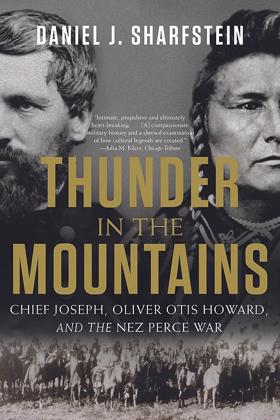
"Oliver Otis Howard thought he was a man of destiny. Chosen to lead the Freedmen's Bureau after the Civil War, the Union Army general was entrusted with the era's most crucial task: helping millions of former slaves claim the rights of citizens. He was energized by the belief that abolition and Reconstruction, the country's great struggles for liberty and equality, were God's plan for himself and the nation. To honor his righteous commitment to a new American freedom, Howard University was named for him. But as the nation's politics curdled in the 1870s, General Howard exiled himself from Washington, D.C., rejoined the army, and was sent across the continent to command forces in the Pacific Northwest. Shattered by Reconstruction's collapse, he assumed a new mission: forcing Native Americans to become Christian farmers on government reservations. Howard's plans for redemption in the West ran headlong into the resistance of Chief Joseph, a young Nez Perce leader in northeastern Oregon who refused to leave his ancestral land. Claiming equal rights for Native Americans, Joseph was determined to find his way to the center of American power and convince the government to acknowledge his people's humanity and capacity for citizenship. Although his words echoed the very ideas about liberty and equality that Howard had championed during Reconstruction, in the summer of 1877 the general and his troops ruthlessly pursued hundreds of Nez Perce families through the stark and unforgiving Northern Rockies. An odyssey and a tragedy, their devastating war transfixed the nation and immortalized Chief Joseph as a hero to generations of Americans. Re-creating the Nez Perce War through the voices of its survivors, Daniel J. Sharfstein's visionary history of the West casts Howard's turn away from civil rights alongside the nation's rejection of racial equality and embrace of empire. The conflict becomes a pivotal struggle over who gets to claim the American dream: a battle of ideas about the meaning of freedom and equality, the mechanics of American power, and the limits of what the government can and should do for its people. The war that Howard and Joseph fought is one that Americans continue to fight today."--Jacket
xvii, 613 pages : maps ; 25 cm
Desiderata
Be brave, Tah-hy! the journey of Chief Joseph's daughter by Jack R. Williams, Jo Proferes (Illustrator)
On June 17, 1877, gunshots marked the start of war—one that swept twelve-year-old Tah-hy (Chief Joseph’s daughter) and her people into a harrowing journey across the American West. Relentlessly pursued, they endured multiple battles, cold, hunger, and death. Eventually, after months of exile and heartbreak, they began their path to a new way of life. Based on actual events and narrated by Tah-hy’s youthful voice, this biographical novel is intended for young adults, but will also interest older readers. The story presents many aspects of the Nez Perce Dreamer culture and reminds us of what was lost when they were overpowered and displaced.
134 pages : color illustrations ; 21 x 26 cm
Desiderata
Chief Joseph's allies by Clifford E. Trafzer, Richard D. Scheuerman
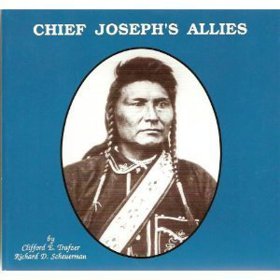
Authored by historians Clifford E. Trafzer and Richard D. Scheuerman, Chief Joseph's Allies chronicles the complex and often overlooked role of the Palus, or Palouse, people during the tragic Nez Perce War of 1877. The book details how these indigenous communities bravely navigated escalating colonial pressures, offered vital sanctuary and alliance to Chief Joseph's band across the Columbia Plateau, and subsequently suffered devastating displacement and military retribution. Through rich archival documentation and tribal oral histories, the text restores the voices of a sovereign people whose historical narrative was long suppressed by dominant frontier myths. A keen insight drawn from the work is how regional military histories deliberately erase peripheral indigenous actors; by centering the strategic sacrifices of the Palouse, the authors reveal that the tragic outcome of 1877 was not just a bilateral conflict between the U.S. Army and the Nez Perce, but a multi-tribal resistance effort against an overwhelming imperial enclosure of the entire Columbia River basin.
vii, 112 pages : illustrations ; 21 x 22 cm
Non-circulating [ 1 ]
Saga of the Coeur d'Alene Indians an account of Chief Joseph Seltice by Joseph Seltice, Edward J. Kowrach, Thomas E. Connolly

Joseph Seltice, Edward J. Kowrach, and Thomas E. Connolly's Saga of the Coeur d'Alene Indians provides a vital indigenous perspective on the historical transitions of the Schitsu'umsh people across the lake shores, river valleys, and timbered expanses of the northern Idaho panhandle. Centered around the critical waterways of Coeur d'Alene Lake, the St. Joe River, and the Spokane River basin, the narrative details how extensive ancestral kinship networks were forced to adapt their traditional seasonal settlements in response to encroaching Euro-American pioneers and Jesuit missionaries. The account traces the tribe's deliberate shift toward cooperative agrarian communities, particularly around the Sacred Heart Mission at Cataldo, illustrating a profound resilience as families worked together to preserve their cultural identity and shared land base. Ultimately, this firsthand history documents the complex struggle of the Coeur d'Alene people to navigate violent frontier conflicts and restrictive federal reservation policies while actively maintaining the deeply rooted familial bonds that sustained their society.
372 pages : illustrations ; 26 cm
Non-circulating [ 1 ]
Chief Joseph country land of the Nez Perce by Bill Gulick

The relationship between Westering Americans and the Nez Perce Indians covers a time-span of one hundred years, from the meeting of the Lewis and Clark party with the Indians in 1805 to the death of Chief Joseph in 1904. It is epic drama, taking place on a vast stage during a critical period in the development of the United States. Certainly no setting could be more spectacular than the rugged, beautiful homeland of this tribe. No story can equal in historical importance the long-standing friendship given by the Nez Perces to the white newcomers in their country. And no event is more poignant, bitter, and tragic than the Nez Perce War. Before acquiring the horse around 1730, the Nez Perces occupied approximately 27,000 square miles of what is now north-central Idaho, northeastern Oregon, and southeastern Washington. After becoming a mounted people, they ranged over a much larger area, traveling east to the buffalo country claimed by Blackfeet, Crow, and Sioux, west to the great fishing and trading station on the lower Columbia, Celilo Falls. Uniquely situated as they were between the Plains and Coastal Indian cultures, they would play a key role in the struggle between Great Britain and the United States as to which nation would take title to the Pacific Northwest. In Chief Joseph Country: Land of the Nez Perce, author Bill Gulick lets the participants in the developing drama tell the story in their own words by excerpting diaries, letters, and statements made in contemporary accounts. Beginning with the prehistory of the Nez Perces, he relates how, after being pedestrians for eight thousand years, acquisition of the horse drastically altered their way of life. Then, in rapid succession, came firearms, American explorers, British fur traders, the Manifest Destiny struggle, missionaries, Oregon Trail emigrants, settlers, gold miners, farmers, and finally war. "If there is a bias in this book, it is that I have given more credence to statements made by Indians than to words written by white men," the author says. "Time and again in my research I have come across references to the importance the Indian placed on telling the plain, simple truth when relating any event in which he was involved. To the contrary, time and again I have found statements made by white leaders so contradictory and at variance with the truth that I began to question everything they wrote." In selecting the many historical photographs and sketches used to illustrate the book, the author examined the holdings of some twenty institutions from coast to coast, some of which dated back to the 1850s. As he did in Snake River Country, Bill Gulick applies skills learned as a novelist and dramatist to the non-fiction field of history, using the twin tools of dramatic narrative and sound research to bring history alive to the layman reader. He writes: "As in all epic dramas, forces beyond the understanding or control of the people involved were at work as the Nez Perces and the whites confronted one another, driving them toward a fate neither could forsee. "Here, I have recorded that confrontation from the Indian point of view."
xiv, 316 pages : illustrations ; 29 cm
Non-circulating [ 1 ]
I will fight no more forever Chief Joseph and the Nez Perce War by Merrill D. Beal

Merrill D. Beal’s I Will Fight No More Forever chronicles the tragic 1877 flight of Chief Joseph and the Nez Perce, detailing a masterful but desperate tactical retreat across the most unforgiving topography of the inland Pacific Northwest. The narrative meticulously maps the arduous 1,170-mile route, beginning with the tribe's forced expulsion from the fertile, mountain-ringed Wallowa Valley of northeastern Oregon, continuing through the precipitous depths of the Snake River canyon, and ascending over the steep, densely timbered divide of the Bitterroot Mountains via Lolo Pass. By detailing how the fleeing bands—burdened with elders, children, and horse herds—utilized this formidable alpine terrain and the volcanic plateaus of Yellowstone to repeatedly stall and outmaneuver pursuing United States cavalry columns, the book illustrates the profound strategic role of the region's physical environment. The text captures the devastating final siege on the freezing, windswept foothills of Montana's Bear Paw Mountains, just short of the Canadian sanctuary. Ultimately, this account demonstrates how the pioneer seizure of traditional agricultural basins forced an epic, agonizing migration, proving that the harsh geographical realities of the western frontier were as much an adversary as the military forces enforcing the region's brutal geopolitical displacement.
xvii, 366 pages, 8 unnumbered pages of plates : illustrations, 1 map, portraits ; 21 cm
Non-circulating [ 1 ]
Entry Details
Related Online Resources
- No external online resources or related links found
Last updated: 2026-09-30