Oregon State
Oregon was inhabited by many indigenous tribes before Western traders, explorers, and settlers arrived. An autonomous government was formed in the Oregon Country in 1843, the Oregon Territory was created in 1848, and Oregon became the 33rd state on February 14, 1859.
Mapped Location
Oregon: The mapped location is an approximation and should not be used for navigation or wayfinding.
Information
General information on Oregon
- Feature Type: State
- State Capitol: City of Salem
- Established as a Territory: Monday, August 14, 1848
- Admitted to the Union: Monday, February 14, 1859
Official, historical, colloquial and alternative toponyms for Oregon
A brief list of names that this geographic feature has been named
| Name | Description |
|---|---|
| State of Oregon | Official |
Related Catalog Titles
A Bibliography for Oregon, State
Toward Oregon 2050 planning a better future by Megan Horst , Oregon State University Press (Publisher)
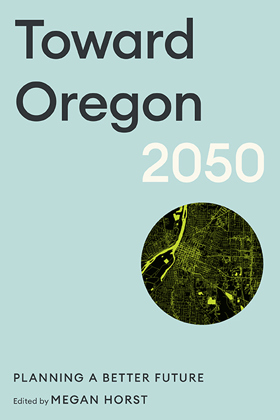
"How do we plan for a better Oregon in 2050? What will the state be like in that year for five million Oregonians, particularly for the least privileged and powerful residents? These are the questions that drive Oregon 2050, an interdisciplinary project at Portland State University that aims to help the state become more environmentally sustainable, socially equitable, and fiscally resilient. In this compelling volume, leading experts in land use and urban planning, in cooperation with other scholars and community partners, envision various possible futures and begin the work of developing statewide plans to guide Oregon through the decades ahead. Building on the state's policy innovation and planning legacy, contributors to Toward Oregon 2050 address current challenges such as housing scarcity, income inequality, the rural-urban divide, and climate change. They offer recommendations on a range of issues, from culture to incarceration, transportation to voting rights, all with the goal of imagining what a fair and equitable Oregon might look like. Some of the imagined futures-with worsening effects of climate change, environmental harms, and social inequities-are not bright for many Oregonians. Other futures include enhanced resiliency to forest fires and flooding, more Oregonians in high-paying jobs and in secure housing, and more children walking and biking to school. But those positive futures are not guaranteed, and getting there won't be easy. They'll require all stakeholders-state and local government, members of all political parties, private businesses, non-profit organizations, and individual residents-to play a role in ensuring a better future for the next generation of Oregonians. Intended for all Oregonians who care about their state's future, Toward Oregon 2050 will also appeal to scholars and planners who have long looked to Oregon for inspiration and lessons learned. The book invites readers to envision the future of Oregon and to contribute their part toward a better future for the state"-- Provided by publisher
ix, 452 pages : illustrations, maps ; 23 cm
CIRC [ 0 ]
Field guide to Oregon rivers by Tim Palmer (Author, Photographer), William E. Avery (Illustrator), Oregon State University Press (Publisher)
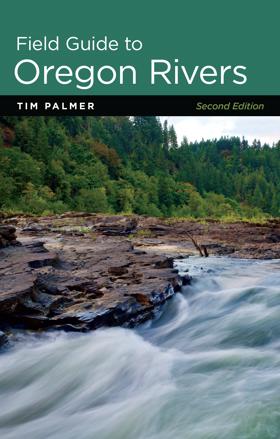
"In this updated edition of his classic Field Guide to Oregon Rivers, Tim Palmer gives us an unprecedented reference, introducing the state's waterways and offering outdoor enthusiasts and resource professionals an interpretive approach to an extraordinary network of streams. He begins with natural history-geology, climate, hydrology, plants, and wildlife-then profiles 111 rivers with notes about nature, fish, and conservation, followed by essential tips on where to see each river, to hike along the shores, to fish, and to explore by canoe, kayak, and raft. Illustrations identify riparian plants and animals while more than 150 photographs showcase a magnificent rivers estate. This volume is an essential outdoor companion for Oregonians and visitors alike."-- Provided by publisher
319 pages : color illustrations, color maps ; 21 cm
CIRC [ 0 ]
A peculiar paradise a history of blacks in Oregon, 1788-1940 by Elizabeth McLagan , Oregon Black Pioneers (Publisher)
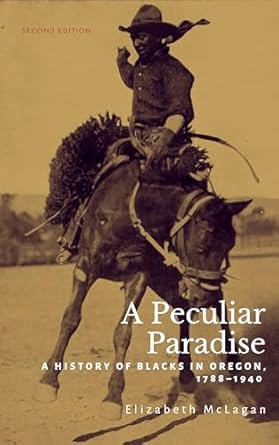
A Peculiar Paradise: A History of Blacks in Oregon, 1788–1940, remains the most comprehensive chronology of Black life in Oregon more than forty years after its original publication in 1980. Elizabeth McLagan’s work reveals how in spite of those barriers, Black individuals and families made Oregon their home and helped create the state’s modern Black communities. A longtime resource for those seeking information on the legal and social barriers faced by people of African descent in Oregon, the book is available again through this co-publication with Oregon Black Pioneers, Oregon’s statewide African American historical society. The revised second edition includes additional details for students and scholars, an expanded reading list, a new selection of historic images, and a new foreword by Gwen Carr and afterword by Elizabeth McLagan. Oregon Black Pioneers is Oregon’s only historical society dedicated to preserving and presenting the experiences of African Americans statewide. Since 1993, Oregon Black Pioneers has illuminated the seldom-told history of people of African descent in Oregon through exhibitions, public programs, publications, and historical research. Learn more at oregonblackpioneers.org.
xiv, 193 pages : illustrations, portraits ; 23 cm
CIRC [ 0 ]
Oregon painters landscape to modernism, 1859-1959 by Ginny Allen , Jody Klevit
"Since the first edition of Oregon Painters was published in 1999, it has served as an invaluable reference to the early history of Northwest art, with well-worn and closely guarded copies found in libraries and art collections throughout Oregon and nationally. The original volume was an encyclopedia and index of Oregon painters, with historical data about the evolution of painting styles, educational institutions, and exhibition venues in the Northwest. Oregon Painters: Landscape to Modernism, 1859-1959 expands the focus on the history of painting in Oregon by adding essays on Impressionism and Modernism while using more and better visual examples to illustrate the strength of the state's early painters. In addition, the original indexed content has been edited and condensed. Essays address Indigenous art, the Lewis and Clark Exposition, the Impressionist and Modernist movements, New Deal Art, and the Federal Art Projects in Oregon. The biographical section is now fully illustrated with color images of the majority of the 630 painters' works. A list with an additional 4000 names is also included. Little has been written about the early history of Northwest art and this volume serves as a valuable resource for discovering artists who remain largely unknown but whose works continue to gain in reputation and value. With faithful full-color reproductions from institutional and private collections, it will be treasured by art students, scholars, teachers, gallery owners, museumgoers, collectors, and art lovers everywhere"-- Provided by publisher
372 pages : illustrations (chiefly color) ; 25 x 30 cm
CIRC [ 0 ]
Oregon painters landscape to modernism, 1859-1959 by Ginny Allen , Jody Klevit
"Since the first edition of Oregon Painters was published in 1999, it has served as an invaluable reference to the early history of Northwest art, with well-worn and closely guarded copies found in libraries and art collections throughout Oregon and nationally. The original volume was an encyclopedia and index of Oregon painters, with historical data about the evolution of painting styles, educational institutions, and exhibition venues in the Northwest. Oregon Painters: Landscape to Modernism, 1859-1959 expands the focus on the history of painting in Oregon by adding essays on Impressionism and Modernism while using more and better visual examples to illustrate the strength of the state's early painters. In addition, the original indexed content has been edited and condensed. Essays address Indigenous art, the Lewis and Clark Exposition, the Impressionist and Modernist movements, New Deal Art, and the Federal Art Projects in Oregon. The biographical section is now fully illustrated with color images of the majority of the 630 painters' works. A list with an additional 4000 names is also included. Little has been written about the early history of Northwest art and this volume serves as a valuable resource for discovering artists who remain largely unknown but whose works continue to gain in reputation and value. With faithful full-color reproductions from institutional and private collections, it will be treasured by art students, scholars, teachers, gallery owners, museumgoers, collectors, and art lovers everywhere"-- Provided by publisher
372 pages : illustrations (chiefly color) ; 25 x 30 cm
CIRC [ 0 ]
Governing Oregon continuity and change by Richard A. Clucas , Mark Henkels , Priscilla L. Southwell , Edward P. Weber
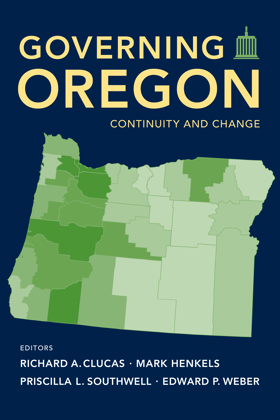
At the end of the twentieth century, the state government of Oregon was routinely entangled in intense partisan conflict, with opposing sides waging bitter battles in elections, the legislature, and the courts. Many of the most important state laws—such as Measure 5, which capped property taxes—were decided through the initiative process rather than by lawmakers in Salem. As the twenty-first century began, this political dynamic began to shift. Partisan conflict in the capitol grew less rancorous, legislative gridlock eased, and ballot initiatives lost their central role in defining Oregon politics. Less visible changes reshaped issues from agricultural policy to tribal government. This shifting dynamic coincided with significant transformations in Oregon’s economy and cultural life. The state’s economy sustained severe blows twice in the early 2000s, but by 2014, Oregon boasted one of the fastest-growing economies in the nation. Along with economic expansion, Oregon’s population grew in both size and diversity. Despite these powerful forces of change, other aspects of Oregon political life remained entrenched, including the deep urban-rural divide and the state’s problematic fiscal system. With contributions from twenty-seven leading experts and political insiders, Governing Oregon: Continuity and Change offers insight into the people, political practices, governing institutions, and public policies of Oregon. It will be of tremendous value to political scientists, public servants, and engaged citizens alike.
xii, 372 pages : illustrations, maps ; 23 cm
CIRC [ 0 ]
Rivers of Oregon by Tim Palmer
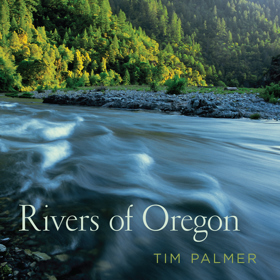
“Rivers are the essence of Oregon,” writes award-winning author and photographer Tim Palmer. In over 140 brilliant photos and evocative, informative text, Rivers of Oregon captures the life, the beauty, and the magic of Oregon’s remarkable array of waterways. The book’s engaging essays address the nature and ecology of flowing waters, the joy of travel on these lifelines of the planet, and the historic saga of Oregonians’ commitment to preserve, protect, and restore the best of their state for future generations. Rivers of Oregon captures the beauty and the intrinsic qualities of the state’s irresistible riverscapes like no other book has done. From the underwater view and from the refuge of riparian forests, from the seat of a canoe or raft and from distant mountain summits, readers will gain new perspectives on the extraordinary features that provide us with water, with life, and with scenes whose loss would leave us deeply impoverished. Join this celebrated photographer, author, conservationist, and river guide on a journey of discovery that will change the way you think about flowing water and the alluring paths it makes across our land.
162 pages : color illustrations ; 24 cm
CIRC [ 0 ]
Keeping Oregon green livability, stewardship, and the challenges of growth, 1960-1980 by Derek R. Larson
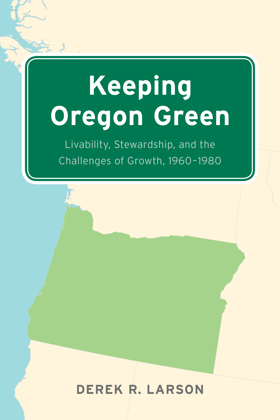
"Keeping Oregon Green is a new history of the signature accomplishments of Oregon's environmental era: the revitalization of the polluted Willamette River, the Beach Bill that preserved public access to the entire coastline, the Bottle Bill that set the national standard for reducing roadside litter, and the nation's first comprehensive land use zoning law. To these case studies is added the largely forgotten tale of what would have been Oregon's second national park, intended to preserve the Oregon Dunes as one of the country's first National Seashores. Through the detailed study of the historical, political, and cultural contexts of these environmental conflicts, Derek Larson uncovers new dimensions in familiar stories linked to the concepts of 'livability' and environmental stewardship. Connecting events in Oregon to the national environmental awakening of the 1960s and 1970s, the innovative policies that carried Oregon to a position of national leadership are shown to be products of place and culture as much as politics. While political leaders such as Tom McCall and Bob Straub played critical roles in framing new laws, the advocacy of ordinary citizens--farmers, students, ranchers, business leaders, and factory workers--drove a movement that crossed partisan, geographic, and class lines to make Oregon the nation's environmental showcase of the 1970s. Drawing on extensive archival research and source materials, ranging from poetry to congressional hearings, Larson's compelling study is firmly rooted in the cultural, economic, and political history of the Pacific Northwest. Essential reading for students of environmental history and Oregon politics, Keeping Oregon Green argues that the state's environmental legacy is not just the product of visionary leadership, but rather a complex confluence of events, trends, and personalities that could only have happened when and where it did"-- Provided by publisher
ix, 307 pages ; 23 cm
CIRC [ 0 ]
At the hearth of the crossed races a French-Indian community in nineteenth-century Oregon, 1812-1859 by Melinda Marie Jetté
"Despite the force of Oregon's founding mythology, the Willamette Valley was not an empty Eden awaiting settlement by hardy American pioneers. Rather, it was, as Melinda Jette explores in At the Hearth of the Crossed Races, one of the earliest sites of extensive intercultural contact in the Pacific Northwest. Jette's study focuses on the 'hearth' of this contact: French Prairie, so named for the French-Indian families who resettled the homeland of the Ahantchuyuk Kalapuyans. Although these families sought a middle course in their relations with their various neighbors, their presence ultimately contributed to the Anglo-American colonization of the region. By establishing farming and husbandry operations in the valley, the French-Indian settlers enhanced the Willamette Valley's appeal as a destination of choice for the Anglo-Americans who later emigrated to the Pacific Northwest via the Oregon Trail. Upon these emigrants' arrival, the social space for the people of the 'crossed races' diminished considerably, as the Anglo-Americans instituted a system of settler colonialism based on racial exclusion. Like their Native kin, the French-Indian families pursued various strategies to navigate the changing times and Jette's study of French Prairie takes on the relationships among all three: the French-Indian families, the Indigenous peoples, and the Anglo-American settlers. With At the Hearth of the Crossed Races, Jette delivers a social history that deepens our understanding of the Oregon Country in the nineteenth century. This history of French Prairie provides a window into the multi-racial history of the Pacific Northwest and offers an alternative vision of early Oregon in the lives of the biracial French-Indian families whose community challenged notions of white supremacy, racial separation, and social exclusion"-- Provided by publisher
xix, 337 pages : illustrations ; 23 cm.
CIRC [ 1 ]
Oregon geology by Elizabeth L. Orr, William N. Orr
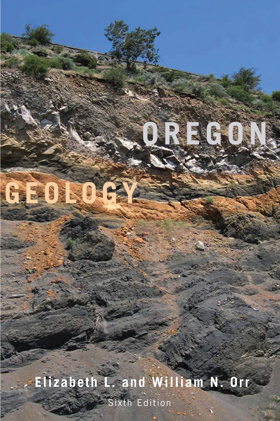
Because Oregon sits on the leading edge of a moving crustal plate, a striking diversity of geologic events have molded its topography. Over a century of study, a deeper understanding of the region’s tectonic overprint has emerged. In this timely update to the 2000 edition, Elizabeth and William Orr incorporate that new knowledge, addressing current environmental problems and detailing tectonic hazards. “Caught between converging crustal plates,” the Orrs write, “the Pacific Northwest faces a future of massive earthquakes and tsunamis.” A comprehensive treatment of the state’s geologic history, Oregon Geology moves through Oregon’s regions to closely examine the unique geologic features of each, from the Blue Mountains to the Willamette Valley, from the high lava Plains to the Coast Range. The book includes biographical sketches of notable geologists. It is lavishly illustrated and includes an extensive bibliography.
304 pages : illustrations, maps ; 28 cm
CIRC [ 0 ]
Atlas of Oregon wilderness by William L. Sullivan
With the addition of 200,000 more acres designated by Congress as Oregon wilderness in 2009, use this as a planning guide to explore new areas and old favorites from The Three Sisters and Mount Hood to Eagle Cap and Steens Mountain. This is a complete guide to Oregon's backcountry. This complete guide to Oregon's backcountry includes the new wilderness areas designated by Congress in March 2009 as well as old favorites from Mt. Hood and the Three Sisters to Steens Mountain and the Wallowas. The atlas features 70 pages of detailed, shaded-relief maps, 40 pages of color photographs, 146 recommended backpacking trips, 500 featured hikes, and tips for mountain climbers, whitewater rafters, kayakers, Nordic skiers, and snowshoers.
384 pages : illustrations (some color), maps, plates ; 23 cm
CIRC [ 0 ]
Oregon off the beaten path, a guide to unique places by Myrna Oakley
With this attractive and easy-to-use guide in hand youll discover the Oregon you never knew existed. Nine maps and thirteen black-and-white illustrations help you become acquainted with this unknown Oregon.
x, 261 pages : illustrations ; 23 cm.
CIRC [ 1 ]
Oregon fossils by Elizabeth L. Orr, William N. Orr
This revised and expanded edition of Oregon Fossils includes a record of all known fossils in Oregon going back 400 million years, along with collecting localities by county, age, rock formation, and published source. The book also provides a geologic overview of the state, from ocean beaches to the high desert, from the Blue Mountains to the Siskiyous. Unique among fossil field guides, Oregon Fossils includes both specimen identification and interesting notes about their discovery, naming, and conservation. The narrative is sprinkled with biographical sketches of paleontologists who have contributed to the state’s fossil record, and the text is richly illustrated with photographs, line drawings, charts, and maps. A complete bibliography lists full citations to fossil material. The only single volume that provides Oregon’s fossil record and history, Oregon Fossils is a well-written, well-organized guide. It is an excellent reference for classroom and library use, for researchers, and for private collectors and hobbyists.
xiv, 300 pages : illustrations, maps ; 26 cm
CIRC [ 0 ]
Odd place names and their origin by United States Works Progress Administration, Federal Writers' Project (Or), Historical Records Survey (Or), Oregon State Board of Control
Oregon A short history of a long journey from the Atlantic Ocean to the region of the Pacific by land by John B. Wyeth

The story of one adventurer from Massachusetts who made the overland journey to the Rocky Mountains in 1832. A cousin of Nathaniel J. Wyeth, he joined his expedition and relates the tragedies and travails that plagued the expedition and its members as they passed through barren lands and encountered Native Americans.
87 pages ; 19 cm
ONLINE CIRC [ 1 ]
A geographical sketch of that part of North America called Oregon by Hall J Kelley
Containing an account of the Indian title, the nature of a right of sovereignty, The first Discoveries, Climate and Seasons, Face of the Country and Mountains, Natural Divisions, Physical Appearance and Soil of Each, Forests and Vegtable prouductions, rivers, bays.
80 pages frontispiece (folded map) 22 cm
ONLINE CIRC [ 1 ]
Related Online Resources
Oregon Historical Society
The Oregon Historical Society is dedicated to making Oregon’s long, rich history visible and accessible to all
WEB LINKThe Oregon Encyclopedia
The Oregon Encyclopedia of History and Culture is a collaborative encyclopedia focused on the history and culture of the U.S. state of Oregon.
WEB LINKOregon History Project
The Oregon History Project is a digital resource of the Oregon Historical Society, making hundreds of historical records and expert scholarship accessible to the public.
WEB LINKOregon TimeWeb
The TimeWeb is a timeline made up of evidence about the history of Oregon, from the beginning of the region’s human history to the present.
WEB LINKOregonHistory Wayfinder
The Oregon History Wayfinder is an interactive map that identifies significant places, people, and events in Oregon history. Each point on the map connects to the historical records and scholarship on the Oregon History Project and The Oregon Encyclo
WEB LINKThe National Archives at Seattle
We maintain and provide access to permanent records created by Federal agencies and courts in the following states: Alaska, Idaho, Oregon, Washington
WEB LINKSODA: Southern Oregon Digital Archives
The Southern Oregon Digital Archives (SODA) was funded originally by a grant from the Institute of Museum and Library Services (IMLS). From July of 2001 through December of 2004, IMLS funding enabled Hannon Library to create a digital library of over 1,500 documents in two text collections, the Bioregion Collection and First Nations Collection, using the PTFS platform called ArchivalWare (currently, Knowvation). The digitized books, documents, and articles were drawn from Hannon Library’s rich collections of federal, state, and county publications, other library materials, and from outreach to regional agencies. Public access to the SODA database began in October 2002.
WEB LINKAtlas of the Pacific Northwest: 2019 Edition
Since 1953, the Atlas of the Pacific Northwest has been an invaluable reference for Northwesterners and newcomers alike—an authoritative portrait of the region. Nine editions have been released by OSU Press, the most recent in 2003 (currently out of print). This 2019 edition is the second to be released in a digital, fully-interactive format, designed to highlight facets of the Pacific Northwest landscape with novel approaches to data presentation. Where previous editions of the atlas were designed to ask and answer questions, this atlas serves as a platform for the geographically curious to explore the region, providing as many critical questions as it does critical answers.
WEB LINKOregon Scenic Images
Search and browse over 60,000 photos documenting Oregon's natural and built environments. Photos may be used freely with attribution: creativecommons.org/licenses/by/4.0. High resolution TIFF versions available (native pixel dimensions: 7360 x 4912). This digital collection is a collaboration between the Oregon State Archives & Northwest Digital Heritage, a project of the State Library of Oregon. Funded in part by the Institute of Museum & Library Services (IMLS).
WEB LINKNorthwest Digital Heritage
A partnership between the Washington State Library, the Oregon Heritage Commission, and the State Library of Oregon, Northwest Digital Heritage leverages existing infrastructure and best practices to enhance access to libraries, museums, and cultural heritage organizations throughout Oregon and Washington.
WEB LINKJapanese American Museum of Oregon
Formerly known as the Oregon Nikkei Legacy Center, the Japanese American Museum of Oregon at Naito Center is a venue for culture and research as well as an invaluable resource for exploring Nikkei experiences and their role in Oregon’s multicultural community. Our permanent exhibit space highlights Issei immigration and early life in Oregon, Nihonmachi (Japantown), life after Executive Order 9066 (including the Portland Assembly Center), and contemporary Nikkei life.
WEB LINK
Political Boundaries
Oregon
- Baker County
- Benton County
- Clackamas County
- Clatsop County
- Columbia County
- Coos County
- Crook County
- Curry County
- Deschutes County
- Douglas County
- Gilliam County
- Grant County
- Harney County
- Hood River County
- Jackson County
- Jefferson County
- Josephine County
- Klamath County
- Lake County
- Lane County
- Lincoln County
- Linn County
- Malheur County
- Marion County
- Morrow County
- Multnomah County
- Polk County
- Sherman County
- Tillamook County
- Umatilla County
- Union County
- Wallowa County
- Wasco County
- Washington County
- Wheeler County
- Yamhill County
Last updated: 2025-09-23