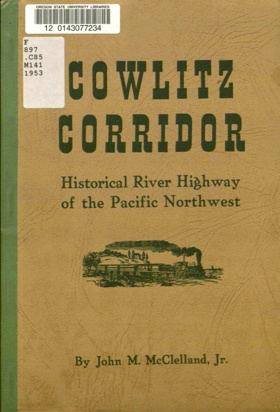
Cowlitz corridor by John M. McClelland, Albert Gustav Kletsch
Catalog Title Details
Title:
Cowlitz corridor
Author(s):
John M. McClelland, Albert Gustav Kletsch
Circulation:
ONLINE Circulation [ 1 ]
Published:
1953
Edition:
1st Edition
Document:
Book · Paperback
Physical Description:
64 pages : illustrations, map ; 23 cm
Genre:
History
I. First came explorers -- II. Canoe and bateau -- III. Came religion and government -- IV. Terrible road but beautiful -- V. Commerce comes to Cowlitz -- VI. N.P. lays its first rails -- VII. Monticello steamboat enterprise -- VIII. Opening of Kellogg era -- IX. Steamboating in its heyday -- X. Close of steamboat era -- XI. Good roads at last
Cowlitz County (Wash.) History, History, Railroads, Railroads Washington (State) Cowlitz County, River boats, River boats Washington (State) Cowlitz River, Steam-navigation, Steam-navigation Washington (State) Cowlitz River, Washington (State) Cowlitz County, Washington (State) Cowlitz River
" ... The Cowlitz Valley connects the prairies south of the Sound with the Columbia Valley and Oregon. It is a natural corridor, used continuously and with ever increasing frequency for more than a century. The story of the Cowlitz Corridor is primarily one of modes of travel. It begins with foot trails and shovel-nosed Indian canoes and ends with U.S. 99 converted to four lanes and astra-domed streamliners traveling over the same roadbed where once puffed the first standard gauge locomotive in Washington, the sturdy hut small Minnetonka. In between were long years when even a governor's wife, in order to traverse the valley, was forced to sit all day cramped in a narrow canoe, when the one road was so muddy and steep the stagecoach horses had to be changed at the end of a nine-mile run, and when the only way a farmer could get his oats out to the Portland market was on a shallow draft steamboat that could make regular runs when the water was just right. But always there was movement of some kind explorers taking a first look at new country; families moving in to settle; the first produce going out to market; sheep being herded north; cattle for export being floated south; farm machinery going up; potatoes and hops coming down; gold seekers rushing south to California in '49 and north to Alaska in '98; first citizens canoeing down to Monticello to petition for a territory in 1852 and going north to Olympia to establish a government in '53; new army draftees being hurried up to the Seattle Port of Embarkation in 1942; rotation troops going home from Korea in 1952. Through the years the movement has been steady, sometimes exciting, always interesting. This is the story of the corridor." Preface
Circulation Status
View holding locations, available formats, and specific editions.
| Collection | Resource | Edition | Published | Publisher | Avaliability |
|---|---|---|---|---|---|
|
Oregon State University ScholarsArchive@OSU |
Book | 1st Edition | 1953 | Longview Publishing Co | Read Online · Oregon State University |
Oregon State University
ScholarsArchive@OSU
Last updated: 2026-10-02