Nowhere to remember Hanford, White Bluffs, and Richland to 1943
|
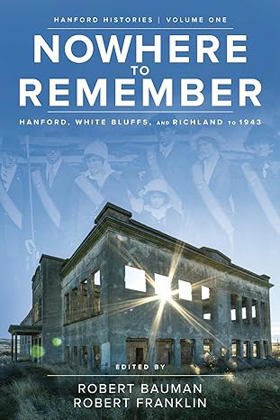
Euro-American Priest River Valley settlers turned acres of sagebrush into fruit orchards. Although farm life required hard work and modern conveniences were often spare, many former residents remember idyllic, close-knit communities where neighbors helped neighbors. Then, in 1943, families received forced evacuation notices. "Fruit farmers had to leave their crops on their trees. And that was very hard on them, no future, no money...they moved wherever they could get a place to live," Catherine Finley recalled. Some were given just thirty days, and Manhattan Project restrictions meant they could not return. Drawn from Hanford History Project personal narratives, Nowhere to Remember highlights life in Hanford, White Bluffs, and Richland--three small agricultural communities in eastern Washington's mid-Columbia region. It covers their late 1800s to early 1900s origins, settlement and development, the arrival of irrigation, dependence on railroads, Great Depression struggles, and finally, their unique experiences in the early years of World War II. David W. Harvey examines the impact of wagon trade, steamships, and railroads, grounding local history within the context of American West history. Robert Franklin details the tight bonds between early residents as they labored to transform scrubland into an agricultural Eden. Laura Arata considers the early twentieth century experiences of women who lived and worked in the region. Robert Bauman utilizes oral histories to tell forced removal stories. Finally, Bauman and Franklin convey displaced occupants' reactions to their lost spaces and places of meaning--and explore ways they sought to honor their heritage. |
| Author(s): | Robert Bauman (Editor of compilation), Robert Franklin (Editor of compilation) |
| Document: | Book · Paperback · CIRC [ 0 ] |
| Edition: | 1st Edition |
| Published: | 2018 |
| Physical Description: | xvi,196 pages : illustrations, maps, portraits ; 23 cm |
| Genre: | Biographies |
| Contents: | Acknowledgments Abbreviations Preface Michael MaysIntroduction: "Making a History of It May Help": The Hanford Site and Its Spaces and Places of Meaning Robert Franklin and Robert Bauman1. An Oasis in the Desert?: White Bluffs, Hanford, and Richland, The Early YearsDavid W. Harvey2. "We Worked in the Orchards and We Played in the River": Life in the Towns of Richland, White Bluffs, and Hanford Robert Franklin3. Orchards and Open Arms: Women in the Priest Rapids Valley Laura Arata4. "It Was Like an Invasion!": The Federal Government and the Displacement of Peoples in the Priest Rapids Valley Robert Bauman5. Hanford and White Bluffs Reunions: Remembering the Pre-War Communities of the Priest Rapids Valley Robert Bauman and Robert FranklinAppendix: Oral History InterviewsIntroduction, Robert Bauman Robert Fletcher, on Richland Leatris Reed, on White Bluffs Dick Wiehl, on White Bluffs Bibliography Contributors Index |
| Subjects: | Benton County (Wash.) Biography, Biographies, Entretiens Washington (État) Benton, Evacuation of civilians, Farm life, Farm life Washington (State) Benton County, Hanford (Wash.) History, Hanford Site (Wash.) Histoire, Hanford Site (Wash.) History, History, Internally displaced persons, Internally displaced persons Washington (State) Benton County |
| Related Places: | Benton County , White Bluffs , Hanford , City of Richland |
Circulation
Here are a list of places where this title can be found and the various formats it can be found in.
| Collection | Resource | Available | Edition | Published | Publisher |
|---|---|---|---|---|---|
| This title is not currently available in digital format online. | |||||
Last updated: 2024-06-27