Alexander Ross 1783-1856
Alexander Ross was a Scottish-born fur trader, explorer, and author whose extensive field experience and subsequent historical writings provided some of the most vital firsthand accounts of the Pacific Northwest's early commercial era. Arriving on the ill-fated ship Tonquin in 1811 as a clerk for John Jacob Astor's Pacific Fur Company, he helped establish Fort Astoria before journeying inland to found Fort Okanogan, the first American settlement in present-day Washington state. Following the American enterprise's collapse during the War of 1812, Ross remained in the region, serving consecutively with the British North West Company and the Hudson's Bay Company, where he led extensive and often grueling trapping expeditions deep into the Snake River country of present-day Idaho. After retiring to the Red River Settlement in 1825, he authored two seminal books, Adventures of the First Settlers on the Oregon or Columbia River (1849) and The Fur Hunters of the Far West (1855). These remarkably detailed memoirs remain indispensable primary sources for historians, offering unmatched insights into the daily operations, Indigenous relations, and intense corporate rivalries that defined the region's pioneering fur trade.
Fur trader who founded Fort Astoria and Fort Okanogan.
Biographical Overview
- Lived from 1783 to 1856
- Born: May 9, 1783, Morayshire, Scotland
- Died: Oct 28, 1856, Kildonan, Manitoba, Canada
Historical Events
- No referenced events linked
Bibliography for Alexander Ross
A listing of books related by subject
The fur hunters of the far West a narrative of adventures in the Oregon and Rocky Mountains by Alexander Ross
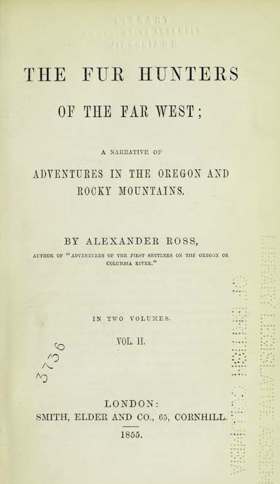
Alexander Ross’s 1855 narrative, The Fur Hunters of the Far West, provides an indispensable firsthand account of inland fur trade logistics, corporate maneuvers, and territorial diplomacy across the Columbia River basin and the northern Rocky Mountains. Chronicling his service with the North West Company and subsequently the Hudson’s Bay Company, Ross details the establishment and operation of key interior outposts—most notably Fort Nez Percés (Walla Walla), Fort Okanagan, and Spokane House—which were systematically constructed at strategic river confluences, traditional salmon fisheries, and seasonal gathering grounds long stewarded by the Cayuse, Walla Walla, Nez Perce, Spokane, and Syilx (Okanagan) peoples. The text illuminates the profound operational vulnerability of interior fur brigades, showing how overland transport and the grueling Snake River trapping expeditions were utterly dependent on negotiated interdependent alliances with regional Plateau and equestrian nations to secure vital pack horse herds, seasonal dried provisions, and navigational guides. Ross’s granular documentation of river rapids, overland trail corridors, and volatile trade councils exposes the fragile mechanics of early corporate resource extraction, illustrating how the fur companies were forced to superimpose their inland supply networks directly onto an established, deeply defended Indigenous geography.
1 online resource (2 volumes) : map, portrait
ONLINE Circulation [ 1 ]

Four years after Lewis and Clark stimulated American interest in the far western reaches of the continent, John Jacob Astor, a New York businessman, dispatched an overland expedition to establish a fur-trading post on the Columbia River. A second group traveled by sea aboard the Tonquin, among them Alexander Ross, a clerk in Astor's Pacific Fur Company. Adventures of the First Settlers is a vivid account of the expedition and its struggles to establish a successful trading venture. Ross details the Tonquin's dangerous voyage and documents the Astorians' painstaking struggles to clear the land and build a new trading post. Their settlement, Astoria, became the first American outpost on the Pacific Slope. Although the Astorians were aggressive in expanding their presence in the Columbia River country, their enterprise was short-lived. Ross chronicles their competition with the rival North West Company for furs and empire, the colorful and hazardous exploits of the fur trappers, and the eventual transfer of Astoria to the north West Company in the midst of the War of 1812. His detailed descriptions of the Columbia River Indians reveal Ross to be an astute and informed observer. In a new introduction to a book he calls "one of the charter literary documents for the Pacific Northwest," historian William Robbins considers the relationship between exploration, commerce, and empire in the Astorians' experience. An appendix containing a Chinook vocabulary and a table of weather conditions at Astoria in 1811.
xv, 352 pages, 1 unnumbered folded leaf of plates + 16 pages advertisements : 1 map ; 19 cm
ONLINE Circulation [ 1 ]
Entry Details
Related Online Resources
- No external online resources or related links found
Last updated: 2026-09-29