James Douglas 1803-1877
Sir James Douglas was a formidable Hudson's Bay Company executive who shaped the early economic and political landscape of the Pacific Northwest while managing vast fur trade operations out of Fort Vancouver in present-day Washington. Anticipating the 1846 Oregon Treaty boundary settlement, he directed the construction of Fort Victoria on Vancouver Island to secure a new northern headquarters for British interests. Later serving as the inaugural Governor of the Colony of British Columbia, Douglas successfully asserted British authority and law during the tumultuous 1858 Fraser Canyon Gold Rush, effectively thwarting the region's annexation by American miners. His decisive leadership in managing the transition from a commercial fur-trade monopoly to a governed colonial territory permanently secured the land north of the 49th parallel, earning him the enduring title of the "Father of British Columbia."
Biographical Overview
- Lived from 1803 to 1877
- Born: Aug 15, 1803, Demerara, British Guiana
- Died: Aug 2, 1877, Victoria, British Columbia
Historical Events
- No referenced events linked
Bibliography for James Douglas
A listing of books related by subject
Old Square-Toes and his lady the life of James and Amelia Douglas by John D. Adams

August 12, 2003, marks the 200th anniversary of the birth of Sir James Douglas. Although he played an integral role in British Columbia's history, in many ways Douglas remains misunderstood and an enigma. He is known for his contradictory qualities he was self-serving, racist, a military hawk, sometimes violent and arrogant. Yet he was also extremely community oriented, a humanitarian, brave and a devoted family member. John Adam's bestseller Old Square-Toes and His Lady: The Life of James and Amelia Douglas serves as an important source of information regarding Douglas's public and private lives. As Adams writes, [the term] old square-toes characterizes him as an unbending, stodgy, boring individual, but nothing could be further from the truth. At the pinnacle of his career, Douglas was knighted by order of Queen Victoria. Considering his modest, mixed-race beginnings in South America, his lofty status is, indeed, remarkable. Equally so is the life of his wife, Amelia. She was also of mixed blood, her mother being Cree and her father Irish. But unlike Douglas, who was educated in Scotland, she never left the northern forests until they married. Their ending up as a knight and lady of the British Empire was an unusual achievement. Old Square-Toes discusses the Douglases' diverse experiences of astonishing contrasts, from crossing North America by canoe to touring Europe by train, from Native uprisings to the frantic gold rush. Besides finding glory, they also faced grief in losing seven of their beloved children. This is a story of the adventure, heartbreak, and devotion that lies at the roots of western Canada
xi, 243 pages : illustrations, maps ; 22 cm
Non-circulating [ 1 ]
James Douglas father of British Columbia by Dorothy Blakey Smith
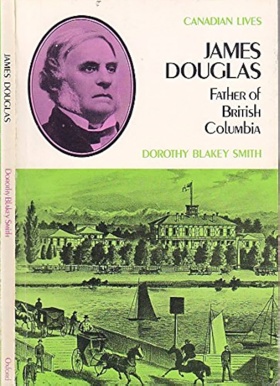
James Douglas father of British Columbia examines the aggressive imperial consolidation and sprawling fur-trade administration situated across the immensely fractured, mountainous macro-geography of the Pacific Northwest mainland and Vancouver Island. Smith details how the region's formidable topography—specifically the treacherous, whitewater chasms of the Fraser River Canyon, the sprawling, impenetrable mountain barriers of the Coast Range, and the vital, easily fortified maritime anchorages of the Salish Sea—strictly dictated the margins of Hudson's Bay Company monopoly logistics, frantic gold rush migrations, and desperate colonial road-building. By mapping Douglas’s strategic shift from directing remote interior trapping networks to commanding the massive overland engineering of the Cariboo Wagon Road—a physical necessity to assert British sovereignty over highly inaccessible inland gold fields swarming with foreign miners—the narrative highlights how this specific, imposing geography anchored a deeply precarious, top-down imposition of imperial authority. Ultimately, this biographical and geopolitical record serves as a macro-level spatial history, demonstrating how the immense overland isolation, severe topographic barricades, and vital maritime-interior corridors of this Pacific Northwest landscape fundamentally shaped the highly strategic, geographically defensive character of James Douglas's early British Columbia.
128 pages : illustrations ; 20 cm.
Non-circulating [ 1 ]
British Columbia and Sir James Douglas, K.C.B. (1803-1877) by Charles A. Banks
Charles A. Banks’s British Columbia and Sir James Douglas, K.C.B. (1803-1877) chronicles the urgent administrative and physical subjugation of a vast, aggressively fractured continental wilderness spanning from the remote maritime enclave of Vancouver Island to the towering alpine barricades of the mainland interior. The narrative maps how the severe environmental realities of this untamed expanse—defined by treacherous coastal fjords, impenetrable temperate rainforests, and the violent hydrology of the Fraser River canyon—initially threatened to plunge the region into lawless chaos during explosive inland gold rushes, forcing early colonial authorities to rapidly impose terrestrial and civic order. By detailing Douglas’s crucial transition from commanding isolated corporate fur-trading outposts to directing the monumental, explosive engineering of the Cariboo Wagon Road directly through sheer granite river gorges, the text illustrates how the projection of imperial sovereignty was strictly dictated by the necessity of physically breaching these massive topographical barricades. Ultimately, the account demonstrates that artificially carving mechanized transit corridors into this forbidding alpine landscape and deploying robust governmental infrastructure to conquer the profound geographical isolation of the interior were the absolute prerequisites for transforming a vulnerable, heavily contested frontier into the unified, governable colony of British Columbia.
27 pages illustrations.
Non-circulating [ 1 ]
Sir James Douglas and British Columbia by W. N. Sage
Authored in 1930 by University of British Columbia historian Walter Noble Sage, Sir James Douglas and British Columbia is a foundational academic biography chronicling the life of the man widely heralded as the "Father of British Columbia." The text meticulously traces the geopolitical transition of the Pacific coast from the sprawling, resource-extracting corporate fiefdom of the Hudson’s Bay Company into a formal, legally structured British Crown colony. Sage emphasizes Douglas’s autocratic but stabilizing governance during the chaotic influx of tens of thousands of American miners during the 1858 Fraser River Gold Rush, framing his tenure as the critical administrative bulwark that successfully secured British sovereignty in the Pacific Northwest against the aggressive tide of American Manifest Destiny.
A keen insight drawn from the work is how the academic reliance on the "Great Man" theory of history functions to morally validate the mechanics of imperial state formation. By framing Douglas as a pragmatic, enlightened patriarch who single-handedly imposed civilized British law upon an unruly frontier of rowdy prospectors and "untamed" Native populations, Sage effectively sanitizes the inherent violence of colonization. This historiographical maneuver subtly recasts the systemic dispossession of First Nations peoples—including Douglas's own highly contested, paternalistic land policies and inadequate reserve allocations—not as acts of territorial theft, but as necessary, sober administrative burdens managed by a benevolent British bureaucracy. Consequently, the establishment of the modern province is memorialized as a triumph of dignified imperial order over wilderness, structurally obscuring the profound colonial trauma embedded in its legal foundation.
398 pages folded map 25 cm.
ONLINE Circulation [ 1 ]
Entry Details
Related Online Resources
- No external online resources or related links found
Last updated: 2026-09-30