Isaac Stevens 1818-1862
Isaac Ingalls Stevens was an American military officer and politician who aggressively shaped the geopolitical landscape of the Pacific Northwest as the first governor and Superintendent of Indian Affairs for Washington Territory. Arriving in 1853, he simultaneously commanded the northern Pacific Railroad Survey, mapping a northern transcontinental route across the rugged inland geography to promote the region's future economic integration with the East. However, his most consequential and enduring legacy stems from his ruthless acceleration of American settlement through a rapid series of controversial treaties—most notably Medicine Creek, Point Elliott, and Walla Walla—negotiated between 1854 and 1855. By systematically extinguishing Indigenous land titles to millions of acres, Stevens established the foundational reservation system in Washington State, but did so under terms of intense coercion and profound cultural misunderstanding. The resulting displacement and broken promises directly ignited a devastating era of regional conflicts, including the Puget Sound War and the Yakima War. Stevens subsequently represented the territory in Congress before leaving the Pacific Northwest permanently to serve as a Union general, ultimately dying in combat at the Battle of Chantilly during the American Civil War.
The first Governor of Washington Territory, serving from 1853 to 1857.
Biographical Overview
- Lived from 1818 to 1862
- Born: Mar 25, 1818, North Andover, Massachusetts
- Died: Sep 1, 1862, Battle of Chantilly, Virginia
Historical Events
- No referenced events linked
Bibliography for Isaac Stevens
A listing of books related by subject
Isaac I. Stevens young man in a hurry by Kent D. Richards

Washington Territory's first governor remains as controversial today as he was to his frontier contemporaries during the Pacific Northwest's most turbulent era -- the mid-1850s. Indian wars, martial law, and bitter political disputes, as well as the establishment of a new, sound governmental system, characterized Isaac I. Stevens' years as governor (1853-1857). History professor Kent Richards counters the popular misconception that Stevens acted with haste in forcing treaties on regional tribes, thus precipitating hostilities in 1855. Richards argues that this was in fact not the case, with the possible exception of the Flathead Council. An 1839 West Point graduate, Stevens pursued an exciting and useful career for his country, being as much at ease on horseback in the wilderness as in the halls of government at the nation's capital. In addition to serving as Washington's territorial governor, Superintendent of Indian Affairs, and, eventually, delegate to the U.S. Congress, Stevens also distinguished himself in the Mexican War, the Coast Survey, and as head of the Northern Pacific transcontinental railroad survey. In the early years of the Civil War, he was appointed a major general in the Union Army. Dying as flamboyantly as he had lived, Stevens was stricken down in 1862 while charging with banner in hand toward rebel fortifications on the same battlefield where his son lay wounded. Cut short in mid-career, Stevens nonetheless left an indelible mark on the destiny of the nation's great Northwest region
xv, 451 pages : illustrations, maps ; 23 cm
Non-circulating [ 1 ]
Companion of adventure a biography of Isaac Ingalls Stevens, first governor of Washington Territory by Joseph Taylor Hazard

Joseph Taylor Hazard’s Companion of Adventure: A Biography of Isaac Ingalls Stevens chronicles the aggressive political and cartographic subjugation of a massively fractured, untamed territorial expanse spanning from the towering alpine barricades of the northern Rockies to the deep-water maritime enclaves of Puget Sound. The narrative maps how the severe environmental realities of this formidable western frontier—defined by impassable, snow-choked mountain passes, sprawling arid high-desert steppes, and impenetrable coastal rainforests—initially paralyzed large-scale overland migration and dictated a profound continental isolation. By detailing Stevens’s grueling deployment as both territorial governor and commander of the northern transcontinental railroad surveys, the text illustrates how the violent imposition of imperial sovereignty and the aggressive execution of indigenous treaties were strictly governed by the urgent necessity to engineer a mechanized terrestrial transit corridor directly through these geographical extremes. Ultimately, the account demonstrates that systematically calculating the physical vectors of this forbidding topography and legally clearing the massive terrestrial right-of-ways for heavy rail infrastructure were the absolute prerequisites for shattering the territory's geographic detachment and firmly anchoring the raw Pacific edge to an expanding industrial empire.
[16], 238 pages, 16 unnumbered pages of plates : illustrations, map, portraits ; 22 cm
Non-circulating [ 1 ]
Life of General Isaac I. Stevens by Hazard Stevens
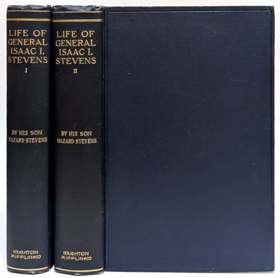
Written by his son Hazard Stevens, this extensive biography chronicles the life of General Isaac I. Stevens, focusing on his tenure as the first governor of Washington Territory and his subsequent military service during the Civil War. The narrative details his ambitious efforts to survey the northern transcontinental railroad route, his aggressive treaty negotiations with Pacific Northwest Native American tribes, and his eventual death at the Battle of Chantilly. A keen insight drawn from the text is how its deeply defensive, hagiographic tone—particularly regarding Stevens's highly controversial use of martial law during the Puget Sound War—demonstrates how 19th-century biographers actively sanitized the harsh realities of Manifest Destiny to cement a heroic family legacy. Ultimately, the work remains a vital, albeit heavily biased, historical record of the political and military foundations of the Pacific Northwest.
Isaac Ingalls Stevens (March 25, 1818 - September 1, 1862) was the first governor of Washington Territory, a United States Congressman, and a major general in the Union Army during the American Civil War until his death at the Battle of Chantilly.
2 volumes (xix., 480, [13] leaves of plates; xx, 530 pages, [44] leaves of plates) : illustrations, maps, plans, portraits ; 24 cm
ONLINE Circulation [ 2 ] Non-circulating [ 2 ]
Entry Details
Related Online Resources
- No external online resources or related links found
Last updated: 2026-09-30