Ezra Meeker 1830-1928
American pioneer Ezra Meeker played a prominent role in the agricultural and civic development of Washington Territory, arriving via the Oregon Trail in 1852 and subsequently founding the city of Puyallup. Capitalizing on the region's fertile soil, he built a massively successful agricultural enterprise, eventually earning the moniker "Hop King of the World" before an aphid blight decimated his fortune in the 1890s. In his later years, Meeker became a tireless advocate for historical preservation, undertaking a famous 1906 cross-country journey in a covered wagon to permanently mark and commemorate the rapidly disappearing Oregon Trail. Through his relentless public campaigns, national tours, and published memoirs, he successfully secured the pioneer route's enduring legacy in the American historical consciousness and cemented his own status as an iconic figure of Pacific Northwest settlement.
Ezra Manning Meeker was an American pioneer who traveled the Oregon Trail by ox-drawn wagon as a young man, migrating from Iowa to the Pacific Coast. Late in life he worked to memorialize the Trail, repeatedly retracing the trip of his youth. Once known as the "Hop King of the World", he was the first mayor of Puyallup, Washington.
Biographical Overview
- Lived from 1830 to 1928
- Born: Dec 29, 1830, Huntsville, Ohio
- Died: Dec 3, 1928, Seattle, Washington
Historical Events
- No referenced events linked
Bibliography for Ezra Meeker
A listing of books related by subject
Saving the Oregon Trail Ezra Meeker's last grand quest by Dennis M. Larsen

"Much has been written about Ezra Meeker, most of it by Meeker himself. Despite the paper trail he left behind, no one has yet written his comprehensive biography. In this, the last of three volumes on Meeker, Larsen examines the pioneer's most enduring legacy-his grand and much publicized promotion of the Oregon Trail"-- Provided by publisher
xi, 266 pages : illustrations, map, portraits ; 23 cm
Desiderata
Ox-team days on the Oregon trail by Ezra Meeker, Howard R. Driggs
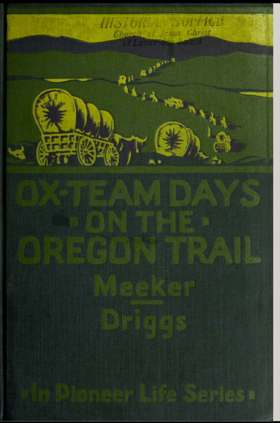
Published in 1922 as a collaborative revision between iconic pioneer Ezra Meeker and educational author Howard R. Driggs, Ox-Team Days on the Oregon Trail is a heavily sanitized, accessible autobiography aimed directly at the American public school system. The book recounts Meeker’s grueling 1852 overland migration to the Pacific Northwest by ox-drawn wagon, his early homesteading struggles, and his famous early twentieth-century crusade to retrace the route and erect physical monuments along the fading Oregon Trail. Serving as both a personal memoir and a pedagogical tool, the text was meticulously engineered to immortalize the pioneer experience as the ultimate expression of American grit and national destiny.
A keen insight drawn from the work is how the authors actively weaponized pioneer nostalgia for civic indoctrination; by repackaging the ecologically disruptive and inherently colonial act of westward expansion into an uplifting, state-sanctioned children’s textbook, Meeker and Driggs effectively cleansed the Oregon Trail of its violent realities. Their narrative actively shielded subsequent generations from the brutal consequences of Indigenous displacement, ensuring that the massive demographic invasion of the Pacific Northwest was memorialized purely as a righteous, patriotic pilgrimage essential to the American character.
viii, 225 pages : illustrations ; 21 cm.
ONLINE Circulation [ 1 ]
Seventy years of progress in Washington by Ezra Meeker
Published in 1921 by the Pacific Northwest's most famous and self-promoted trailblazer, Ezra Meeker, Seventy Years of Progress in Washington is a deeply personal memoir that doubles as a triumphalist history of the territory's evolution. The text chronicles Meeker’s grueling 1852 overland migration via the Oregon Trail, his early homesteading struggles in the Puget Sound region, his highly lucrative tenure as the "Hop King of the World" in Puyallup, and the rapid industrial urbanization of Washington State. Serving as both an autobiographical adventure and a civic retrospective, the book captures the staggering velocity of change from remote wilderness to modern industrial state within a single human lifetime.
A keen insight drawn from the work is how Meeker successfully weaponized his own longevity to elevate the pioneer generation into an untouchable moral aristocracy; by actively marketing himself as the living embodiment of westward expansion, Meeker transformed the ecologically and socially destructive realities of colonization into a nostalgic, heroic spectacle. His narrative effectively demanded that modern residents revere the pioneer struggle not merely as history, but as the state's sacred founding mythology, thereby insulating the colonial project from any critical moral scrutiny.
381, [2], 52 pages, 14 unnumbered leaves of plates : illustrations, portraits ; 24 cm
ONLINE Circulation [ 1 ] Non-circulating [ 1 ]
The Ox Team or, The Old Oregon Trail, 1852-1906 by Ezra Meeker
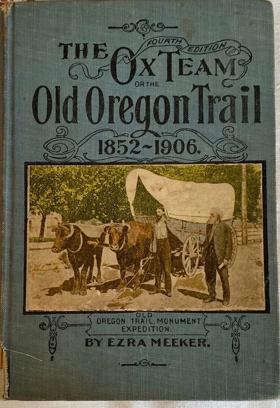
An account of the author's trip across the plains, from the Missouri River to Puget Sound, at the age of twenty-two, with an ox and cow team in 1852, and of his return with an ox team in the year 1906, at the age of seventy-six : with copious excerpts from his journal and other reliable sources of information, a narrative of events and descriptive of present and past conditions
[4], 248, [5] pages : illustrations, maps, portrait ; 19 cm
Desiderata
Pioneer reminiscences of Puget Sound : the tragedy of Leschi by Ezra Meeker

"Pioneer Reminiscences of Puget Sound: The Tragedy of Leschi" is a historical account written by Ezra Meeker, an American pioneer who settled in the Puget Sound region of Washington state in the mid-1800s. The book focuses on the tragic story of Chief Leschi, a prominent leader of the Nisqually tribe who was accused of murder and subsequently executed by the territorial government in 1858. Meeker provides a firsthand account of the events leading up to Leschi's trial and execution, as well as his own personal experiences living among the Native American tribes of the region. The book offers a unique perspective on the early history of the Pacific Northwest, shedding light on the complex relationships between settlers and Native Americans during a tumultuous period of American expansion.
xx, 554 pages, 26 unnumbered leaves of plates (2 folded) illustrations 24 cm
ONLINE Circulation [ 1 ]
Washington territory west of the Cascade mountains by Ezra Meeker
Ezra Meeker’s Washington territory west of the Cascade mountains explores the active pioneer settlement, agricultural development, and collaborative community building within the dense, maritime landscapes of the Puget Sound basin. The narrative illustrates how the profound environmental realities of this coastal topography—defined by towering, rain-swept timberlands, fertile but heavily forested river valleys, and the intricate, navigable waterways of the Salish Sea—required immense physical resilience and shared daily adaptation from early homesteaders. By detailing the gradual transition from the grueling communal labor of clearing old-growth forests to the cooperative establishment of thriving agricultural enterprises and vital maritime trade networks, the text highlights how the region's early prosperity relied heavily on community-driven responses to its immense natural abundance. Ultimately, the account demonstrates that patiently cultivating the rich valley soils and cooperatively harnessing the region's vast timber and maritime resources were essential steps in transforming a dense, isolated frontier into a highly connected, culturally enduring civic heartland of the Pacific Northwest.
Containing a description of Puget Sound, and rivers emptying into it, the Lower Columbia, Shoalwater Bay, Gray's Harbor, Timber, Lands, Climate, Fisheries, Ship Building, Coal Mines, Market Reports, Trade, Labor, Poupluation, Wealth and Resources.
52 pages : tables ; 21 cm
ONLINE Circulation [ 1 ]
Entry Details
Related Online Resources
- No external online resources or related links found
Last updated: 2026-09-30