John E. Rees 1868-1928
John Ephriam Rees was an Idaho pioneer, educator, and historian whose early ethnographic research profoundly enriched the historical record of the inland Pacific Northwest. Arriving in Lemhi County as a child in 1877, he spent much of his early life working at the Lemhi Indian Agency's trading post, where he developed a deep, firsthand understanding of Shoshone language, culture, and lore. He later taught history and literature in Salmon, Idaho, and served as the county's prosecuting attorney, but his enduring legacy stems from his meticulous archival and linguistic research. In 1918, he published Idaho: Chronology, Nomenclature, Bibliography, a seminal reference work that systematically documented the region's pioneer milestones and the indigenous origins of its geographic place names. Additionally, his dedicated writings on the crucial Lemhi Shoshone contributions to the Lewis and Clark Expedition—particularly concerning Sacajawea and the guide Toby—helped institutionalize Native American narratives within Idaho's broader frontier historiography.
Biographical Overview
- Lived from 1868 to 1928
- Born: Jan 1, 1868, Emporia, Kansas
- Died: Jan 1, 1928, Salmon, Idaho
Historical Events
- No referenced events linked
Bibliography for John E. Rees
A listing of books related by subject
Oregon—Its Meaning, Origin and Application by John E. Rees
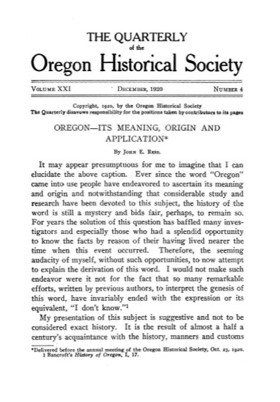
Published in 1920 by pioneer historian John E. Rees, Oregon—Its Meaning, Origin and Application is a brief etymological tract dedicated to deciphering the heavily contested linguistic roots of the state's name. Expanding upon the speculative methodologies he applied to neighboring Idaho, Rees argues that "Oregon" derives from specific Native American phonetic roots, attempting to definitively anchor the title in regional Indigenous dialects rather than European cartographic errors. By weaving together regional folklore, early exploration accounts, and localized vocabulary, the monograph attempts to construct a seamless narrative of authentic native pedigree for the broader Oregon Territory. A keen insight drawn from the work is how early regional scholars felt compelled to anchor new geopolitical entities to an imagined, romanticized Indigenous past; by fiercely claiming a "pure" Native origin for the state's name, historians like Rees actively commodified Indigenous heritage to lend an air of ancient, natural legitimacy to a recently manufactured colonial government.
1 volume (unpaged) ; 24 cm
ONLINE Circulation [ 1 ]
Idaho Chronology, Nomenclature, Bibliography by John E. Rees, B. Sc.
The book provides a comprehensive overview of the history and development of the state of Idaho, including a detailed chronology of important events, a thorough exploration of the state's place names and their origins, and an extensive bibliography of literature related to Idaho's history. The book is a valuable resource for anyone interested in the history of Idaho, and provides a fascinating glimpse into the state's past.
125 pages ; 22 cm
ONLINE Circulation [ 1 ]
Idaho, its meaning, origin and application by John E. Rees
Published in 1917 by pioneer historian and Indian trader John E. Rees, Idaho: Its Meaning, Origin and Application is a focused etymological monograph attempting to definitively trace the linguistic roots of the state's name. The text argues that the word originates from the Shoshone exclamation "Ee-dah-how," romantically translated as "the sun comes down the mountain," drawing heavily upon Rees's personal interactions with local tribes and early frontier lore. By compiling linguistic fragments, regional myths, and legislative records, the booklet served to establish a poetic Indigenous pedigree for the newly minted state, one that was enthusiastically embraced by local civic boosters despite subsequent linguistic disputes. A keen insight drawn from the work is how the pioneer-era appropriation of Native language functioned as a form of cultural trophy-hunting; by cementing a highly romanticized, settler-translated Indigenous phrase as the official state identity, early historians actively co-opted Native heritage to give the colonial government an aura of natural, ancient legitimacy while simultaneously overseeing the systemic marginalization of the very people whose language they claimed to honor.
Vol. 18, No. 2 (Jun., 1917), pp. 83-92 (10 pages)
ONLINE Circulation [ 1 ]
Entry Details
Related Online Resources
- No external online resources or related links found
Last updated: 2026-09-30