Franz Boas 1858-1942
A highly influential anthropologist who fundamentally shaped the study of Indigenous cultures in the Pacific Northwest. His extensive fieldwork in British Columbia, particularly among the Kwakwaka'wakw, revolutionized modern anthropology by introducing the concept of cultural relativism.
Biographical Overview
- Lived from 1858 to 1942
- Born: Jan 1, 1858, Minden, Westphalia, Germany
- Died: Jan 1, 1942, New York, New York, U.S.
Historical Events
- No referenced events linked
Bibliography for Franz Boas
A listing of books related by subject
Bella Bella texts by Franz Boas
Published in 1928 by Franz Boas, the foundational architect of modern American anthropology, Bella Bella Texts is a dense, bilingual ethnographic repository preserving the oral literature of the Heiltsuk (historically referred to by colonists as the Bella Bella) people of the central coast of British Columbia. Relying on Indigenous informants, Boas systematically transcribed creation histories, family crest narratives, and shamanistic lore into rigorous phonetic notation alongside literal English translations. The volume reflects Boas’s massive, career-long mandate of "salvage anthropology"—a scientifically urgent rush to document the complex Indigenous societies of the Pacific Northwest Coast before their anticipated erasure under the intense pressures of Canadian assimilation policies, residential schools, and the strict federal prohibition of the potlatch.
A keen insight drawn from the work is how the supposedly objective methodology of anthropological transcription actively divorced Indigenous oral traditions from their inherent legal and territorial authority. In Heiltsuk society, these narratives were not mere "folklore" or public entertainment; they were highly guarded intellectual property that codified family lineages, governed resource rights, and asserted territorial sovereignty. By extracting these sacred histories, stripping them of their performative and ceremonial contexts, and flattening them into standardized, bilingual data points for Western academic consumption, Boas’s project subtly disarmed them. The text inadvertently functioned as a mechanism of colonial containment, transforming active, legally binding Indigenous constitutional frameworks into static, depoliticized scientific specimens housed safely within the American academic archive.
ix, 291 ; 24 cm
ONLINE Circulation [ 1 ]
Tsimshian texts by Franz Boas
Franz Boas’s Tsimshian texts provides a foundational ethnographic record that preserves the intricate oral histories and deep environmental knowledge of the Tsimshian people along the rugged northern Pacific coast. Rather than viewing these narratives as mere folklore, the compiled accounts function as complex geographic ledgers, mapping the ancient maritime trade routes, seasonal salmon-fishing camps, and territorial boundaries established long before Euro-American maritime exploration. The text illustrates how the Tsimshian maintained highly sophisticated social structures, relying on strict family networks and deep interdependent alliances to govern access to the region's rich coastal estuaries and cedar forests. For historians of the Pacific Northwest, Boas’s transcriptions reveal the organized indigenous territorial reality that early maritime fur traders and loggers encountered, demonstrating that the northern coastal landscape was already extensively engineered and culturally managed by complex indigenous societies prior to frontier settlement.
244 pages ; 30 cm
ONLINE Circulation [ 1 ]
Kathlamet texts by Franz Boas
Franz Boas’s 1901 compilation, Kathlamet texts, serves as a vital companion to his earlier Chinookan research, preserving the complex oral traditions and ecological knowledge of the communities located along the upper estuary of the lower Columbia River. Also transcribed from Charles Cultee, these narratives function as deep environmental ledgers that map the specific riverine corridors, seasonal salmon-fishing encampments, and dense timberlands defining Kathlamet territory. The text reveals a highly structured indigenous society that relied on tight family networks and interdependent alliances to manage the region's rich aquatic resources and coordinate regional inland trade. For historians of Pacific Northwest settlement, these transcribed traditions demonstrate that the subsequent pioneer development in areas like Wahkiakum County—such as the establishment of early logging camps, steamship docks, and commercial canneries—was explicitly mapped onto the ancient, culturally managed geography of the Kathlamet people. Ultimately, Boas’s work underscores that the frontier infrastructure and supply networks utilized by incoming Euro-American homesteaders were entirely built upon a foundation of established indigenous territorial knowledge.
261 pages, 1 unnumbered leaf of plates : portraits ; 30 cm
ONLINE Circulation [ 1 ]
The Thompson Indians of British Columbia by James Alexander Teit, Franz Boas
The following description of the Thompson Indians is based on two manuscripts prepared by Mr. James Teit, - the one a description of the Upper Thompson Indians, written in 1895; the other a description of the Lower Thompson Indians, written in 1897 as a result of work done by Mr. Teit for the Jesup North Pacific Expedition.
pages 163-392. illustrations (including map) plates XIV-XX. 36 cm
ONLINE Circulation [ 1 ]
Chinook texts by Franz Boas
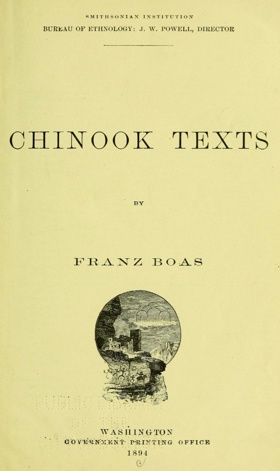
Franz Boas’s 1894 compilation, Chinook texts, provides an essential linguistic and ethnographic rescue of the Lower Chinookan oral traditions, preserving the worldview of the preeminent mercantile power at the mouth of the Columbia River. Transcribed from Charles Cultee—one of the last fluent speakers of the language—the narratives function as an intricate geographic ledger that maps the ancient tidewater trade routes, seasonal salmon-fishing encampments, and navigation corridors governing the region's coastal economy. The text illustrates how the Chinook maintained control over this vital riverine choke point through complex trade negotiations and deep interdependent alliances with both interior nations and coastal neighbors. For historians of frontier settlement, Boas’s compilation underscores that the early maritime fur trade and subsequent pioneer infrastructure—most notably the establishment of Fort Astoria—were deliberately mapped directly onto this highly organized indigenous mercantile geography, proving that early Euro-American logistics were entirely dependent on established Chinookan river networks and territorial knowledge.
278 pages frontispiece (portrait) ; 25 cm.
ONLINE Circulation [ 1 ]
Chinook texts by Franz Boas, Charles Cultee
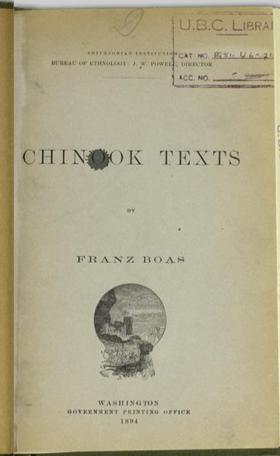
Published in 1894, Chinook Texts is a foundational ethnolinguistic work compiled by anthropologist Franz Boas, who meticulously transcribed the myths, historical narratives, and cultural traditions of the Lower Chinook people directly from Charles Cultee, one of the last living fluent speakers. A keen insight drawn from the text is how the urgency of Boas's "salvage anthropology" highlights the devastating impact of colonization, demonstrating how the preservation of an entire linguistic system ultimately relied on the extraordinary memory of a single indigenous informant. By presenting the original phonetically transcribed Chinookan dialect alongside literal English translations, the volume rigorously documents the complex grammatical syntax and nuanced worldview of the lower Columbia River tribes. Consequently, the book stands not merely as a collection of regional folklore, but as an indispensable archival record that permanently secured the heritage of a vanishing Pacific Northwest civilization.
1 preliminary leaf, 278 pages, 2 leaves of plates : portraits ; 24 cm
ONLINE Circulation [ 1 ]
Entry Details
Related Online Resources
- No external online resources or related links found
Last updated: 2026-09-30