Alejandro Malaspina 1754-1809
A brilliant Italian-born naval officer who commanded a major scientific expedition for the Spanish Crown along the Pacific Northwest coast. His crew conducted extensive botanical, ethnographic, and cartographic research in Alaska and British Columbia.
Biographical Overview
- Lived from 1754 to 1809
- Born: Jan 1, 1754, Bilbao, Spain
- Died: Jan 1, 1809, Zaragoza, Spain
Historical Events
- No referenced events linked
Bibliography for Alejandro Malaspina
A listing of books related by subject
En la costa de la niebla el paisaje y el discurso etnográfico ilustrado de la expedición Malaspina en el Pacífico by Fernando Monge

Published by Fernando Monge, En la costa de la niebla: el paisaje y el discurso etnográfico ilustrado de la expedición Malaspina en el Pacífico examines the late 18th-century scientific voyage led by Alejandro Malaspina along the fog-shrouded Pacific Northwest coast. The book analyzes the intricate intersection of Enlightenment-era exploration, landscape representation, and the visual ethnography captured by artists and naturalists documenting indigenous societies from Alaska down to the Spanish colonial outposts. Through a close reading of historical journals and newly contextualized illustrations, the text reveals how imperial ambition sought to categorize and control remote foreign geographies through the dual lens of science and art. A keen insight drawn from the work is how Enlightenment science in the Pacific was never truly neutral; rather, the detailed cataloging of local native cultures and misty coastlines served as an aesthetic tool of Spanish territorial claim-making, transforming indigenous homelands into legible imperial commodities.
238 pages ; 24 cm
Non-circulating [ 1 ]
Voyages of enlightenment Malaspina on the Northwest coast, 1791-1792 by Thomas Vaughan, E. A. P. Crownhart-Vaughan , Mercedes Palau Baquero
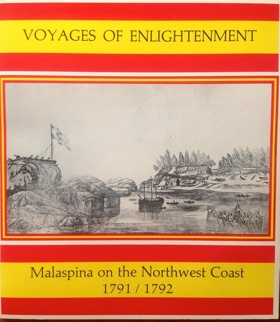
Voyages of Enlightenment: Malaspina on the Northwest Coast, 1791-1792 chronicles the ambitious Spanish maritime expedition tasked with charting the complex, glaciated shorelines and intricate archipelagos of the extreme Pacific seaboard. Vaughan, Crownhart-Vaughan, and Palau Baquero detail how the region's formidable hydrographic barriers—specifically the labyrinthine fjords, treacherous tidal narrows, and towering coastal mountains stretching from Alaska's Yakutat Bay to Vancouver Island's Nootka Sound—severely tested the navigational limits of eighteenth-century explorers searching for a mythical transcontinental waterway. By mapping the expedition's rigorous scientific, botanical, and ethnographic surveys, the narrative highlights the immense logistical effort required to visually and scientifically document a rugged marine environment dominated by impenetrable coastal rainforests and massive alpine ice fields. Furthermore, the account underscores the deep spatial relationship between the Indigenous Tlingit and Nuu-chah-nulth peoples and their water-bound world, illustrating how Native communities had long mastered the precarious coastal topography that European empires were merely struggling to chart. Ultimately, this detailed historical and visual record serves as a vital spatial history, demonstrating how the unforgiving, deeply carved maritime geography of the Pacific Northwest fundamentally shaped the limits of European imperial expansion and Enlightenment-era scientific inquiry on the remote frontier.
viii, 61 pages : illustrations ; 23 cm.
Non-circulating [ 1 ]
Entry Details
Related Online Resources
- No external online resources or related links found
Last updated: 2026-09-30