Edmond S. Meany 1862-1935
A prominent historian, politician, and mountaineer who served as a professor at the University of Washington for decades. He was instrumental in preserving Pacific Northwest history, expanding the university campus, and co-founding The Mountaineers club.
Biographical Overview
- Lived from 1862 to 1935
- Born: Dec 28, 1862, East Saginaw, MI
- Died: Apr 22, 1935, Seattle, WA
Historical Events
- No referenced events linked
Bibliography for Edmond S. Meany
A listing of books related by subject
The Pacific Northwest a syllabus by Edmond S. Meany
Compiled in the early twentieth century by University of Washington professor Edmond S. Meany—the premier institutional architect of the state's historical canon—The Pacific Northwest: A Syllabus operated as a formal pedagogical framework designed to standardize the teaching of regional history in higher education. Functioning as a strict curriculum guide, the text organized the region’s past into a rigid, highly structured taxonomy of chronological eras: maritime discovery, the fur trade, missionary settlement, the pioneer migrations, and the triumphant march to statehood. By dictating the precise historical milestones, key figures, and required readings for university students, Meany’s syllabus built the foundational academic infrastructure that determined exactly how the next generation of teachers, politicians, and civic leaders would learn and transmit their region's origins.
A keen insight drawn from the work is how the seemingly neutral, objective format of a university syllabus functioned as a profound instrument of epistemological erasure; by plotting the region’s history strictly along a timeline of Anglo-American achievements, treaties, and legal milestones, Meany conceptually banished millennia of Indigenous civilization to the static realm of "pre-history" or mere environmental obstacles to be overcome. The syllabus weaponized the authority of the university to institutionalize a teleological narrative of colonial progress, ensuring that the violent displacement of Native peoples was academically processed by future civic leaders not as an ongoing injustice, but as a concluded, natural phase in the inevitable maturation of the American state.
18 unnumbered pages ; 22 cm
ONLINE Circulation [ 1 ]
Origin of Washington geographic names by Edmond S. Meany
Published in 1923 by the University of Washington Press, Origin of Washington Geographic Names is a comprehensive reference work compiled by noted regional historian and professor Edmond S. Meany. The book catalogs the etymology and historical background of place names across Washington State, serving as a foundational text for Pacific Northwest history. Originally serialized as a collection of articles in the Washington Historical Quarterly, the 357-page volume documents how various towns, waterways, and landforms received their designations. Today, it remains a valuable resource for understanding the geographic, indigenous, and pioneer heritage of the region
ix, 357 pages ; 21 cm
ONLINE Circulation [ 2 ] Non-circulating [ 1 ]
Mountain camp fires by Edmond S. Meany
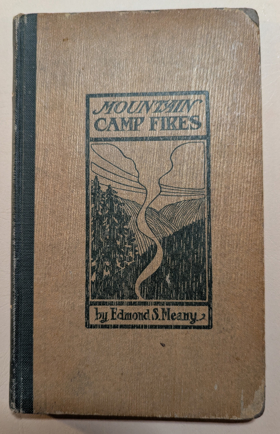
Authored by prominent Pacific Northwest historian and avid outdoorsman Edmond S. Meany, Mountain Camp Fires is a 1911 collection of evocative poetry celebrating the rugged, untamed wilderness of Washington State. The volume captures the spirit of the nascent "Mountaineers" club, translating the physical exhaustion and spiritual triumphs of alpine climbing, forest treks, and starlit encampments into romantic verse. Rather than detailing regional economic conquests, Meany uses rhythmic tributes to local geography, flora, and the camaraderie of the campfire to document the emerging conservationist ethos of the early 20th century. A keen insight drawn from the work is how the popularization of wilderness poetry signaled a profound regional shift in the cultural conception of nature; by framing the harsh, mountainous frontier as a sanctuary for spiritual renewal and recreation, Meany's verse captures the exact historical moment when the Pacific Northwest landscape transitioned from a hostile adversary to be conquered into a curated playground for the urban middle class.
viii, 90 pages, 1 unnumbered leaf of plates frontispiece (illustration) 19 cm
ONLINE Circulation [ 1 ] Non-circulating [ 1 ]
History of the state of Washington by Edmond S. Meany
Edmond S. Meany’s 1909 foundational text, History of the state of Washington, serves as an expansive civic chronicle detailing the rapid transformation of the Pacific Northwest from a complex indigenous landscape into a modernized American industrial territory. Moving beyond a standard political timeline, Meany meticulously catalogs the grueling overland migrations, the fragile establishment of early maritime supply chains, and the aggressive expansion of territorial railroads. The narrative documents how the region’s foundational frontier infrastructure—including military forts, steamship docks, and logging camps—was consistently mapped directly onto the ancient overland trails and riverine trade networks long managed by the Coast Salish, Chinookan, and Plateau peoples. Furthermore, the history heavily emphasizes the intense cooperative labor, deep community bonds, and complex interdependent alliances required by isolated pioneers to clear massive timberlands and establish the state's earliest civic institutions. As one of the first formal academic histories of the region, Meany’s work effectively institutionalized the frontier narrative, capturing the immense bureaucratic and physical effort required to superimpose a newly engineered political geography over a profoundly established indigenous domain.
xv, 412 pages : illustrations, maps ; 20 cm
ONLINE Circulation [ 1 ] Non-circulating [ 1 ]
Vancouver's discovery of Puget Sound portraits and biographies of the men honored in the naming of geographic features of northwestern America by Edmond S. Meany, Washington State Library Classics in Washington History
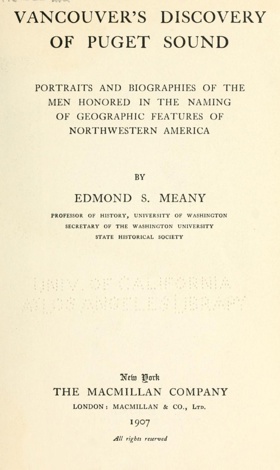
Edmond S. Meany’s 1907 text, Vancouver's discovery of Puget Sound, provides a detailed biographical ledger of the imperial cartography that fundamentally redefined the geographic identity of the Pacific Northwest. Chronicling Captain George Vancouver’s 1792 maritime expedition, the text details how British naval officers systematically renamed the ancient, complex marine highways and prominent peaks of the Coast Salish peoples, assigning the names of European aristocrats, diplomats, and crewmen to vital geographical features like Mount Rainier, Mount Baker, and Puget Sound. This act of imperial mapping constituted a profound linguistic superimposition, drafting the official navigational blueprints that would later guide the maritime supply chains and coastal infrastructure of incoming Euro-American pioneers. Furthermore, to survive the treacherous tidal currents and successfully chart the labyrinthine inlets, Vancouver's isolated crew engaged in intense cooperative maritime labor and frequently relied on observing the established coastal villages and deep environmental knowledge of local indigenous communities. Ultimately, Meany’s biographical catalog illustrates how initial naval exploration formally mapped a European bureaucratic framework directly onto a highly managed, pre-existing indigenous seascape, setting the stage for subsequent territorial settlement and corporate resource extraction.
xvii, 344 pages : illustrations ; 22 cm
ONLINE Circulation [ 1 ] Non-circulating [ 1 ]
Entry Details
Related Online Resources
- No external online resources or related links found
Last updated: 2026-10-01