Ada County County
Established December 22, 1864 with its county seat at Boise. Named for Ada Riggs, the first white child born in the area and daughter H.C. Riggs, one of the founders of Boise and a member of the Idaho Territorial Legislature. Boise became the capital of Idaho in 1865.
Mapped Location
Ada County: The mapped location is an approximation and should not be used for navigation or wayfinding.
Information
General information on Ada County
- Feature Type: County
- County Seat: City of Boise
- Established: Thursday, December 22, 1864
Official, historical, colloquial and alternative toponyms for Ada County
A brief list of names that this geographic feature has been named
| Name | Description |
|---|---|
| Ada County | Official |
Origin Notes and History of Ada County
References to Ada County that document the origin of its place name
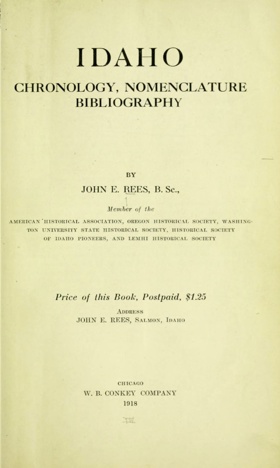
ADA.—Named for Ada Riggs, the oldest daughter of Hon. H. C. Riggs, and who was the first white child born in Boise City, in 1863. The county seat is Boise, named for the Boise River (q.v.).
Related Catalog Titles
A Bibliography for Ada County, County
Murder & mayhem in Boise by Mark Iverson , Jeff Wade

Cemetery stories : where'd Dr. McIteeny get to and the Sad tale of Sergeant Peter Vogel; Ezekiel Litell's axe to grind; Grove Street gutting; H.B. Lane orders a drink, is served a shot; The wheels of justice begin to turn; Simeon Walters's short drop; A bad year in the life of T. Burmester, Esquire; Never let your guard down at Goodwin's mill
127 pages : illustrations ; 23 cm
CIRC [ 0 ]
The other Idahoans forgotten stories of the Boise Valley by Todd Shallat
Fallen angels in the bawdy houses. Migrants barred from Main Street. Homesteaders driven from homesteads when August rained black storms of dust. The Other Idahoans recovers their hard-luck stories. Volume 7 of Boise State University's prizewinning research series, the book closes with a driving tour of storied places from history's underside.
139 pages : illustrations (some color), color maps ; 23 cm.
CIRC [ 0 ]
The Beer Baron of Boise the life of John Lemp, millionaire brewer of frontier Idaho by Herman W. Ronnenberg
Although he arrived in America penniless, John Lemp became the most successful brewer in the history of Idaho. As befits a business leader of the Gem state, he cut a multitude of other facets into his personal and professional identity. As an early Idaho businessmen, his story gives insights into the early development of the state and, particularly, of Boise. This biography could be interpreted as fitting into the literature of various individual businessmen in the West.
xxv, 436 pages : illustrations, maps ; 24 cm
CIRC [ 0 ]
Boise, Idaho, 1882-1910 prosperity in isolation by Carol Lynn MacGregor
MacGregor's study of Boise begins with the removal of the Northern Shoshoni and follows the progress of government, infrastructure, business, and social institutions in the area. Along the way, MacGregor (history, Boise State) describes Boise's architecture, arts, culture and changing demographics. She creates in all its details the peculiar history of this unusually prosperous and progressive city. The text includes photographs and maps of the evolving city. Annotation ©2006 Book
xiv, 306 pages : illustrations, maps ; 23 cm
CIRC [ 1 ]
The Boise Massacre on the Oregon Trail attack on the Ward party in 1854 and massacres of 1859 by Donald H. Shannon
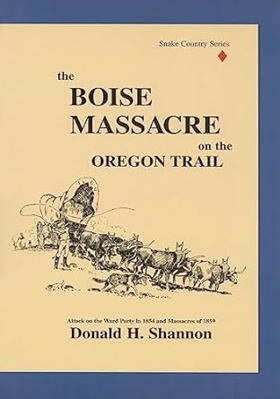
Only some half-dozen of the adverse encounters between Indians and emigrants on the Oregon and California Trails can be termed "massacre". The Ward Party Massacre that occurred on the Boise river is one of those unfortunate, and often overlooked events. Author Donald H. Shannon explores the relations between the peoples of the "Snake Country" of Southern Idaho, Shoshoni, Northern Paiutes, Bannocks and Emigrants, in a attempt to describe the environment that led to several of the most violent conflicts that occurred along the Oregon and California trails.
xi, 287 pages : illustrations, maps ; 23 cm.
CIRC [ 1 ]
Chinatown, Boise, Idaho, 1870-1970 by Arthur A. Hart
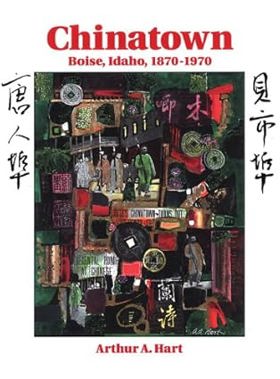
Boise's Chinatown was a rich and colorful part of community life for more than a century. Arthur A. Hart has devoted more than thirty years to researching Chinese people in Idaho, including Boise s Chinatown. You will learn why the Chinese came here, the prejudice and hardships they faced, and their important contributions to the city and the state.
xiv, 144 pages : illustrations, maps, portraits ; 28 cm
CIRC [ 0 ]
The boys of Boise furor, vice & folly in an American city by John Gerassi, Peter Boag
A classic account of a 1950s sex scandal that depicts middle America's traditional response to homosexuality. Written in 1965 about a same-sex sexual scandal that occurred in 1955 in Boise, Idaho, John Gerassi’s classic study depicts both middle America’s traditional response to homosexuality and an era in the country’s history before the modern gay rights movement really got underway. Because much of what Gerassi wrote about persists in today’s struggles over gay and lesbian issues, his book still has much to tell us about how contemporary society reacts to, and misunderstands, homosexuality. On the morning of November 2, 1955, the people of Boise, Idaho, were stunned by a screaming headline in the Idaho Daily Statesman, THREE BOISE MEN ADMIT SEX CHARGES. Time magazine picked up the story, reporting that a "homosexual underworld" had long operated in Idaho’s staid capital city. The Statesman led the hysteria that resulted in dozens of arrests—including some highly placed members of the community—and sentences ranging from probation to life imprisonment. Peter Boag’s Foreword places the book in historical perspective, summarizing the popular psychological theories and legal conceptions that helped to shape Gerassi’s research. He discusses advances in Idaho’s public approach to homosexuality and ways in which the provincialism chronicled by Gerassi persists to this day.
xxxii, 328 pages ; 22 cm.
CIRC [ 0 ]
Union Pacific rails to the mines the Boise, Nampa & Owyhee Railway by Thornton Waite
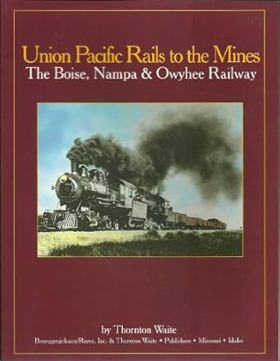
Authored by railroad historian Thornton Waite, Union Pacific Rails to the Mines: The Boise, Nampa & Owyhee Railway details the ambitious and financially volatile history of the late 19th-century rail line that connected southwestern Idaho's rich mining districts and agricultural valleys to the broader transcontinental network. The book traces the corporate maneuvers, engineering challenges, and economic battles required to construct and operate tracks through the rugged terrain between Nampa, Boise, and the Owyhee mountains. Drawing heavily on corporate archives, vintage maps, and historical photographs, the text illustrates how steel infrastructure dictated the survival and decline of regional boomtowns. A keen insight drawn from the work is how regional feeder railways acted as economic gatekeepers rather than mere public utilities; by holding a monopoly over mineral and crop transportation, independent lines like the Boise, Nampa & Owyhee held the ultimate power of life or death over local commerce, frequently leaving isolated communities at the mercy of distant corporate boardrooms.
64 pages : illustrations ; 28 cm
CIRC [ 1 ]
Boise baseball the first 125 years by Arthur A. Hart
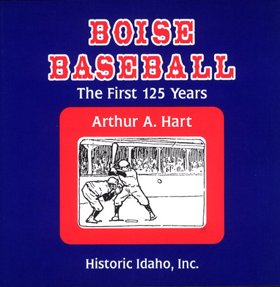
Here are stories about some of the great players and fascinating characters, as well as many yarns that Arthur A. Hart has collected through years of research and interviews with former players and those closely connected with the game.
109 pages : illustrations ; 21 cm
CIRC [ 0 ]
The Boiseans at home by Arthur A. Hart
To own a fine house is a mark of success, and Boiseans of earlier times were no different from those of today in recognizing this. This volume is a collection of short essays that aim to capture the flavor of the life and times of some of the families that played a significant part in Boise s history.
86 pages : illustrations, portraits ; 20 cm
CIRC [ 0 ]
Report from Grimes Creek after a hard winter by Nancy Stringfellow

Authored by Nancy Stringfellow, Report from Grimes Creek After a Hard Winter captures the isolated, rugged reality of pioneer life and gold-mining culture in the mountainous backcountry of Boise County, Idaho. The book reflects on the punishing aftermath of a brutal winter season, detailing how local homesteaders, miners, and families endured freezing isolation, scarce supplies, and the grueling physical toll of sub-zero mountain living. Through evocative prose and regional historical anecdotes, the text preserves a snapshot of resilient community survival along a historic Idaho creek. A keen insight drawn from the work is how seasonal extremes served as the ultimate equalizer on the mining frontier; by demonstrating how a severe winter instantly stripped away the speculative hype of the gold rush and reduced all residents to a shared struggle for basic warmth and sustenance, the narrative reveals that true frontier survival relied far more on stubborn endurance against nature than on mineral wealth.
34 pages : illustrations ; 23 cm
CIRC [ 1 ]
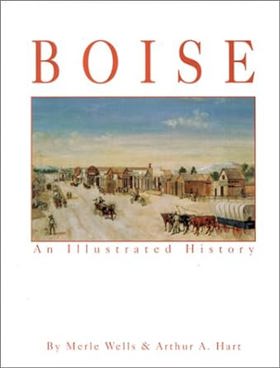
Boise an illustrated history by Merle W. Wells, Arthur A. Hart, Greater Boise Chamber of Commerce
Historic Boise an introduction to the architecture of Boise, Idaho, 1863-1938 by Arthur A. Hart, Boise City Historic Preservation Commission
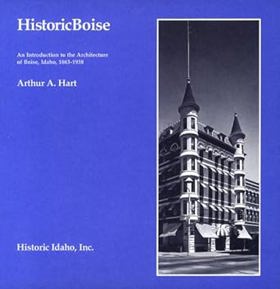
This is a brief introduction to the architectural legacy of Idaho's capital city, from its founding in 1863 to the eve of World War II. It is cultural history at its best because it shows that buildings have dimensions beyond descriptions of size or style.
82 pages : illustrations ; 21 cm
CIRC [ 0 ]
Old Fort Boise by Annie Laurie Bird, Arthur E. Yensen (Illustrator)
Boise, the peace valley by Annie Laurie Bird

Published in 1934 by Idaho educator and regional historian Annie Laurie Bird, Boise, the Peace Valley is a localized civic history charting the evolution of the Boise River basin from a prominent fur-trade waypoint into the urban and agricultural epicenter of the state. Drawing upon early explorer journals, pioneer diaries, and territorial records, Bird chronicles the expeditions of Wilson Price Hunt, the establishment of the original Hudson's Bay Company Fort Boise, the massive migrations along the Oregon Trail, and the eventual 1862 gold rush that catalyzed permanent American settlement. The narrative leans heavily into the romantic motif of the valley as an idyllic, timbered sanctuary—an essential oasis of respite for weary overland emigrants navigating the punishing, arid expanses of the Snake River Plain. Operating as a classic regional monument, the book is designed to immortalize the pioneer endurance and capitalist enterprise that transformed an untamed geographic resting stop into a prosperous, irrigated metropolis.
A keen insight drawn from the work is how the strategic branding of the region as a "peace valley" functions to fundamentally depoliticize a fiercely contested landscape. By defining the basin primarily as an innate, natural sanctuary destined by geography to nurture and shelter Anglo-American travelers, Bird’s narrative effectively recharacterizes a vital Indigenous homeland—traditionally managed and defended by the Shoshone, Bannock, and Northern Paiute peoples—as a passive, welcoming haven awaiting colonial occupancy. This historiographical maneuver subtly sanitizes the violent realities of the era, notably the 1863 establishment of a United States military fort specifically designed to crush Native resistance and enforce territorial enclosure. By framing the landscape as inherently cooperative to pioneer settlement, the text allows readers to view the subsequent systemic displacement of Indigenous populations not as a hostile military invasion, but as the peaceful, inevitable inheritance of a valley practically begging for American cultivation.
408 pages illustrations 20 cm
CIRC [ 1 ]
Ada County
- Barber
- Beatty
- Blacks (historical)
- Blacks Creek
- City of Boise
- Cloverdale
- Collister
- City of Eagle
- Garden City
- Hillcrest
- City of Kuna
- Leone
- City of Meridian
- Mora
- Neal (historical)
- Orchard
- Owyhee
- Perkins
- Pleasant Valley
- Regina
- Sonna
- South Boise (historical)
- City of Star
- Swan Falls
- Ustick
- Vernon
Political Boundaries
Last updated: 2025-09-23