Blaine County County
Established March 5, 1895 with Hailey as the county seat. Named for James G. Blaine, U.S. Secretary of State (1889-1892) under President Benjamin Harrison. The area was first explored in 1818 by Donald MacKenzie.
Mapped Location
Blaine County: The mapped location is an approximation and should not be used for navigation or wayfinding.
Information
General information on Blaine County
- Feature Type: County
- County Seat: City of Hailey
- Established: Tuesday, March 5, 1895
Official, historical, colloquial and alternative toponyms for Blaine County
A brief list of names that this geographic feature has been named
| Name | Description |
|---|---|
| Blaine County | Official |
Origin Notes and History of Blaine County
References to Blaine County that document the origin of its place name
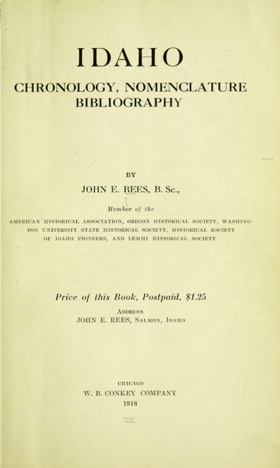
BLAINE. —Named for Hon. James G. Blaine, the American statesman. The county seat is Hailey, named for Hon. John Hailey (q.v.).
A Selected Bibliography of Blaine County, County
A compilation of essential readings detailing the history, geography, and culture of the region.
The Sun Valley story by Doreen Marsh Dorward

The Sun Valley Story by Doreen Marsh Dorward is a locally published historical booklet that chronicles the development and charm of the iconic Sun Valley, Idaho resort area. Released through the author's own Ketchum-based photography studio, the work utilizes both original imagery and local history to capture the picturesque landscapes that transformed a remote mountain valley into a world-renowned destination. Ultimately, it serves as an intimate visual keepsake that preserves the pioneering heritage of America's first luxury winter sports resort.
32 pages : illustrations ; 23 cm
Non-circulating [ 1 ]
History of Alturas and Blaine counties, Idaho by George A. McLeod

George A. McLeod’s History of Alturas and Blaine counties, Idaho explores the steady pioneer settlement and enduring civic adaptation within the rugged, mineral-rich landscapes of central Idaho. The narrative illustrates how the challenging environmental realities of this topography—defined by the sheer peaks of the Pioneer and Smoky mountains, the vital riverine corridors of the Wood River Valley, and the profound seasonal shifts of the high-elevation climate—initially required immense resilience and cooperative effort from early miners and homesteaders. By detailing the gradual transition from isolated, transient silver and lead mining camps to the collaborative establishment of enduring agricultural communities and the thoughtful integration of early regional rail networks, the text highlights how the area's prosperity relied on community-driven adaptation to a demanding environment. Ultimately, the account demonstrates that cooperatively harnessing the valley's waterways for irrigation and patiently building cohesive, responsive local institutions were essential steps in transforming a remote, mountainous frontier into a thriving, deeply rooted civic and economic heartland of the intermountain West.
iv, 192, v-xx pages : plate, portraits ; 20 cm
Non-circulating [ 1 ]
Blaine County
- Barite
- City of Bellevue
- Boulder
- Broadford
- Bullion
- City of Carey
- Cathedral Pines
- Clarendon Hot Springs
- Cream Can Junction
- DeWoff
- Doniphan
- Easley Hot Springs
- Elkhorn Village
- Galena
- Gannett
- Gimlet
- City of Hailey
- Hawley
- City of Ketchum
- Leduc (historical)
- Magic City
- Magic Resort
- Picabo
- Sawtooth City (historical)
- Smith Springs
- Stanton Crossing
- City of Sun Valley
- Tikura
- Triumph
- Wapi
Political Boundaries
Last updated: 2016-11-27