Clearwater County County
Established in February 27, 1911 with its county seat at Orofino. Named for the Clearwater River whose name was translated from the Nez Perce term KoosKoos-Kai-Kai, describing clear water. In 1805, Lewis and Clark followed an old Indian trail between the north and middle forks of the Clearwater River and met the Nez Perce near the present site of Weippe. Gold was first discovered by E.D. Pierce in 1860 and Pierce City, the oldest mining town in Idaho came into existence.
Mapped Location
Clearwater County: The mapped location is an approximation and should not be used for navigation or wayfinding.
Information
General information on Clearwater County
- Feature Type: County
- County Seat: City of Orofino
- Established: Monday, February 27, 1911
Official, historical, colloquial and alternative toponyms for Clearwater County
A brief list of names that this geographic feature has been named
| Name | Description |
|---|---|
| Clearwater County | Official |
Origin Notes and History of Clearwater County
References to Clearwater County that document the origin of its place name
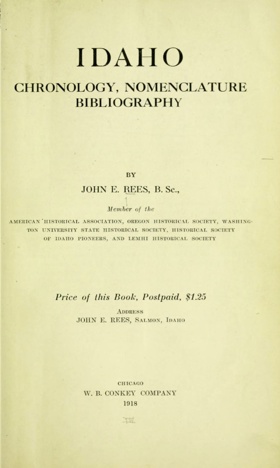
CLEARWATER RIVER, Clearwater County.—This stream is named for its chief characteristic, that of being brilliantly clear and transparent, which name was first applied by the Nez Perce Indians, the whites using the translated word "Clearwater." It has three principal branches, the North, Middle and South forks. It was formerly called by its Nez Perce Indian name, "Koos-koos-kia" (q.v.)
LOLO PASS AND CREEK, Clearwater County.—In very early days an old half-breed hunter and trapper by the name of Lawrence lived among the Flathead Indians and after his death was buried on Lolo Creek, Montana. The creek was named by the Indians for him, but as there is no 'r' in the Flathead vocabulary "Loulou" was as near as they could come in pronouncing the name Lawrence, which the United States Geographic Board has spelled Lolo. This stream flows into the Bitterroot and was called Traveler's Rest Creek by Lewis and Clark. The pass at the head of this creek, which lies between the Clearwater and the Bitterroot rivers, is called Lolo pass and also a small stream flowing into the Clearwater is named Lolo Creek, but originality called by Lewis and Clark Collins Creek (q.r). The Nez Perce Indians crossed thru this pass in 1877 while being pursued by Gen. O. O. Howard.—WHEELER, Trail of Lewis and Clark.
Related Catalog Titles
A Bibliography for Clearwater County, County
Clearwater steam, steel, & spirit by Carole Simon-Smolinski, Anne Weatherill (Illustrator)
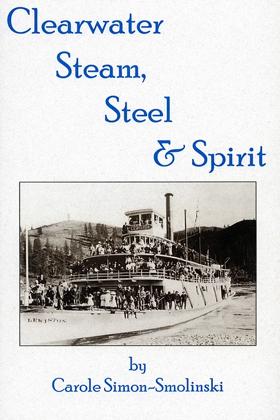
The era of stern-wheel steamboats on the Clearwater River, Idaho, speaks of a quieter time. Sometimes we long to return to that age. Railroads, which played such an important part in the development of that region, are now as much a part of the past as the steamers. Nostalgia carries our thoughts back to those years as well, when time moved slower in a more peaceful setting. But looking back distorts reality. Stern-wheelers and railroad trains moved clocks rapidly forward, catching the wilderness of North Central Idaho up with the modern times of early 20th century America. They played an important role in the development of the Clearwater Country, just as the pioneer spirit left its important legacy. They must not be forgotten. - author
v, 101, [1] pages + [1] page advertisement : illustrations, map, portraits ; 14 x 19 cm
CIRC [ 1 ]
The Clearwater of Idaho by Cecil P. Dryden
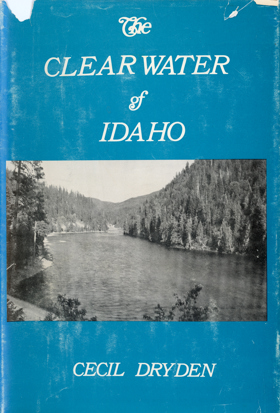
I write about a river I feel close to, having known it for well over a half century. My father's "benchland" ranch was just over the ridge from the narrow valley through which the Clearwater plows its urgent way to sea level. I have observed this river in all its vagaries; its spring rampagings which have set ferries adrift, lifted bridges from their piers, washed out trackage, and inundated highways; its summer somnolence; and its colorful September thinness which brings into view all the sumacbedecked islands, including "turkey-man's paradise," made safe by two channels against marauding coyotes. Although I know something about the land carved by the river, for this story I have relied in large measure on the works of numerous scholars whose research has left a legacy rich in Idaho lore. The book owes a special debt of gratitude to the following: Sister Alfreda Elsensohn for her monumental two-volume History of Idaho County; the late Robert G. Bailey, who produced the indispensable River of Not Return and Hell's Canyon, and his son, R. G. Bailey, Jr., for granting permission to use the photographs from River of No Return. Further, I am indebted to Potlatch Forests, Incorporated, for making available information and photographs. This book is an informal history of the Clearwater drainage area, including borderlands whose history naturally interweaves. I have not attempted to follow in detail all the threads of growth from their beginnings, but have stressed origins and directions in a setting of unfolding dramas. If certain characters and events have been omitted, the reason lies in the selective process that has had to be employed. -The Author, Cecil Dryden
258 pages illustrations 21 cm.
CIRC [ 1 ]
Related Online Resources
Clearwater County
- Ahsahka
- Best Corner
- Bingo Creek Landing
- Blake
- Boehls
- Bruce Eddy
- Brunning
- Cardiff
- Cardiff Mill
- Cavendish
- Cayuse Junction
- Cooper
- Cow Creek
- Cully Moores
- Dent
- City of Elk River
- Five Corners
- Fraser
- Greer
- Haley
- Hansberg
- Headquarters
- Hollywood
- Isabella Landing
- Jaype
- Johnson
- Johnson
- Johnsons Mill
- Judge Town
- Kameron
- Konkolville
- Moose City
- Musselshell
- Neva
- Omill
- Oro Fino (historical)
- City of Orofino
- Peck
- City of Pierce
- Riverside
- Rudo
- Slocum
- Teakean
- The Cedars
- City of Weippe
Political Boundaries
Last updated: 2016-11-29