City of Corvallis Benton County, Oregon
Mapped Location
City of Corvallis: The mapped location is an approximation and should not be used for navigation or wayfinding.
Information
General information on City of Corvallis
- Feature Type: Incorporated
Official, historical, colloquial and alternative toponyms for City of Corvallis
A brief list of names that this geographic feature has been named
| Name | Description |
|---|---|
| City of Corvallis | Official |
| Corvallis | Official |
A Selected Bibliography of City of Corvallis, Benton County, Oregon
A compilation of essential readings detailing the history, geography, and culture of the region.
Corvallis trails exploring the heart of the valley by Margie C. Powell
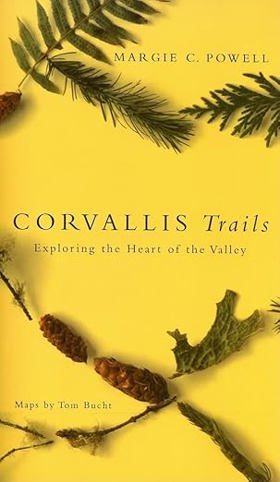
Situated in the heart of the Willamette Valley and nestled against the rolling hills of the Coast Range, Corvallis is an outdoor enthusiast's paradise, renowned for its abundance of parks and natural areas, easily accessed within a few minutes from downtown. This informative, well-organized guide introduces nearly sixty trails, all either in Corvallis or within an hour's drive, and many suited for casual hikers and families with children. In Corvallis Trails, you'll discover close-in recreational opportunities, including walks and short hikes in Corvallis city parks and McDonald Forest. Most of these are easily accessible by foot, bicycle, or public transportation. trails outside of Corvallis but still within easy reach, including Marys Peak, four National Wildlife Refuges, two waterfall walks, and nearby Coast Range outings. The detailed trail descriptions include directions, maps, the length and difficulty of each trail, and a wealth of information on the plants, wildlife, and natural attractions to be found. Also included are accounts of area history and local conservation efforts. Walkers, hikers, runners, mountain bikers, equestrians, and outdoor enthusiasts of all kinds will find this comprehensive guidebook an essential companion as they explore the miles of well-known - and not so well-known - trails in Corvallis and environs.
161 pages : illustrations, maps ; 24 cm
Desiderata
Rogue River War speech of Dr. A.G. Henry, of Yamhill, delivered before the citizens of Corvallis, on the evening of Dec. 3d, 1855 by Anson G. Henry

Delivered by pioneer physician and politician Anson G. Henry, Rogue River War Speech captures a fiery public address given in Corvallis, Oregon, in December 1855 to rally support for military action against Indigenous tribes during the height of the Rogue River Wars. The speech plays upon frontier anxieties, detailing alleged atrocities and framing the violent subjugation of local native populations as an urgent, righteous defense of American settlers. Through contemporary rhetorical appeals, the text preserves the raw, unmasked political panic and racial animosity that drove territorial policy during the Pacific Northwest's Indian wars. A keen insight drawn from the work is how wartime rhetoric deliberately inverted the roles of aggressor and victim; by casting preemptive military campaigns of displacement as defensive humanitarian rescue missions, pro-war leaders successfully mobilized civilian volunteers and legitimized state-sanctioned violence under the banner of civic protection.
41 pages : illustrations ; 19 cm
Non-circulating [ 1 ]
The Library of Oregon State University its origins, management, and growth : a centennial history by William Hugh Carlson, Oregon State University
William Hugh Carlson’s The Library of Oregon State University chronicles the institutional evolution of the academic repository at the heart of Oregon’s pioneer land-grant university in Corvallis. While fundamentally an administrative history, the narrative maps the intellectual and economic maturation of the fertile Willamette Valley and the broader state. By detailing the library's mandate to amass and organize research materials supporting forestry, marine biology, and agricultural sciences, the book illustrates how the sheer physical diversity of Oregon’s landscapes—from its dense coastal timberlands to its expansive inland farming basins—demanded a rigorous scientific infrastructure. Ultimately, the text captures a distinct facet of regional development, demonstrating how the structured curation of knowledge became essential for late-nineteenth and twentieth-century residents to systematically harness and cultivate the formidable natural resources of the Pacific Northwest.
94 pages ; 28 cm
ONLINE Circulation [ 1 ]
Last updated: 2017-01-16