City of Nampa Canyon County, Idaho
Mapped Location
City of Nampa: The mapped location is an approximation and should not be used for navigation or wayfinding.
Information
General information on City of Nampa
- Feature Type: Incorporated
Official, historical, colloquial and alternative toponyms for City of Nampa
A brief list of names that this geographic feature has been named
| Name | Description |
|---|---|
| City of Nampa | Official |
| Nampa | Official |
Origin Notes and History of City of Nampa
References to City of Nampa that document the origin of its place name
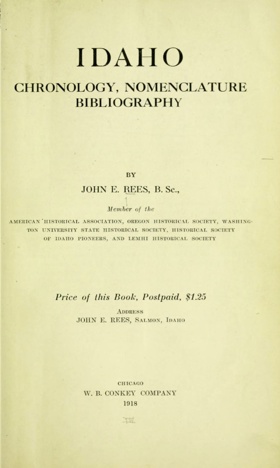
NAMPA, Canyon County.—This is a Shoshoni word meaning '"Namp," "foot" and '"puh" an expression denoting a "bigness," and refers to Chief Bigfoot who was war chief Nampah of the Wihinast which was that branch of the Shoshonis that lived along the Boise River (q.v.). These Indians were known for their large chiefs. Donald Mackenzie states that in 1822 these Indians were governed by Chief Pee-eye-em and a sub-chief, who were brothers, and both fine looking men; the former was six feet two inches high, the latter about six feet, and both stout in proportion. Mackenzie himself, the stoutest of the whites, was a corpulent, heavy man, weighing 312 pounds; yet he was nothing to be compared, either in size or weight, to this Indian chief. His waistcoat was too narrow by fourteen inches to button around Pee-eye- em. Alexander Ross in 1824 said this chief was the great sachem, so frequently and favorably mentioned by his friends on former expeditions. Both himself and his escort were as fine a set of athletic men as he had ever seen in the country. Chief Nampuh was descended from this race of chieftains. He was reputed to have a foot seventeen and one-half inches long and six inches wide and was the hereditary chief of the Wihinast. He was a bold and skillful leader, but given to thievery, horse stealing and murder, which embroiled him and his tribe in the Indian War of 1863. He was killed by the highwayman Wheeler in 1868 during a personal encounter. Pee-eye-em is a Shoshoni word meaning "Pee-ah," "large" and "nim," "Indian" or "Big Indian." The Wihinast were put upon the Fort Hall Indian Reservation (q.v.) at the time it was formed in 1869.—ROSS, Fur Hunters.
Canyon County
- Allendale
- Amsco
- Apple Valley
- Bowmont
- Bugtown (historical)
- City of Caldwell
- Central Cove
- Deal
- Doles
- Enrose
- Fischer
- Fort Boise (historical)
- City of Greenleaf
- Huston
- Josephson
- Karcher Junction
- Kings Corner
- Knowlton Heights
- Maddens
- City of Melba
- City of Middleton
- Midway
- Moss
- City of Nampa
- City of Notus
- City of Parma
- Riverside
- Rookstool Corner
- Roswell
- Simplot
- Sunnyslope
- Swartz Corner
- Tiegs Corner
- Underkoflers Corner
- Walters Ferry
- Warrens
- Weitz
- Westma
- City of Wilder
Political Boundaries
Last updated: 2017-01-10