Fort Vancouver National Historic Site Feature
Mapped Location
Fort Vancouver National Historic Site: The mapped location is an approximation and should not be used for navigation or wayfinding.
Information
General information on Fort Vancouver National Historic Site
- Feature Type: Feature
Official, historical, colloquial and alternative toponyms for Fort Vancouver National Historic Site
A brief list of names that this geographic feature has been named
| Name | Description |
|---|---|
| Fort Vancouver National Historic Site | Official |
Origin Notes and History of Fort Vancouver National Historic Site
References to Fort Vancouver National Historic Site that document the origin of its place name
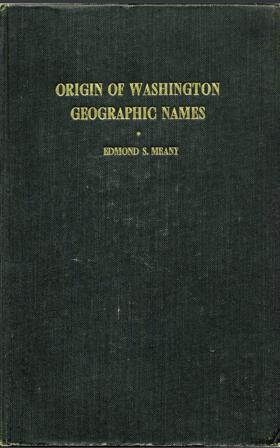
VANCOUVER, a town in the southwestern part of Clarke County, is the oldest continuous home of white men in the State of Washington. See Fort Vancouver, Point Vancouver and Clarke County. Samuel R. Thurston was sent to Congress in 1849 as Oregon Territory's first Delegate. He hated the British and sought to remove their geographic names While he was in Washington, the Post-Master General changed the name of Vancouver to Columbia City. (H. H. Bancroft, Works, Volume XXX., pages 118-119, quoting Oregon Statesman for May 28, 1851.) It is annoying to find Bancroft forgetting this information when writing the next volume of his long series. In Volume XXXI., pages 77-78, he has this footnote: "Vancouver is called Columbia City in the act. This patriotic change of name occurred about 1851 or 1852, but I fail to find any mention of it. I think it was done on the motion of the first postmaster at that place, R H Lonsdale, who had the post-office called Columbia City. The name, however, would not pass in the face of long usage, and the Washington legislature at its second session changed it to Vancouver." The act which named "Columbia City" as the county seat of Clarke County located it "on the east side of Mrs. Esther Short's land claim" and Mrs. Short's house was made the legal place of holding court until the county should provide a more suitable building. (Laws of Washington, 1854, page 475.) James C. Strong says that he and another man surveyed that land into lots, blocks and streets. ("Reminiscenses of a Pioneer," in Washington Historical Quarterly, for July, 1912, page 182.) The act by which "Columbia City" was changed back to the old name of Vancouver may be found in Laws of Washington, 1855, page 44. As explained in items above cited, the Vancouver honored by this city's name was Captain George Vancouver, the great English explorer, who named many geographic features in the Pacific Northwest during the years 1792, 1793, and 1794. His biography may be found in Edmond S. Meany's Vancouver's Discovery of Puget Sound, pages 7 to 21. The Indian name for the site of the city is given as Alashikash. (E. S. Curtis, The North American Indian, Volume VII., page 182.)
A Selected Bibliography of Fort Vancouver National Historic Site, Feature
A compilation of essential readings detailing the history, geography, and culture of the region.
The York Factory Express Fort Vancouver to Hudson Bay, 1826-1849 by Nancy Marguerite Anderson

"Every March between 1826 and 1854, the York Factory Express began its journey from the Hudson's Bay Company's headquarters on the Pacific Ocean. From Fort Vancouver, the express-men paddled their boats up the Columbia River to the base of the Rocky Mountains at Boat Encampment, a thousand miles to the east. At Jasper's House they were 3,000 feet above sea level. Their river route would return them to salt water once more, at York Factory, on the shores of Hudson Bay. It was an amazing climb and an amazing descent, and they would do another climb and descent on their journey home. The stories of the York Factory Express, and of the Saskatchewan Brigades they joined at Edmonton House, are told in the words of the Scottish traders and clerks who wrote the journals. However, the men who made the journey possible are the invisible, unnamed Canadiens, Orkney-men, Iroquois, and their Métis children and grand-children, who powered the boats across the continent every year. The voyageurs did all the heavy work and were almost entirely responsible for the success of the 5,400-mile journey. But their history was oral. If the traders had not preserved the stories the voyageurs told them, we would not know this history today."-- Provided by publisher
295 pages, 24 unnumbered pages of plates : illustrations, maps ; 23 cm
Desiderata
Exploring Fort Vancouver by Douglas Calvin Wilson, Theresa E. Langford
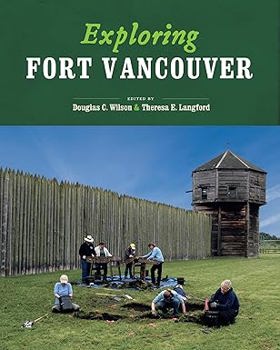
To explore the sweep of human history at Fort Vancouver is to grasp some of the essentials of the North American experience. The fort has been part of the major historical trends of the Pacific Northwest for over 150 years, from the effects of colonialism native peoples to the role of the U.S. Army. Native Americans, traders, homesteaders, and soldiers lived and worked at the fort, their lives interwoven and their stories imbedded in the objects they left behind. Exploring Fort Vancouver uses some of the most intriguing objects from the fort's extensive archaeological and archival collections to tell the history of technology, material culture, globalization, health and diet, and the National Park Service at this significant place.
xii, 116 pages : illustrations (some color), color maps ; 26 cm
Desiderata
Northwest bastion the U.S. Army barracks at Vancouver, 1849-1916 by Ted Van Arsdol, Heritage Trust of Clark County (Wash)
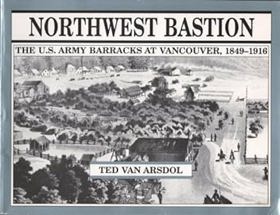
The U.S. Army, obeying the command, arrived May 13, 1849, to establish a military presence north of the Columbia River. The Hudson's Bay Co. moved from the Bastion to Victoria on Vancouver Island and slowly sold or abandoned its holding below the 49th parallel. A new chapter began in American history that year, as the bugle call was heard up and down the Columbia River. The United States extended from "sea to shining sea" and the country began to develop fully its economic, social, and cultural identity. Ch. 1 speaks of the Ninth Regiment stationed at Fort Vancouver and the famous Shanghai drill that was performed daily. The Indian Frontier (1849-1860) is the title of the first chapter. Ch. 2 talks of Volunteers Take Over (1861-1866) because the Civil War was beginning, and an early effect of that war was the removal of most regular Army units. Trained soldiers were required in the East. Some officers resigned and joined the Confede rates. This era at the fort was called the volunteer era. They had to let go of men like Sheridan, Augur, an Ingalls, and a Grant. Ch. 3 is about Pacifying The Natives (1867-1882) and the worry for Indian Tribes in the area. The troops at Vancouver were called out to curb tribes in the surrounding area. By 1882 the last Indian war of the Pacific NW was fought, and transition was under way into a different era. Ch. 4 speaks of Marking Time (1883-1898) because during this time the life of the fort was a round of dinner parties, dances, and theatricals. Ch. 5 is all about preparing troops for overseas duty, hence, Troops For Overseas (1898-1906). They were going "to the front" - artillery troops were leaving for Cuba from Vancouver. And later for the Philippines. Ch. 6 is called, Heading to Armageddon (1907-1916). Germany was exercising an expanding role in Europe at this time. Initially there were no big concerns about building up armed forces. 7 yrs. later this all changed.
xii, 110 pages : illustrations, facsimiles, map ; 22 x 28 cm
Non-circulating [ 1 ]
The March of the mounted riflemen first United States military expedition to travel the full length of the Oregon Trail from Fort Leavenworth to Fort Vancouver, May to October, 1849 : as recorded in the journals of Major Osborne Cross and George Gibbs and the official report of Colonel Loring by Osborne Cross, George Gibbs, William Wing Loring, Raymond W. Settle
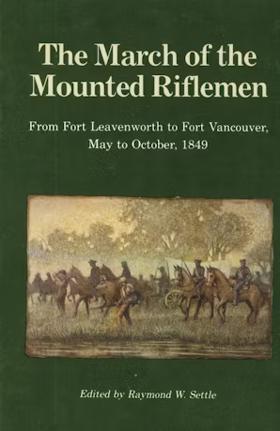
Raymond W. Settle’s edited collection, The March of the mounted riflemen, chronicles the grueling 1849 military expedition across the vast plains, treacherous Rocky Mountain passes, and the rugged Columbia River Gorge along the full length of the Oregon Trail. Set against the formidable continental divide and the regiment's eventual terminus at Fort Vancouver, these primary journals detail how the cavalry operated as a tightly knit, mobile community tasked with protecting the massive influx of pioneer families migrating toward the Willamette Valley. By documenting the shared physical hardships of navigating arid deserts and swollen river crossings, the text reveals how these soldiers and the civilian wagon trains they escorted forged deep cooperative bonds essential for surviving the overland journey. Ultimately, this firsthand military record demonstrates how securing this immense geographic corridor paved the way for the enduring domestic settlements and deeply rooted agricultural communities that would soon define the Pacific Northwest.
The March Of The Mounted Riflemen, First published in 1940, is important as the only complete record of one of the longest marches ever made
378 pages : illustrations ; 21 cm
Non-circulating [ 1 ]
Dr. John McLoughlin's last letter to the Hudson's Bay Company, as chief factor, in charge at Fort Vancouver, 1845 by Katharine Berry Judson, John McLoughlin

Katharine Berry Judson’s presentation of Dr. John McLoughlin's last letter to the Hudson's Bay Company, as chief factor, in charge at Fort Vancouver, 1845 provides a critical primary source documenting the geopolitical tipping point of the Pacific Northwest. Written from the administrative hub of Fort Vancouver—a massive fur-trade headquarters strategically mapped onto the ancient Columbia River trade corridors of the Chinookan peoples—McLoughlin’s correspondence details the inevitable collapse of the British fur monopoly in the face of mass American migration. The letter fiercely defends his controversial decision to extend vital credit, seeds, and supplies to waves of starving overland immigrants, emphasizing how these desperate homesteaders relied on unexpected interdependent alliances with the Hudson's Bay Company to survive the final, brutal stretch of the Oregon Trail. Ultimately, this foundational document captures the tense transition from a corporate resource-extraction frontier to an agricultural territory, highlighting how McLoughlin’s pragmatic humanitarianism and local community bonds inadvertently laid the civic infrastructure for American dominion over the region.
pages 104-134
Desiderata
Last updated: 2016-12-12