Astoria & empire
|
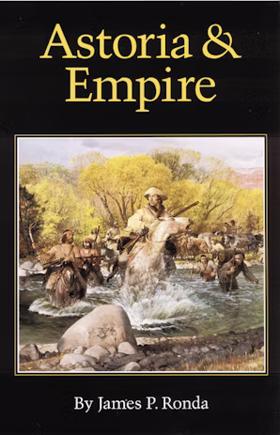
In late December 1788 a worried Spanish official in Mexico City set down his fears about a new and aggressive northern neighbor. Viceroy Manuel Antonio Florez offered a gloomy prediction about the future of Spanish-United States relations in the West. He already knew about the steady march of frontiersmen toward St. Louis and now came troubling word of Robert Gray's ship Columbia on the Northwest coast. All this seemed to fit a pattern, a design for Yankee expansion. "We ought not to be surprised," warned the viceroy, "that the English colonies of America, now being an independent Republic, should carry out the design of finding a safe port on the Pacific and of attempting to sustain it by crossing the immense country of the continent above our possessions of Texas, New Mexico, and California." Canadian fur merchants and Russian bureaucrats also viewed the young republic as a potential rival in the struggle for western dominion. The viceroy's vision of the future proved startlingly accurate. Within the next two decades an American president would authorize a federally funded expedition to find just the sort of transcontinental route Florez imagined. Equally important, a New York entrepreneur would propose and put into motion an ambitious plan to make the Northwest an American political and commercial empire. John Astor's Pacific Fur Company, with Astoria as its central post on the Columbia River, was Florez's nightmare come true. Astoria had long represented either a daring overland adventure or simply a failed trading venture. The Astorians surely had their share of adventure. And the Pacific Fur Company never brought its founder the profits he expected. But all those involved in the extensive enterprise knew it meant more. Thomas Jefferson once described Astoria as the "germ of a great, free and independent empire," believing that the entire American claim to the lands west of the Rockies rested on "Astor's settlement at the mouth of the Columbia." And John Quincy Adams, the expansionist-minded secretary of state, labeled then entire Northwest as "the empire of Astoria." This book seeks to explore Astoria as part of a large and complex struggle for national sovereignty in the Northwest. The Astorians and their rivals were always engaged in more than trading and trapping. They were advance agents of empire. -- from Preface |
| Author(s): | James P. Ronda |
| Document: | Book · Paperback · CIRC [ 1 ] |
| Edition: | 1st Edition |
| Published: | 1990 |
| Physical Description: | xiv, 400 pages : illustrations, maps ; 23 cm |
| Genre: | History |
| Contents: | Astoria: the origins of an imperial idea Planning Astoria The Russian connection To Astoria by sea The overland passage: Montreal to the Arikara Villages From the Arikara Villages to Astoria LIfe at Fort Astoria Astoria at war Astoria in retreat Astoria: the legacy |
| Subjects: | 1800-1899, Astoria (Or.) History, Astoria, Or, Columbia River Valley History, Columbia, Vallée de la Histoire, Fourrures Commerce Oregon Histoire 19e siècle, Fur trade, Fur trade Northwest, Pacific History 19th century, Fur trade Oregon History 19th century, Fur traders, Fur traders Northwest, Pacific, Geschichte Anfänge-1859, History, Northwest |
| Related Places: | City of Astoria |
Circulation
Here are a list of places where this title can be found and the various formats it can be found in.
| Collection | Resource | Available | Edition | Published | Publisher |
|---|---|---|---|---|---|
| The Cascade District: Encyclopedia Library | Book | Paperback | 1st Edition | 1990 | University of Nebraska Press, Lincoln, 1990 |
Last updated: 2026-09-10