Robert Gray 1755-1806
Biographical Abstract
An American merchant sea captain who commanded the first US ship to circumnavigate the globe and became the first known American to explore the Columbia River in 1792.
Robert Gray was an American merchant sea captain who pioneered the United States maritime fur trade along the Pacific Northwest coast during the late eighteenth century. In May 1792, he became the first non-Indigenous explorer to successfully navigate the treacherous sandbar at the mouth of the region's largest river, which he named the Columbia after his ship, the Columbia Rediviva. During his voyages, Gray spent extensive time charting the coastline and trading with Native communities from present-day Oregon up to Vancouver Island's Clayoquot Sound. His documented discovery of the Columbia River ultimately served as the foundational pillar for the United States' successful territorial claims to the broader Pacific Northwest.
Online Resources
Biographical Overview
- Lived from 1755 to 1806
- Born: May 10, 1755, Tiverton, RI
- Died: Jul 1, 1806, At Sea
Historical Events
- No referenced events linked
Bibliography for Robert Gray
A listing of books related by subject
Hail, Columbia! Robert Gray, John Kendrick, and the Pacific fur trade by John Scofield

On the first day of October 1787, captains John Kendrick and Robert Gray, along with fifty other men - sailors and tradesmen alike - set sail from Boston, soon to be the first Yankees to lay eyes on the lush and resource-rich Northwest Coast of North America. This journey, and Gray's subsequent voyage in 1790, were trading ventures that would lead to little wealth for anyone involved, but would supply future generations with rich stories of encounters between the Native Americans and the traders, of desperate escapades along the coast, and, eventually, the reward to the United States of the Columbia River. Kendrick, on board the Columbia Rediviva, and Gray, on the Lady Washington, maneuvered around treacherous Cape Horn, then sailed north up the western coasts to present-day Oregon, Washington, and British Columbia. There they traded with the Indians for the prized sea-otter pelts (called by the Russians "soft gold"). Finally, they would sail for the China ports of Macao and Canton, where they traded the skins for tea and fine china. The American ships had joined a contingent of international vessels (mostly British and Spanish) assembled at Nootka Sound, some to trade, others on voyages of exploration. The two captains eventually would switch ships, and Kendrick would remain on the Northwest Coast, while Gray sailed on to China and to Boston - then back once again. These were the first citizens of the new nation to sail into the Pacific, and the repercussion of their voyages would ring loudly for years to come. The dreamer Kendrick would never return to Boston, choosing to remain on the other side of the world until his death in the Sandwich Islands, late in 1794. The more pragmatic Gray would continue his career as a sea captain into the nineteenth century.
xx, 378 pages : illustrations, maps ; 26 cm.
Non-circulating [ 1 ]
Columbia's river the voyages of Robert Gray, 1787-1793 by J. Richard Nokes

Covers the voyages of Robert Gray from 1787 to 1793 along the Pacific Northwest coast. The two voyages of the American Robert Gray, one began in 1787 and the other in 1790. In 1787, he was captain of the sloop Lady Washington, and entailed trade and discovery in the Pacific Northwest. He switched to captaining the Columbia which he took back to Boston by crossing the Pacific to China, thus becoming the first American to circumnavigating the globe. In 1790 he sailed the Columbia from Boston, around Cape Horn and up the west coast of South and North Americas to the Pacific Northwest.
xviii, 352 pages : illustrations, maps ; 24 cm
Non-circulating [ 1 ]
Astoria & empire by James P. Ronda
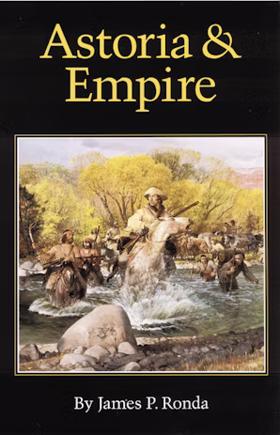
In late December 1788 a worried Spanish official in Mexico City set down his fears about a new and aggressive northern neighbor. Viceroy Manuel Antonio Florez offered a gloomy prediction about the future of Spanish-United States relations in the West. He already knew about the steady march of frontiersmen toward St. Louis and now came troubling word of Robert Gray's ship Columbia on the Northwest coast. All this seemed to fit a pattern, a design for Yankee expansion. "We ought not to be surprised," warned the viceroy, "that the English colonies of America, now being an independent Republic, should carry out the design of finding a safe port on the Pacific and of attempting to sustain it by crossing the immense country of the continent above our possessions of Texas, New Mexico, and California." Canadian fur merchants and Russian bureaucrats also viewed the young republic as a potential rival in the struggle for western dominion. The viceroy's vision of the future proved startlingly accurate. Within the next two decades an American president would authorize a federally funded expedition to find just the sort of transcontinental route Florez imagined. Equally important, a New York entrepreneur would propose and put into motion an ambitious plan to make the Northwest an American political and commercial empire. John Astor's Pacific Fur Company, with Astoria as its central post on the Columbia River, was Florez's nightmare come true. Astoria had long represented either a daring overland adventure or simply a failed trading venture. The Astorians surely had their share of adventure. And the Pacific Fur Company never brought its founder the profits he expected. But all those involved in the extensive enterprise knew it meant more. Thomas Jefferson once described Astoria as the "germ of a great, free and independent empire," believing that the entire American claim to the lands west of the Rockies rested on "Astor's settlement at the mouth of the Columbia." And John Quincy Adams, the expansionist-minded secretary of state, labeled then entire Northwest as "the empire of Astoria." This book seeks to explore Astoria as part of a large and complex struggle for national sovereignty in the Northwest. The Astorians and their rivals were always engaged in more than trading and trapping. They were advance agents of empire. -- from Preface
xiv, 400 pages : illustrations, maps ; 23 cm
Non-circulating [ 1 ]
Entry Details
Related Online Resources
- No external online resources or related links found
Last updated: 2026-09-29