City of Astoria Clatsop County, Oregon
Mapped Location
City of Astoria: The mapped location is an approximation and should not be used for navigation or wayfinding.
Information
General information on City of Astoria
- Feature Type: Incorporated
Official, historical, colloquial and alternative toponyms for City of Astoria
A brief list of names that this geographic feature has been named
| Name | Description |
|---|---|
| City of Astoria | Official |
| Astoria | Official |
Related Catalog Titles
A Bibliography for City of Astoria, Clatsop County, Oregon
Astoria by Chelsea K. Vaughn
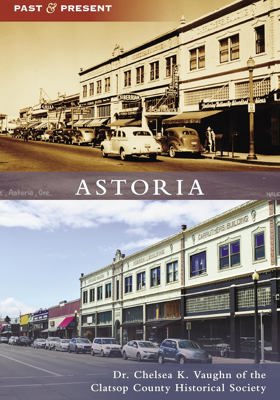
Established in 1811, Astoria, Oregon, holds claim to being the oldest US settlement west of the Rockies. After surviving devastating fires and severe economic downturns, modern Astoria--with its well-preserved historic homes and bustling downtown--is a beacon on the scenic Columbia River. Comparing our present to our past is how we understand our history. Books in this series offer a special view of American life by placing historical images side by side with contemporary photographs.--From back cover
x, 95 pages : illustrations (some color) ; 24 cm.
CIRC [ 0 ]
Astoria an Oregon history by Karen L. Leedom
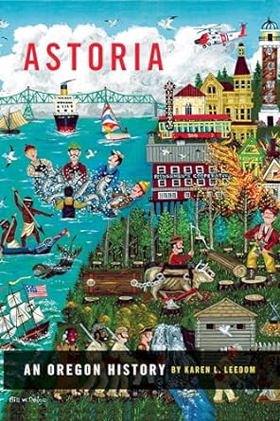
The rest of the country is just beginning to discover Astoria, Oregon, that historic gem of a town at the mouth of the Columbia River west of Portland, and the oldest European-American settlement west of the Rockies. The author provides a chronological look dating back to the 1500s, including European exploration, Native American life, logging, fishing, Chinese laborers in the salmon industry, a giant cheese in the Civil War, Oregon’s first female surgeon, Victorian architecture, and valiant Coast Guard rescues.
vi, 218 pages : illustrations, maps ; 23 cm
CIRC [ 1 ]
Eminent Astorians from John Jacob Astor to the salmon kings by Karen Kirtley, Stephen Dow Beckham
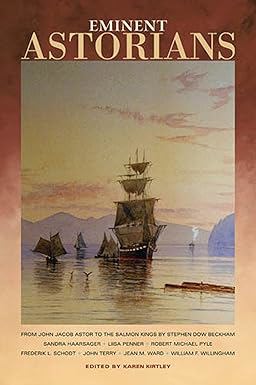
Marks the bicentennial of Astoria in 2011. Each of nine essays presents a literary biography of a figure who looms large in Astoria's history, from Comcomly, the powerful, one-eyed leader of the Chinook Tribe when Lewis and Clark arrived at the mouth of the Columbia River in 1805, to the “Salmon Kings”, who capitalized on the region's natural bounty from the 1870s to the 1910s.
272 pages : illustrations, map ; 23 cm
CIRC [ 0 ]
Astorians, eccentric and extraordinary by Karen Kirtley
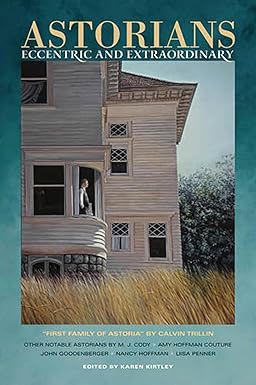
In 1993, The New Yorker published Calvin Trillin’s memorable article on the eccentric Flavel family of Astoria, the descendants of Captain George Flavel, whose ornate Queen-Anne-style mansion is a tourist draw today. With Trillin’s gracious consent, “First Family of Astoria” is reprinted in Part One of Astorians, Eccentric and Extraordinary, making its first appearance in book form. Part Two carries on the theme with portraits of fifty-five other notable Astorians. Five Oregon writers have captured the essence and the flavor of vivid personalities that include the notorious shanghaier Bridget Grant; the charming scoundrel Mayor Francis Clay Harley; the elusive English “barmaid” Jane Barnes, the first white woman in the Pacific Northwest; and Rolf Klep, who believed he could create a major maritime museum in an economically depressed town—and made it happen. In biology, it is said that the richest life forms reside at the edge of the ecosystem. Astoria epitomizes edges—the edge of the country, the edge of a great river, the edge of the Pacific Ocean, and the edge of our American culture. This book celebrates the larger-than-life quality that has appeared with regularity in the town’s two-hundred-year history. As Steve Forrester, publisher of The Daily Astorian, notes in the book’s introduction: “Extraordinary people are not necessarily eccentric. But eccentrics are driven to do extraordinary things.”
224 pages : illustrations, maps ; 23 cm
CIRC [ 0 ]
Astoria & empire by James P. Ronda
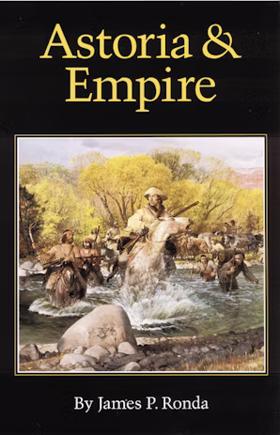
In late December 1788 a worried Spanish official in Mexico City set down his fears about a new and aggressive northern neighbor. Viceroy Manuel Antonio Florez offered a gloomy prediction about the future of Spanish-United States relations in the West. He already knew about the steady march of frontiersmen toward St. Louis and now came troubling word of Robert Gray's ship Columbia on the Northwest coast. All this seemed to fit a pattern, a design for Yankee expansion. "We ought not to be surprised," warned the viceroy, "that the English colonies of America, now being an independent Republic, should carry out the design of finding a safe port on the Pacific and of attempting to sustain it by crossing the immense country of the continent above our possessions of Texas, New Mexico, and California." Canadian fur merchants and Russian bureaucrats also viewed the young republic as a potential rival in the struggle for western dominion. The viceroy's vision of the future proved startlingly accurate. Within the next two decades an American president would authorize a federally funded expedition to find just the sort of transcontinental route Florez imagined. Equally important, a New York entrepreneur would propose and put into motion an ambitious plan to make the Northwest an American political and commercial empire. John Astor's Pacific Fur Company, with Astoria as its central post on the Columbia River, was Florez's nightmare come true. Astoria had long represented either a daring overland adventure or simply a failed trading venture. The Astorians surely had their share of adventure. And the Pacific Fur Company never brought its founder the profits he expected. But all those involved in the extensive enterprise knew it meant more. Thomas Jefferson once described Astoria as the "germ of a great, free and independent empire," believing that the entire American claim to the lands west of the Rockies rested on "Astor's settlement at the mouth of the Columbia." And John Quincy Adams, the expansionist-minded secretary of state, labeled then entire Northwest as "the empire of Astoria." This book seeks to explore Astoria as part of a large and complex struggle for national sovereignty in the Northwest. The Astorians and their rivals were always engaged in more than trading and trapping. They were advance agents of empire. -- from Preface
xiv, 400 pages : illustrations, maps ; 23 cm
CIRC [ 1 ]
Astoria by Washington Irving
Astoria Enterprise beyond the Rocky mountains by Washington Irving

Washington Irving's 'Astoria' chronicles the story of John Jacob Astor's ambitious attempt to establish a trading post on the Columbia River in Oregon in 1810. Irving narrates the adventurous spirit of the pioneers, their encounters with native tribes, and the legacy they left behind. It is a gripping tale of exploration and enterprise, ideal for readers of adventure and history.
xvi, 336 pages ; 22 cm
ONLINE CIRC [ 1 ]
Ross Cox was a fur trader for the Pacific Fur Company. In 1811 he sailed form New York, around the Horn, to Hawaii, and on to the Columbia River, exploring inland to Montana along the Clark Fork and Flathead Rivers. For six years he lived on the frontier--and beyond--in a violent world of white and red men, bears and wolves, frostbite, and starvation. He wasn't a hero, but he was a survivor, and a sharp observer who wrote one of the best firsthand accounts of the fur trapper's life.
340 pages
ONLINE CIRC [ 1 ]
Related Online Resources
Clatsop County
- Arch Cape
- City of Astoria
- Biddle (historical)
- Blind Slough (historical)
- Bradwood
- Brownsmead
- Burnside (historical)
- City of Cannon Beach
- Carnahan
- Chadwell (historical)
- Clifton
- Denver (historical)
- Elsie
- Fern Hill
- Flavel (historical)
- City of Gearhart
- Grand Rapids
- Hamlet
- Jeffers Garden
- Jewell
- Knappa
- Lukarilla
- Melville
- Miles Crossing
- Mishawaka
- Navy Heights
- Necanicum (historical)
- Oklahoma Hill
- Olney
- City of Seaside
- Sunset Beach
- Surf Pines
- Svensen
- Svensen Junction
- Taylorville
- Tideport
- Tolovana Park
- Tongue Point Village
- Uniontown
- Vinemaple
- City of Warrenton
- Wauna
- Westport
Political Boundaries
Last updated: 2017-07-09