Catalog of British Columbiana and Pacific Northwest Americana
Encyclopedia Cascadia Catalog contains book titles of mostly non-fiction Pacific Northwest Coast of North America Titles (primarially British Columbia, Idaho, Oregon and Washington State) in an easy-to-understand title catalog. If you see a link with this badge ONLINE CIRC it means that there is an online institution that provides free access to that title. In some cases there may be more than one institution hosting the title digitally.
| Catalog Title | Published |
|---|---|
|
E. J. Hughes paints British Columbia by Robert Amos , E. J. Hughes 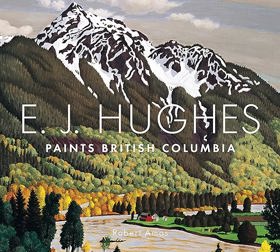
"A retrospective on one of BC's most famous artists that features beautifully reproduced landscape paintings from all over mainland BC, and unveils new photographs, sketches, and ephemera from the artist's estate. E. J. Hughes (1913-2007) is British Columbia's best-loved landscape painter. His lavish, picturesque views of the province are appreciated by art professionals and the public alike. Following the success of his previous volume, E. J. Hughes Paints Vancouver Island, author and artist Robert Amos tracks the footsteps of Hughes as he travelled throughout mainland British Columbia, from Stanley Park to Savary Island, from the Fraser Valley to the Okanagan, and from the Kootenays to the Rockies between the 1930s and 1970s. Working the with Estate of E. J. Hughes, Amos has crafted a nuanced representation of the activities and life of this exceptionally talented and private man. Both biography and monograph, this book features full-page, full-colour reproductions of Hughes's finest paintings, many of them published here for the first time. Each painting is accompanied by supporting sketches, drawings, and photographs from Hughes's personal archive."-- Provided by publisher ix, 189 pages : illustrations (some color), colour map ; 24 x 26 cm CIRC [ 1 ]
|
2019 |
|
Island farming history and landscape of agriculture in the San Juan Islands by Boyd C. Pratt 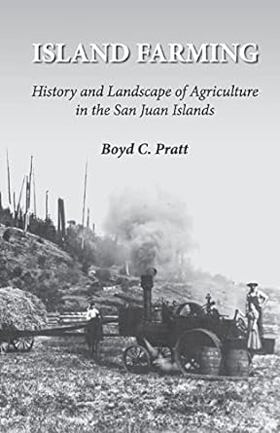
A free-ranging pig that caused an international war; a year's crop of ginseng that paid off a mortgage; and a breachy cow that led to a bloody murder. Farming in the San Juan Islands has always presented challenges and opportunities. From Coast Salish camas cultivation through homesteading to commercial farming, explore the islands' rich agricultural history in the landscape and farms of today. -- from publisher's description vi, 222 pages : illustrations, maps ; 22 cm CIRC [ 1 ]
|
2019 |
|
Lewiston/Clarkston by Samuel D. Hunter 
"LEWISTON: Alice and Connor sit by their roadside stand selling cheap fireworks while developers swallow the land around them. Promised a condo in the new development, their future is secure. Enter Marnie, Alice's long-lost granddaughter, proposing to buy the land to save her family's legacy. Marnie and Alice will become reacquainted with each other's deeply held secrets, uncertain pasts, and hopeful futures. Hunter, a 2014 MacArthur Fellowship recipient, explores the emotional frontiers of a family struggling to make a home in the vastness of the American landscape with affection, poignancy, and a profound sense of empathy."-- Back cover 161 pages ; 21 cm. CIRC [ 1 ]
|
2019 |
|
Sticky wicket over 150 years of cricket on Vancouver Island by John A. Schofield 
"British colonialism, US cultural influences and Canadian immigration policies - these and other forces in Canadian history have helped to shape the evolution of cricket on Vancouver Island. Declared to be the national sport of Canada in the mid-nineteenth century, and today one of the world's most widely played mass spectator sports, cricket has gone largely into the shadows in Canada. Yet the sport retains a committed player base, has become a symbol of Canadian multiculturalism, and has one of the most active cricket communities in the country on Vancouver Island. This in-depth review of a largely overlooked part of the island's social history should appeal not only to those involved in Vancouver Island cricket, but also to historians of sport, local history buffs and enthusiasts of the game beyond Vancouver Island."-- Amazon.ca web site xiii, 178 pages : illustrations ; 23 cm CIRC [ 0 ]
|
2019 |
|
Searching for Pitt Lake gold facts and fantasy in the legend of Slumach by Fred Braches 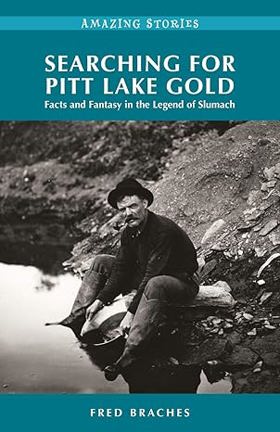
"A smart, concise analysis of the legend of Slumach's Gold, which strives to uncover the truth behind this mythical gold deposit said to be hidden north of Pitt Lake. British Columbia is gold country, and with gold comes legends that have been passed down through the generations. Ever since the Fraser Canyon gold rush, prospectors and adventurers have been looking for a mysterious, exceedingly rich gold deposit in the watershed of Pitt Lake, first mentioned in a small newspaper entry in November 1869. Over time, as the story spread, the man at the centre of this legendary gold start was endowed with the identity of Slum.ook, better known as Slumach, a Katzie man who was ultimately hanged in 1891 for shooting and killing another man in anger. The legend of the gold grew into that of an exceedingly rich deposit known as 'Slumach's gold.' This book presents, unravels, and dissects the legends of the gold of Pitt Lake, and tells the stories of some of the daredevils and venerable prospectors who searched for the mythical gold at their peril."-- Provided by publisher 133 pages : illustrations, maps, portraits ; 22 cm CIRC [ 0 ]
|
2019 |
|
Sixty years in the Scablands a wildlife career in the Palouse Hills in the Pacific Northwest by Gerald Hickman, Tea Joe Hickman, Sabrina Boling 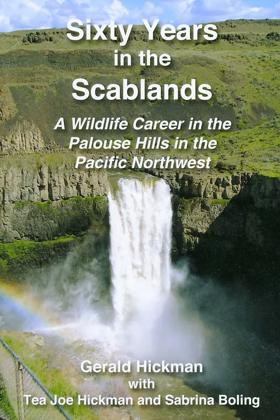
"The author, Gerald Hickman, has lived and worked in the Channeled Scablands since his birth and still lives in Cheney, WA on the northern extent of the geologic area known as the Scablands. The book describes the creation of the Scablands as determined by scientists, the wildlife and people who live there and the author's travels to similar habitats in other parts of our planet from Alaska to Africa." -- Back cover vii, 125 pages : illustrations, maps ; 23 cm CIRC [ 0 ]
|
2019 |
|
The beadworkers stories by Beth H. Piatote 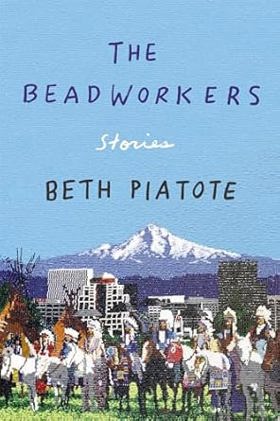
A woman teaches her niece to make a pair of beaded earrings while ruminating on a fractured relationship. An eleven-year-old girl narrates the unfolding of the Fish Wars in the 1960s as her family is propelled to its front lines. A Nez Perce-Cayuse family is torn apart as they debate the fate of ancestral remains in a moving revision of the Greek tragedy Antigone. Told with humor, subtlety, and spareness, the mixed-genre works of Beth Piatote’s first collection draw on Indigenous aesthetics and forms to offer a powerful, sustaining vision of Native life.. Beth Piatote's luminous debut collection opens with a feast, grounding its stories in the landscapes and lifeworlds of the Native Northwest, exploring the inventive and unforgettable pattern of Native American life in the contemporary world. 195 pages ; 22 cm CIRC [ 0 ]
|
2019 |
|
Persistent callings seasons of work and identity on the Oregon Coast by Joseph E. Taylor 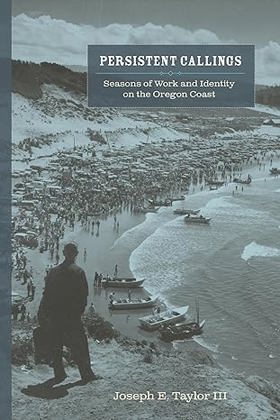
"The Nestucca Valley is a small watershed, tucked away in one corner of a county in far western Oregon. There are no incorporated towns, and cows outnumber humans. It has long been a place without a written history, yet its past offers many surprising twists on received wisdom about rural economies. In crisp prose and succinct chapters, Persistent Callings carries readers from aboriginal times to the present, illustrating the wisdom of seasonal labor, the complex relationships between work and identity, and the resilience of rural economics across more than a century of almost continual change. Life in this watershed, known to locals as 'South County,' has always been demanding. Farming, fishing, and logging were difficult occupations, but work had deeper meanings. Challenges arrived in many forms, including climate shifts, market crashes, regulatory changes, and industry consolidations. Residents' ability to innovate was their greatest resource, and their persistence helps us to recognize the callings they pursued. During the late twentieth and early twenty-first centuries, disruptions came more quickly, and they coincided with infusions of capital that dramatically altered the structure of employment, with devastating results for the valley's hardest working residents. Unemployment and poverty skyrocketed while health and life expectancy dropped to alarming levels. Moreover, the arrival of retirees and rise of environmental amenities actually exacerbated some ecological problems. Little in this history plays out as expected, and much of it will make readers reconsider how they think about the social, economic, and environmental contours of rural life in the American West"-- Provided by publisher viii, 219 pages : illustrations, charts, facsimiles, map ; 23 cm CIRC [ 0 ]
|
2019 |
|
Field guide to the grasses of Oregon and Washington by Cindy Talbott Roché , Richard E. Brainerd , Barbara L. Wilson , Nick Otting , Robert C. Korfhage 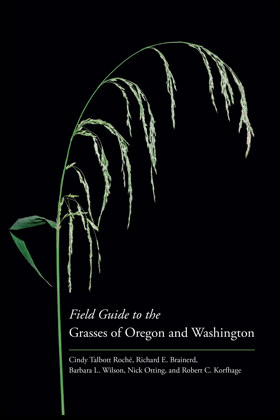
Field Guide to the Grasses of Oregon and Washington is an illustrated guide to all 365 species, subspecies, and varieties of grasses--both native and introduced--that grow wild in Oregon and Washington. It also has broad applicability in neighboring states and provinces. Grasses are important functional components in a variety of ecosystems and are highly valued for habitat restoration in ecosystems ranging from wetlands to deserts, and from sea level to alpine. They are important weeds and are also cultivated as ornamental plants. --Publisher ix, 460 pages : color illustrations, color maps ; 23 cm CIRC [ 0 ]
|
2019 |
|
The new beachcomber's guide to the Pacific Northwest by J. Duane Sept 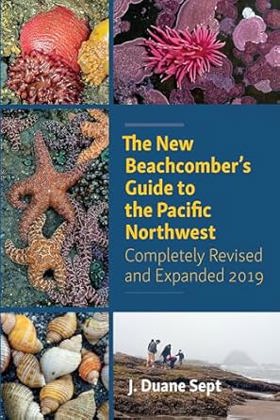
"The Pacific Northwest coast is home to one of the most diverse displays of intertidal marine life in the world. Featuring sponges, clams, snails, crabs, sea stars, sea anemones, jellies, fishes, seaweeds and more, The New Beachcomber's Guide to the Pacific Northwest is a portable and easy-to-use reference for searching out and identifying any of the hundreds of species of seashore life found on the beaches of British Columbia, Washington and Oregon. Covering the Pacific Northwest's most common shoreline-dwelling flora and fauna, each entry contains a detailed description of appearance and habitat accompanied by colour photos for easy identification of any creature you might encounter as you explore your local beach. This guide also provides simple but essential information on tides and the various habitats within the intertidal zones, to assist beachcombers in exploring safely with minimal ecological impact. The Beachcomber's Guide even contains up-to-date descriptions of the best beachcombing sites and when to visit them--you may even find your new favourite exploration grounds! Thoroughly updated and packed with handy and accessible information, this guide belongs in the beach bag or backpack of any avid naturalist, amateur beachcomber or adventurous family."-- Provided by publisher 410 pages : color illustrations ; 23 cm CIRC [ 0 ]
|
2019 |
|
Henry & self a British gentlewoman at the edge of empire by Kathryn Bridge 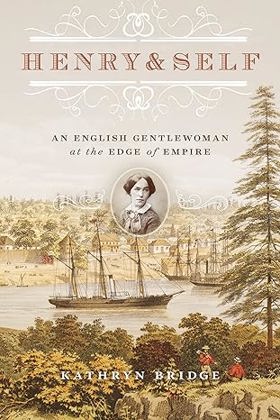
"An intimate portrait of privilege and struggle, scandal and accolade, from the Old World to the new colonies of Vancouver's Island and British Columbia. At the age of 33, Sarah Crease left behind her home in England to travel with her young family to a farflung outpost of the British Empire on the Pacific coast of North America. The detailed journals, letters and artwork she would create over the next half-century as she and her husband, Henry, established themselves in the New World, offer a rich window into the private life and views of an English colonist in British Columbia. In a world where history is still primarily told by men, Henry and Self is a woman's story told in her own words. But it is also a story of the times she lived in, and the ways in which her class, social standing and role as a settler shaped her relationships with the world around her. Henry & Self is the personal story of a remarkable woman who lived through nearly a century of British colonial history, but also a unique first-person perspective on the beliefs and motivations that shaped that history."-- Provided by publisher 234 pages : illustrations, maps ; 23 cm CIRC [ 0 ]
|
2019 |
|
The panic of 1893 the untold story of Washington State's first depression by Bruce A. Ramsey 
"In 1893 Washington, a new state with new people, plunged into the last depression of the 19th century. Banks failed. Railroad building stopped. Money became so scarce that Port Angeles and Bellingham made their own. Jobless men sawed wood, picked blackberries, and dug clams. In Spokane, the town's richest man was wiped out, and from Tacoma and Seattle protesters set off for Washington, D.C., on foot and by stealing rides on trains. In The Panic of 1893, former Seattle newspaper columnist Bruce A. Ramsey tells the story of how people survived and how their resilience defined their new state."-- Back cover 324 pages : illustrations, maps ; 23 cm CIRC [ 1 ]
|
2018 |
|
It takes a river to make a fish by William A. Lansing , Karalynn Ott 
Gone Fishin' is a two-volume set that is hardbound and coffee-table quality. It is filled with superb historical photographs of the recreational and commercial fisheries in the rivers and bays of southwestern Oregon. Volume 1 (182 pages) pays tribute through stories and photographs of the five species of the Pacific Salmon, how they arrived and evolved in the rivers of Oregon. Its title It Takes a River to Make a Fish. Volume 2 (382 pages) pays tribute to the individual rivers from the Umpqua river on the north and the Winchuck on the south near the California border and everything in between. It is filled with stories about Zane Grey and Ginger Rogers, Glen Woolridge and other famous fishermen on each river. Its title It Takes a Watershed to Make a River. Both books the scientific jargon and only have enough statistics to help tell the story. The ocean fishery was omitted. 182 pages : illustrations, maps ; 29 cm CIRC [ 1 ]
|
2018 |
|
It takes a watershed to make a river by William A. Lansing , Karalynn Ott 
Gone Fishin' is a two-volume set that is hardbound and coffee-table quality. It is filled with superb historical photographs of the recreational and commercial fisheries in the rivers and bays of southwestern Oregon. Volume 1 (182 pages) pays tribute through stories and photographs of the five species of the Pacific Salmon, how they arrived and evolved in the rivers of Oregon. Its title It Takes a River to Make a Fish. Volume 2 (382 pages) pays tribute to the individual rivers from the Umpqua river on the north and the Winchuck on the south near the California border and everything in between. It is filled with stories about Zane Grey and Ginger Rogers, Glen Woolridge and other famous fishermen on each river. Its title It Takes a Watershed to Make a River. Both books the scientific jargon and only have enough statistics to help tell the story. The ocean fishery was omitted. 382 pages : illustrations, maps ; 29 cm CIRC [ 1 ]
|
2018 |
|
The glorious mountains of Vancouver's North Shore a peakbagger's guide by David Crerar , Harry Crerar , Bill Maurer 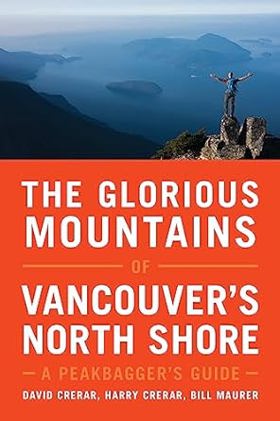
"The beautiful mountains of the North Shore define Vancouver, but few Vancouverites know of the natural beauty and adventure that lies within them, or even their names and history. The Glorious Mountains of Vancouver's North Shore: A Peakbagger's Guide offers something for everyone, from casual hikers to hard-core climbers, from gentle ramblers to ultra-fit trail runners, to parents introducing their children to the splendours of nature, and to those merely curious about what is out there, so close and yet so far. The book provides turn-by-turn route descriptions for climbing 66 North Shore peaks, including exhaustive facts and statistics, special cautions, first ascents, name origins, historic and cultural backgrounds, as well as little-known facts and secrets. Roads and access trails are provided. All peaks feature GPS-based maps, with elevation profiles. The glories of these mountains, creeks and lakes are enticingly illustrated with over 150 colour photographs. Covering all of the hikeable peaks from Capilano in the north, to the Howe Sound Islands in the west and the Seymour-Fannin peaks in the east, this book will encourage you to hop in your kayak or car, on your bike or your own two feet to explore this underappreciated paradise in our own backyard."--Amazon.com 503 pages : color illustrations, color maps ; 23 cm CIRC [ 0 ]
|
2018 |
|
Hells heroes how an unlikely alliance saved Idaho's Hells Canyon by Chris Carlson , Rick Johnson 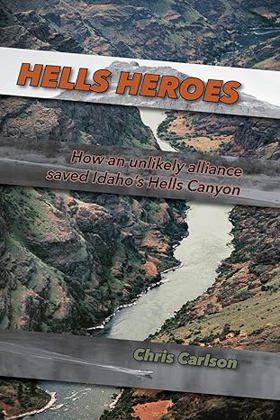
There is a story. There is a story of how Hells Canyon was saved. A story about this special place and special people who care about it. Brock Evans has written that real epics, are not about the deeds of gods and goddesses...Epics are what ordinary people do, rising to scary and demanding occasions and stumbling through them no matter what. Hells Canyon has epic written all over it. One of the West's great rivers slices through it. The rising bluffs and mountains create one of the deepest gorges on earth. The Seven Devils look down from a height of 7,000 feet above the Snake River. But the real epic is in the story of the people who love the place, and of those who worked to save it. 208 pages : color illustrations ; 23 cm CIRC [ 0 ]
|
2018 |
|
Fishes of Idaho a natural history survey by John W. Sigler 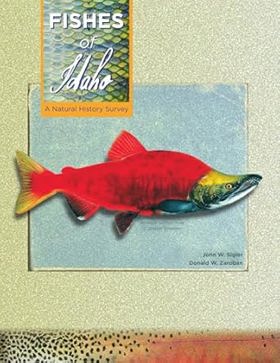
An exhaustive natural survey of all species known to exist in the Gem State, this encyclopedic book provides biologists, naturalists, students and anglers with the most complete reference of its kind. xviii, 794 pages : color illustrations, color maps ; 29 cm CIRC [ 0 ]
|
2018 |
|
Undercurrents from oceanographer to university president by John Vincent Byrne 
Undercurrents recounts the life and career of John Byrne, who started as a geologist at an oil company and retired as president of a major land grant university. He came to Oregon State in 1960 as a faculty member, later becoming department chair, dean, director of the Hatfield Marine Science Center, and vice president for Research and Graduate Studies. Along the way, he took leave from the university to serve the US government, first as a program director for oceanography at the National Science Foundation, and later as the administrator of the National Oceanic and Atmospheric Administration, before returning to OSU in 1984 as its twelfth president. As president of OSU, John Byrne used the lessons learned in industry and government to guide the university through a period of turbulence caused by severe state budget restrictions. During this period of economic contraction, OSU continued under Byrne’s leadership to grow in programs, facilities, and external funding. Byrne was one of the first to introduce Total Quality Management techniques to higher education. He emphasized the importance of international education and was a supporter of significant academic reform in higher education. While focusing on his professional career, Byrne’s memoir also shares personal stories of a childhood and youth shaped by the Great Depression and World War II. Undercurrents demonstrates on every page the curiosity, intellect, and humanity that made John Byrne successful as a scientist, educator, and administrator. Anyone pursuing a career in science or academia, and anyone interested in the history and legacy of land grant universities will welcome this richly detailed and warmly written account of Byrne’s career. 1 online resource CIRC [ 0 ]
|
2018 |
|
Speaking for the river confronting pollution on the Willamette, 1920s-1970s by James V. Hillegas-Elting 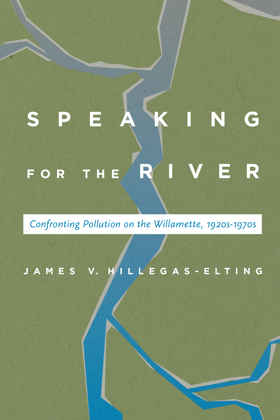
Since the Late 1960s, Oregon has been at the forefront of environmental protection in the United States. The state generally, and Portland in particular, continue to have strong "green" credentials well into the twenty-first century. Within this forty year period of progress, however, the health of the Willamette River has been a consistent blot on the record. Willamette River water pollution has not gone away - the problem has, in fact, gotten much more complex. James Hillegas-Elting's book, Speaking for the River, provides a historical look at this dilemma. Willamette River cleanup efforts between 1926 and 1975 centered on a struggle between abatement advocates and the two primary polluters in the watershed, the City of Portland and the pulp and paper industry. Beginning in 1926, clean streams advocates created ad hoc groups of public health experts, sanitary engineers, conservationists, sportsmen, and others to pressure Portland officials and industry representatives to cease polluting the river. By the late 1960s, these grassroots initiatives found political footholds at the state level. Governor Tom McCall took the issue of environmental protection personally, providing the charisma and leadership that was needed to finally make substantive progress toward cleaning the Willamette. Speaking for the River is the first book to describe the historical roots of Willamette River pollution, providing important context for understanding the political, fiscal, and technological antecedents to the present-day conundrum. Hillegas-Elting's contribution to the academic literature on environmental and urban history in Oregon will be welcomed by policy makers, environmentalists, and concerned citizens alike. Book jacket xiii, 334 pages : illustrations, maps ; 23 cm CIRC [ 0 ]
|
2018 |
|
The troubled life of Peter Burnett Oregon pioneer and first Governor of California by R. Gregory Nokes 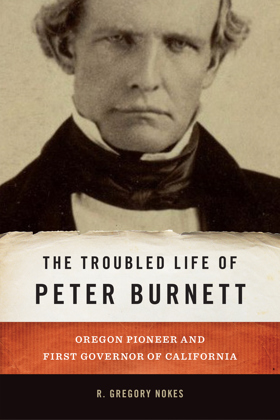
"Few people in the nineteenth-century American West could boast the achievements of Peter Burnett. He helped organize the first major wagon train to the Oregon Country. He served on Oregon's first elected government and was Oregon's first supreme court judge. He opened a wagon road from Oregon to California. He worked with the young John Sutter to develop the new city of Sacramento. Within a year of arriving in California, voters overwhelmingly elected him as the first US governor. He also won appointment to the California Supreme Court. It was one heck of a resume. Yet with the exception of the wagon road to California, in none of these roles was Burnett considered successful or well remembered. Indeed, he resigned from many of his most important positions, including the governorship, where he was widely perceived a failure. Burnett's weakness was that he refused to take advice from others. He insisted on marching to his own drum, even when it led to some terrible decisions. A former slaveholder, he could never seem to get beyond his single-minded goal of banning blacks and other minorities from the West. The Troubled Life of Peter Burnett is the first full-length biography of this complicated character. Historians, scholars, and general readers with an interest in Western history will welcome R. Gregory Nokes' accessible and deeply researched account."-- Provided by publisher xi, 270 pages : illustrations, map ; 23 cm CIRC [ 0 ]
|
2018 |
|
Beginner's luck dispatches from the Klamath Mountains by Malcolm Terence 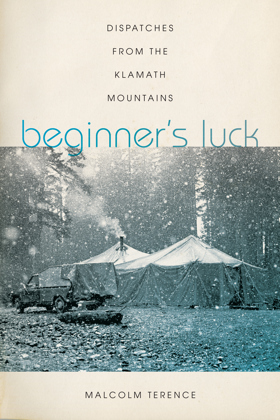
In the late 1960s, Malcolm Terence left his job as a reporter for the Los Angeles Times to look for adventure and may have found more than he bargained for. The era had triggered unprecedented social and political changes in America, tectonic shifts that challenged war and the social order that oppressed people along lines of class, gender, and race. One branch was a back-to-the-land movement, and Terence, who had just traveled for a year managing a rock band, strayed into Black Bear Ranch, a commune just starting in a remote corner of the Klamath Mountains near the California-Oregon border. Black Bear Ranch still exists, but many of its early residents eventually returned to urban civilization. A few, Terence among them, stayed on in neighboring river towns. Some tried logging, others gold mining, and some tried growing marijuana, all with mixed success. The local mining and timber communities had a checkered opinion of their new hippie neighbors, as did the Native tribes, but it was the kind of place where people helped each other out, even if they didn’t always agree. When wildfires grew large, Terence and other veterans of the commune joined the fire crews run by the US Forest Service. In between, the Black Bear expats built homesteads, planted gardens, delivered babies, and raised their children. They gradually overcame the skepticism of the locals and joined them in political battles against the use of herbicides in the forest and the Forest Service’s campaign to close all the mining claims. As in the best of organizing efforts, the organizers learned as much as they led. Beginner’s Luck will appeal to anyone who experienced life on a commune in the 1960s–1970s or who wants to learn about this chapter in modern American history. Terence offers insight into environmental activism and the long history of conflict between resource exploitation and Native American rights without lecturing or pontification. With wit, humor, and humility, his anecdotal essays chronicle a time and place where disparate people came together to form an unlikely community. 236 pages : illustrations ; 23 cm CIRC [ 0 ]
|
2018 |
|
Beyond the rebel girl women and the industrial workers of the world in the Pacific Northwest, 1905-1924 by Heather Mayer 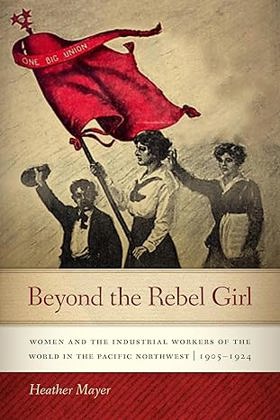
More than a century after their founding in 1905, the Industrial Workers of the World--or Wobblies as they are commonly known--remain a popular subject for study and discussion among students of labor history and social justice. They are often portrayed as lovable underdogs, with their songs and cartoons, generally irreverent attitude, and stalwart courage in the face of systemic persecution from vigilantes, law enforcement, and government officials. In Beyond the Rebel Girl, historian Heather Mayer questions the well-worn vision of Wobblies as young, single, male, itinerant workers. While such workers formed a large portion of the membership, they weren't the whole picture. In small towns across the Northwest, and in the larger cities of Seattle, Portland, and Spokane, women played an integral role in Wobbly life. Single women, but also families--husband and wife Wobbly teams--played important roles in some of the biggest fights for justice. IWW halls in these Northwest cities often functioned as community centers, with family-friendly events and entertainment. Women were drawn to the IWW for its radical vision, inclusionary policies, birth control advocacy, and emphasis on freedom of choice in marriage. The IWW also offered women an avenue for activism that wasn't focused primarily on the fight for suffrage. Beyond the Rebel Girl deepens our understanding of how the WWI functioned and how the union supported women in their fight for birth control, sexual emancipation, and better labor conditions, all while facing persecution at the local, state, and federal levels 204 pages : illustrations ; 23 cm CIRC [ 0 ]
|
2018 |
|
A deadly wind the 1962 Columbus Day storm by John Dodge 
The Columbus Day Storm of 1962 was a freak of nature, a weather outlier with deadly winds topping one hundred miles per hour. The storm killed dozens, injured hundreds, damaged more than fifty thousand homes, and leveled enough timber to build one million homes. To find an equally ferocious storm of its kind, fast-forward fifty years and cross the continent to Superstorm Sandy's 2012 attack on the East Coast. While Superstorm Sandy was predicted days in advance, the Columbus Day Storm caught ill-equipped weather forecasters by surprise. This unrivalled West Coast windstorm fueled the Asian log export market, helped give birth to the Oregon wine industry, and influenced the 1962 World Series. It remains a cautionary tale and the Pacific Northwest benchmark for severe windstorms in this era of climate change and weather uncertainty. From its genesis in the Marshall Islands to its final hours on Vancouver Island, British Columbia, the storm plowed an unparalleled path of destruction. In A Deadly Wind, veteran journalist John Dodge tells a compelling story spiced with human drama, Cold War tension, and Pacific Northwest history. This is a must-read for the tens of thousands of storm survivors, for history buffs, and for anyone interested in the intersection of severe weather events and climate change xvii, 238 pages : illustrations, maps ; 23 cm CIRC [ 0 ]
|
2018 |
|
Sagebrush collaboration how Harney County, Oregon, defeated the takeover of the Malheur National Wildlife Refuge by Peter Walker 
Every American is co-owner of the most magnificent estate in the world—federal public forests, grazing lands, monuments, national parks, wildlife refuges, and other public places. The writer Wallace Stegner famously referred to public lands as “America’s best idea,” but there have always been some who oppose the idea for ideological reasons, or because they have a vested economic interest. In the current decade, federal public lands have been under physical threat as never before, with armed standoffs and takeovers that the US government has proved stunningly unsuccessful at prosecuting in federal courts. One such incident was the takeover of the Malheur National Wildlife Refuge in Harney County, Oregon, in 2016. Armed militants seized the headquarters of the refuge for forty-one days and occupied the community for three months. Militants threatened and harassed local residents, pledging to “give back” the land to unnamed “rightful owners” in their effort to enact a fringe interpretation of the US Constitution. Drawing on more than two years of intensive fieldwork, Sagebrush Collaboration shows that the militants failed in their objectives because the sensible and hardworking citizens of Harney County had invested decades in collaboratively solving the very problems that the militia used to justify their anti–federal government revolution. In Sagebrush Collaboration, Peter Walker offers the first book-length study of why the 2016 takeover of the Malheur National Wildlife Refuge failed. His nuanced and deeply researched account provides the full context for the takeover, including the response from local and federal officials and the grassroots community resistance. It will be essential reading for years to come for anyone who wants to understand the ongoing battle over the future of America’s public lands. xvii, 238 pages : illustrations ; 23 cm CIRC [ 0 ]
|
2018 |
|
The Blues natural history of the Blue Mountains of northeastern Oregon and southeastern Washington by Robert J. Carson (Author, Photographer), Duane Scroggins (Photographer), Bill Rodgers (Photographer), David Frame (Photographer), Kevin R. Pogue (Photographer), Dave Powell (Photographer), Michael E. Denny (Photographer), Merrylynn Denny (Photographer), Clare Carson (Photographer), Donald Snow, Scot 
The Blue Mountains, stretching south of Walla Walla into central Oregon, are one of the Pacific Northwest's iconic mountain ranges. Formed by successive periods of volcanic activity, home to diverse forest and grassland ecosystems, and rich in wildlife, the Blues have long held a special fascination for all who live in and recreate in the range's embrace. Now the Blues' unique natural history is the subject of this new book – the first volume ever to take its readers deep into the story of the range’s creation and history. In geological parlance, the Blue Mountains are a long anticlinal ridge composed mostly of basalt flows, stretching from Clarno, Oregon to Clarkston, Washington. Here, Carson has combined scholarly and elegant writings with the outstanding photography from more than a dozen contributors. The book includes a foreword by Don Snow, an afterword by Scott Elliott, and poems by Katrina Roberts and Janice King. Duane Scroggins, Bill Rodgers, and many others have contributed hundreds of magnificent photographs that draw readers into this incredible region. vii, 208 pages : illustrations (chiefly color), maps (chiefly color) ; 23 x 29 cm CIRC [ 0 ]
|
2018 |