Catalog of British Columbiana and Pacific Northwest Americana
Encyclopedia Cascadia Catalog contains book titles of mostly non-fiction Pacific Northwest Coast of North America Titles (primarially British Columbia, Idaho, Oregon and Washington State) in an easy-to-understand title catalog. If you see a link with this badge ONLINE CIRC it means that there is an online institution that provides free access to that title. In some cases there may be more than one institution hosting the title digitally.
| Catalog Title | Published |
|---|---|
|
An account of a voyage to the north west coast of America in 1785 & 1786 by Alexander Walker, Robin Fisher, J. M. Bumsted 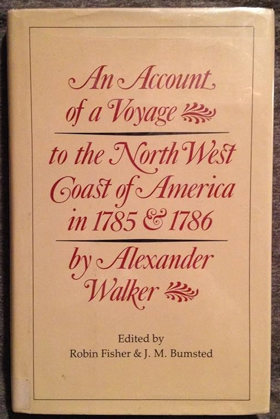
Account of expedition with J.S. Strange to the west coast of B.C. and the southern coast of Alaska. Includes extensive descriptions of the native cultures of Nootka and Prince William Sound 319 pages : illustrations ; 24 cm CIRC [ 1 ]
|
1982 |
|
|
1890 |
|
Among my souvenirs by Bernice C. Molthu 
Collected anecdotes, poems, adages and puns, including The bricklayer's tale 62 pages : illustrations ; 22 cm CIRC [ 1 ]
|
1994 |
|
American Indians of the Pacific Northwest by Elizabeth Von Aderkas, Christa Hook 
The Indian tribes of the Pacific Northwest, on both the Coast and the inland Plateau, were the last to encounter white traders and settlers. When contact occurred in the late 18th century the explorers and traders found two distinct cultures. The fairly recent adoption of the horse had opened up the Plateau tribes to influences from the peoples of the Plains; but the tribes of the Coast lived in a very different culture of rigid class hierarchies, an economy based on fishing and hunting 48 pages : illustrations (some color), maps, portraits (some color) ; 25 cm CIRC [ 1 ]
|
2005 |
|
American burial ground a new history of the Overland Trail by Sarah Keyes 
"This book reinterprets the historic touchstone of the Overland Trail as a story of death and Native activism. Emigrant graves became seeds of U.S. possession across the West. In response Native peoples defended their homelands by pointing to their graves as proofs of Indigenous persistence and enduring territorial claims"-- Provided by publisher 262 pages : illustrations, maps ; 24 cm. CIRC [ 0 ]
|
2023 |
|
America's worst train disaster the 1910 Wellington tragedy by Don Moody 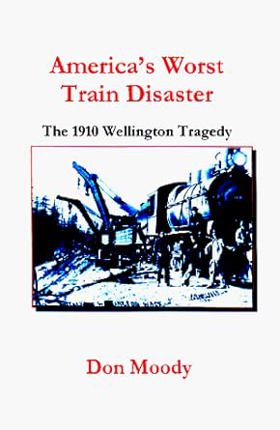
Review from "True Rail Stories" "America's Worst Train Disaster may be about a terrible event back in 1910, but it makes wonderful reading for lovers of steam railroads. It tells of the business pressures driving decisions, decisions that ultimately resulted in over 96 deaths when an avalanche swept a mail and a passenger train down a deep gorge in Washington. According to the author, the trains were trapped in a snowstorm because the railroad undergoing evaluation for a mail contract. Besides that, the railroad also failed to move the trains to a siding which would have saved them from the avalanche. You will find a lot of description of railroad equipment. For example, ever hear of an articulated engine?- one that had a pivot to let it bend in the middle on sharp curves. Of course, there is considerable discussion of equipment and techniques of snow removal. Perhaps you have forgotten that not only passenger trains carried conductors, and the size of snow shoveling crews will amaze you. The book also contains news stories about the trapped trains, the disaster and even good quality photos taken during recovery operations by a newspaper photographer covering the sensational accident. The book contains a view of politics in the days when railroads had the power to mold laws to their liking. Moody obviously feels some of the animosity most people felt toward railroad tycoons. He particularly takes James J. Hill, the founder of the Great Northern Railway to task and suggests that Hill that arranged for the death count to be misstated on the low side. Moody lets no one off the hook in his discussion of the tragedy. He details wild stories newspaper reporters made up about the accident scene in an attempt to stimulate circulation. He tells of social biases against immigrants and uncomplimentary names used to describe foreign workers - not in private conversations but in newspaper columns too. The book does contain typos and errors that may distract the reader, but all in all, Moody did a good job. If railroads are your thing, this book belongs in your collection. 184 pages : illustrations, maps ; 23 cm CIRC [ 1 ]
|
1998 |
|
Always pack a candle a nurse in the Cariboo-Chilcotin by Marion Crook 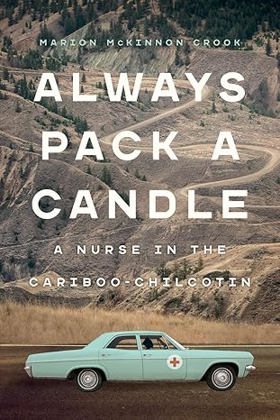
"The true story of an adventurous young nurse who provided much-needed health care to the rural communities of the Cariboo-Chilcotin in the 1960s. In 1962, newly minted public health nurse Marion McKinnon arrived in the small community of Williams Lake in BC's Cariboo region. Armed with more confidence than experience, she got into her government-issued Chevy--packed with immunization supplies, baby scales, and emergency drugs--and headed out into her 9,300-square-kilometre territory, inhabited by ranchers; mill workers; and many vulnerable men, women, and children who were at risk of falling through the cracks of Canada's social welfare system. At twenty-two, a naïve yet enthusiastic Marion relied entirely on her academic knowledge and her common sense. She doled out birth control and parenting advice to women who had far more life experience than she. She routinely dealt with condescending doctors and dismissive or openly belligerent patients. She immunized school children en masse and made home visits to impoverished communities. She drove out into the vast countryside in freezing temperatures, with only a candle, antifreeze, chains, and chocolate bars as emergency equipment. In one year, Marion received a more rigorous education in the field than she had at university. She helped countless people, made many mistakes, learned to recognize systemic injustice, and even managed to get into a couple of romantic entanglements. Pack a Candle is an unforgettable and eye-opening memoir of one frontline worker's courage, humility, and compassion."-- Provided by publisher 278 pages : maps, portrait ; 23 cm CIRC [ 0 ]
|
2021 |
|
Always on call adventures in nursing, ranching, and rural life by Marion Crook 
"In the long-awaited sequel to Always Pack a Candle, intrepid public health nurse Marion Crook juggles marriage, children, and a vast array of patients and cases in rural British Columbia in the 1970s. It has been over a decade since Marion Crook arrived in the Cariboo for her first job out of nursing school. The vast rural territory that once left her awestruck now feels like home, as she embraces life on the ranch with her husband, Carl, three young children, and numerous farm animals. But things are far from idyllic. Overseeing a small staff of irrepressible nurses serving a public health district the size of a small country brings new challenges every day. From runaway patients and needle-phobic hockey players to cultural misunderstandings and heartbreaking cases of abuse and neglect, Marion never knows what is coming next. The 1970s bring signs of social progress as women gain more autonomy and the region grows more culturally diverse. Yet, old prejudices persist, and Marion must fight for her patients, as well as for her adopted son. Recounted with warmth, compassion, and riveting detail, Always On Call is a fascinating portrait of the hectic life of a rural nurse and highlights the importance of the helping professions."-- Provided by publisher 259 pages ; 23 cm CIRC [ 0 ]
|
2024 |
|
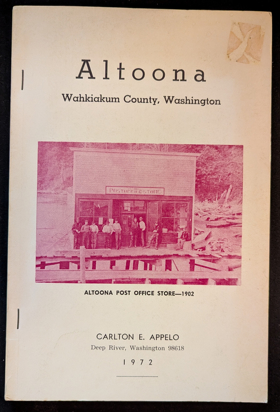
Altoona, Wahkiakum County, Washington by Carlton E. Appelo
|
1972 |
|
Alsea texts and myths by Leo Joachim Frachtenberg
Published in 1920 as a federal bulletin for the Bureau of American Ethnology, linguist Leo Joachim Frachtenberg’s Alsea Texts and Myths presents a meticulously translated, bilingual repository of the oral literature of the Alsea people from the central Oregon coast. Relying on a handful of the last surviving fluent speakers residing on the Siletz Reservation, Frachtenberg rigorously transcribed creation narratives, shamanistic rituals, and animal lore into phonetic notation alongside literal English translations. Designed as a definitive scientific record of a Yakonan language on the verge of extinction, the volume reflects the frantic urgency of the era's "salvage anthropology." A keen insight drawn from the work is how the academic process of textualizing Indigenous oral traditions operated as a subtle mechanism of colonial containment; by severing these sacred narratives from their dynamic, performative contexts and freezing them as rigid, bilingual data points within a government archive, anthropologists effectively neutralized the living cultural power of these myths, transforming them from the active voice of a surviving people into the static, owned property of the American scientific establishment. 304 pages ; 24 cm ONLINE CIRC [ 1 ]
|
1920 |
|
Alpha the classic hills of Alpha Prairie, Washington by Victor J. Kucera 
A history of the area from about 14,000 years ago through the present day. The book also presents a chronicle of the early farm community Alpha Prairie, Washington. Many black and white illustrations and some maps. Also includes an events timeline, endnotes, bibliography and an index. xxiv, 480 pages : illustrations, maps ; 24 cm CIRC [ 1 ]
|
2012 |
|
Along the way by Margaret Lang Hastings
|
1981 |
|
Along the waterfront a history of Gig Harbor and Key Peninsula areas by Goodman Middle School, Gig Harbor, Wash 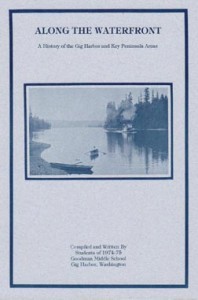
Compiled and written by students of 1974-1975 Goodman Middle School. Gig Harbor, Washington. 130 pages : illustrations ; 21 cm CIRC [ 1 ]
|
1976 |
|
Along the E&N a journey back to the historic hotels of Vancouver Island by Glen Mofford 
"An exploration of the fascinating history of more than thirty historic hotels--with some still in operation--nestled along Vancouver Island's E&N Railway, spanning from Esquimalt to Campbell River. In 1886, Vancouver Island's E&N rail service was established to carry coal to smelters and ships, and the towns in the railway's path prospered as the tracks expanded and passenger travel flourished. Along the E&N celebrates the historic and still-surviving hotels and roadhouses that sprung up near the E&N. Within this carefully researched historical narrative, you'll find stories of the Halfway House in the Esquimalt District, the murder and suicide at the Mt Sicker Hotel, and the iconic Quinsam Hotel in Campbell River, burned down in 2017. This book chronicles the history of more than thirty hotels--many long gone, destroyed by fire, or simply demolished, like the Lorne Hotel in Comox, and others that have been remodelled into modern-day neighbourhood pubs--such as the Rod & Gun in Parksville and the Waverley Hotel in Cumberland. Peppered with the fascinating stories of patrons and proprietors alike, Along the E&N resonates with the haunting echoes of the train's iconic whistle."-- Provided by publisher 263 pages : illustrations, maps, portraits ; 22 cm CIRC [ 1 ]
|
2019 |
|
Almost out of the world scenes from Washington Territory: the Strait of Juan de Fuca, 1859-61 by James G. Swan, William A. Katz
xxiii, 126 pages, 3 unnumbered leaves of plates : map (on lining papers), portraits ; 24 cm CIRC [ 1 ]
|
1971 |
|
All the leavings by Laurie Easter 
"In this nonlinear, loosely chronological memoir, Laurie Easter deftly navigates the rugged terrain of living off the grid in rural southern Oregon, along with the many hazards of the human heart. In quiet, searching, and sometimes experimental essays, she bravely explores the liminal spaces between guilt and forgiveness, life and death, grief and love, human society and the natural world. Whether recounting the home birth of her second child, encounters with cougars, the fraught dynamics of mother-daughter relationships, the destructive power of wildfires, or the community bonds challenged by a tragic suicide, Easter's writing is firmly grounded in place. She takes readers deep into the heart of a still-wild Oregon, perilous yet rich with natural beauty. Written from one woman's perspective as a mother, wife, and friend, All the Leavings is ultimately a book about love-for the child who faces a health crisis, for the friend dying of AIDS, for the one entangled by addiction who then disappears. Long after the final page is turned, it will resonate with readers interested in essays, memoir, alternative lifestyles, and the literature of the West"-- Provided by publisher xi,164 pages ; 23 cm CIRC [ 0 ]
|
2021 |
|
All about Victoria, British Columbia by Alfred Emberson 
Originally published in the late nineteenth and early twentieth centuries, Alfred Emberson’s All About Victoria, British Columbia serves as a comprehensive travel guide and promotional handbook for the rapidly modernizing provincial capital. The book meticulously catalogs the city’s geography, local customs, transportation networks, and burgeoning hospitality industry, effectively marketing Victoria to tourists and potential investors as a sophisticated enclave of British gentility on the edge of the Pacific wilderness. A keen insight drawn from the work is how the early travel guide actively commodified a highly sanitized version of colonial settlement; by charting hotels and scenic attractions while completely omitting the ongoing displacement of the region's Coast Salish peoples, the guidebook sold Victoria not as a contested frontier, but as an exclusive, fully conquered playground designed solely for Anglo-American leisure. 104 pages illustrations 16 cm ONLINE CIRC [ 1 ]
|
1916 |
|
Alexander Robb and the making of British Columbia the life and letters home of an Ulster-Scots pioneer by B. R. D. White , Ulster Historical Foundation (Publisher) 
In 1862 Alexander Robb (1839-1910) was one of a group of young men from County Down, Ireland, who travelled to British Columbia. They were among the thousands seeking to make their fortunes in the goldfields of the Cariboo. Finding no gold and lucky not to starve, Alex got work among the labourers building the Cariboo wagon road. After several years struggling to make a living, he and an Englishman were the first two Europeans to homestead in the Nicola Valley of central British Columbia. Later, appointed by the province as superintendent, he oversaw building the first roads in the valley. In a series of letters to those at home in County Down, Alex told of his experiences as a labourer, rancher and public servant in a young colony that was transitioning into a province of the new Canada. Illness and death in his family took him back to Ireland where he steered the Robb farm successfully through a period of agricultural recession and major political change while continuing his commitment to public service. Alexander Robb’s remarkable story of hardship and perseverance is told along with a full revision of his unique letters. The book also contains insights into the lives of his comrades from County Down and elsewhere who had sought their fortunes in the Cariboo. xi pages, 1 unnumbered page, 177 pages, 20 unnumbered pages of plates : illustrations (some color), maps, portraits ; 24 cm CIRC [ 0 ]
|
2023 |
|
Alberni prehistory archaeological and ethnographic investigations on Western Vancouver Island by Alan D. McMillan, Denis E. St Claire, Alberni Valley Museum
|
1982 |
|
Air, sunlight, and a bit of land by Marian Lowe Quackenbush
|
1982 |
|
Ainsworth, a railroad town by Bette Eunice Meyer, Barbara Kubik
|
1983 |
|
Agents of empire the First Oregon Cavalry and the opening of the interior Pacific Northwest during the Civil War by James Robbins Jewell 
Agents of Empire expands the historiographical scope of Civil War studies to include the war’s intersection with the history of the American West, demonstrating how the war was transcontinental in scope. Much more than a traditional Civil War regimental history, James Robbins Jewell’s work delves into the operational and social conditions under which the First Oregon Cavalry Regiment was formed. In response to ongoing tensions and violent interactions with Native peoples determined to protect their way of life and lands, Colonel George Wright, head of the military’s District of Oregon, asked the governor of Oregon to form a voluntary cavalry unit to protect white settlers and farmers. By using local volunteers, and later two additional regiments of infantry from the region, the federal government was able to draw from the majority of Regular Army troops stationed in the Pacific Northwest, who were eventually sent to fight Confederate forces east of the Mississippi River. Had the First Oregon Cavalry failed to fulfill its responsibilities, the federal government would have had to recall Union forces from other threatened areas and send them to Oregon and Washington Territory to quell secessionist unrest and Indigenous resistance to land theft, resource appropriation, and murder. The First Oregon Cavalry ensured settlers’ security in the Union’s farthest northwest corner, thereby contributing to the Union cause. xxvi, 326 pages : illustrations, maps ; 24 cm CIRC [ 0 ]
|
2023 |
|
Afloat in time by James Sirois 
This is an autobiographical account of experiences with historical BC's logging industry. 271 p., [28] p. of plates : ill., geneal. table, map, ports. ; 22 cm. CIRC [ 1 ]
|
1998 |
|
Ross Cox was a fur trader for the Pacific Fur Company. In 1811 he sailed form New York, around the Horn, to Hawaii, and on to the Columbia River, exploring inland to Montana along the Clark Fork and Flathead Rivers. For six years he lived on the frontier--and beyond--in a violent world of white and red men, bears and wolves, frostbite, and starvation. He wasn't a hero, but he was a survivor, and a sharp observer who wrote one of the best firsthand accounts of the fur trapper's life. 340 pages ONLINE CIRC [ 1 ]
|
1832 |
Four years after Lewis and Clark stimulated American interest in the far western reaches of the continent, John Jacob Astor, a New York businessman, dispatched an overland expedition to establish a fur-trading post on the Columbia River. A second group traveled by sea aboard the Tonquin, among them Alexander Ross, a clerk in Astor's Pacific Fur Company. Adventures of the First Settlers is a vivid account of the expedition and its struggles to establish a successful trading venture. Ross details the Tonquin's dangerous voyage and documents the Astorians' painstaking struggles to clear the land and build a new trading post. Their settlement, Astoria, became the first American outpost on the Pacific Slope. Although the Astorians were aggressive in expanding their presence in the Columbia River country, their enterprise was short-lived. Ross chronicles their competition with the rival North West Company for furs and empire, the colorful and hazardous exploits of the fur trappers, and the eventual transfer of Astoria to the north West Company in the midst of the War of 1812. His detailed descriptions of the Columbia River Indians reveal Ross to be an astute and informed observer. In a new introduction to a book he calls "one of the charter literary documents for the Pacific Northwest," historian William Robbins considers the relationship between exploration, commerce, and empire in the Astorians' experience. An appendix containing a Chinook vocabulary and a table of weather conditions at Astoria in 1811. xv, 352 pages, 1 unnumbered folded leaf of plates + 16 pages advertisements : 1 map ; 19 cm ONLINE CIRC [ 1 ]
|
1849 |