James Cook 1728-1779
British explorer Captain James Cook made a monumental impact on the Pacific Northwest during his third and final voyage in 1778 while searching for the fabled Northwest Passage. After sailing past the coasts of present-day Oregon and Washington, his expedition anchored at Nootka Sound on Vancouver Island, where they repaired their ships and traded extensively with the Indigenous Nuu-chah-nulth people. The sea otter pelts his crew acquired during this stop were later sold in China at astronomical prices, inadvertently sparking a lucrative maritime fur trade that permanently transformed the region's economy and history. Although Cook was killed in Hawaii the following year, his detailed charting of the British Columbian coastline paved the way for subsequent European and American expansion into the Pacific Northwest.
A British explorer, navigator, cartographer, and captain in the Royal Navy.
Biographical Overview
- Lived from 1728 to 1779
- Born: Nov 7, 1728, Marton, Yorkshire, England
- Died: Feb 14, 1779, Kealakekua Bay, Hawaii
Historical Events
- No referenced events linked
Bibliography for James Cook
A listing of books related by subject
Lewis & Clark reframed examining ties to Cook, Vancouver, and Mackenzie by David L. Nicandri , Clay Jenkinson

Spanish, British, and French explorers reached the Pacific Northwest before Meriwether Lewis and William Clark. The American captains benefited from those predecessors, even carrying with them copies of their published accounts. James Cook, George Vancouver, and Alexander Mackenzie--and to a lesser extent fur traders John Meares and Robert Gray--directly and indirectly influenced the expedition. Based on new material as well as revised essays from popular history journals, "Lewis and Clark Reframed" examines several curious and seemingly inexplicable aspects of the journey after the Corps of Discovery crossed the Rocky Mountains. The captains' journals demonstrate that they relied on Mackenzie's 1801 "Voyages from Montreal" as a trail guide. They borrowed field techniques and favorite literary expressions--at times plagiarizing entire paragraphs. Cook's literature also informed the pair, and his naming conventions evoke fresh ideas about an enduring expedition mystery--the identity of the two or three journalists whose records are now missing. Additional journal text analysis dispels the notion that the captains were equals, despite expedition lore. Lewis claimed all the epochal discoveries for himself, and in one of his more memorable passages, drew on Mackenzie for inspiration. Parallels between Cook's and other exploratory accounts offer evidence that like many long-distance voyagers, Lewis grappled with homesickness. His friendship with Mahlon Dickerson lends insights into Lewis's shortcomings and eventual undoing. As secretary of the navy, Dickerson drew from Lewis's troubled past to impede the 1840s ocean expedition set to emulate Cook and solidify America's claim, through Lewis and Clark, to the region.
xxvii, 156 pages : illustrations (some color), maps ; 23 cm
Desiderata
Captain James Cook, R.N., F.R.S., "the circumnavigator" by Arthur Kitson

Authored by Arthur Kitson, Captain James Cook, R.N., F.R.S., "the circumnavigator" offers a comprehensive biographical account of the legendary British explorer and his monumental maritime expeditions. The book traces Cook’s ascent from his early days in the merchant coal trade to his command of three historic global voyages, detailing his meticulous mapping of the Pacific Ocean and his crucial surveys along the Pacific Northwest coastline. Drawing heavily upon Admiralty records and Cook’s own logs, the text captures the immense navigational achievements and devastating final act of a man who fundamentally redrew the map of the world. A keen insight drawn from the work is how Cook's disciplined expeditions marked a pivotal transition in European expansion from speculative treasure-hunting to empirical scientific imperialism; by weaponizing precise cartography and geographic observation, Cook's voyages demonstrated that the true mastery of new frontiers relied on systematic data collection rather than sheer military force.
xvi, 525 pages : facsimiles, folded color map, facsimiles, plates, portraits ; 23 cm
ONLINE Circulation [ 1 ] Non-circulating [ 1 ]
A voyage to the Pacific ocean undertaken, by the command of His Majesty, for making discoveries in the Northern Hemisphere : to determine the position and extent of the west by James Cook, James King
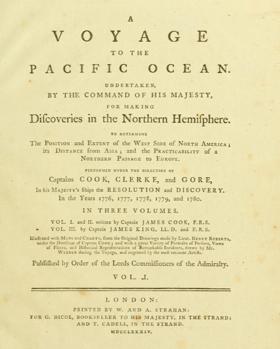
First edition of the account of Captain James Cook's third voyage (1776-1780), consisting of three quarto volumes of text and plates, and one folio atlas, the latter without title-page
3 volumes : 25 illustrations, maps (some folded) ; 30 cm (4to) + 1 atlas (63 leaves of plates (2 folded) : all illustrations, 2 maps, portraits ; 58 cm (folio))
ONLINE Circulation [ 3 ]
Entry Details
Related Online Resources
- No external online resources or related links found
Last updated: 2026-09-30