Bannock County County
Established March 6, 1893 from part of Bingham County, with its county seat at Pocatello. Named for the Bannack Indians, the first inhabitants of the area, whose name was spelled Bannock by early settlers.
Mapped Location
Bannock County: The mapped location is an approximation and should not be used for navigation or wayfinding.
Information
General information on Bannock County
- Feature Type: County
- County Seat: City of Pocatello
- Established: Monday, March 6, 1893
Official, historical, colloquial and alternative toponyms for Bannock County
A brief list of names that this geographic feature has been named
| Name | Description |
|---|---|
| Bannock County | Official |
Origin Notes and History of Bannock County
References to Bannock County that document the origin of its place name
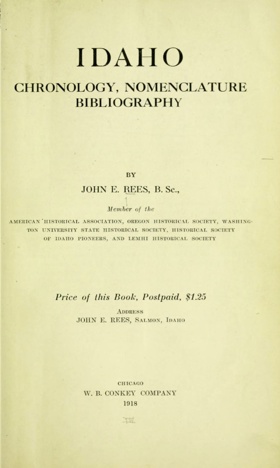
BANNACK.— This name is derived from a tribe of Indians that belong to the Shoshonean family (q.v.). The word is of Shoshoni origin and means "Bamp," "hair" and "naek," "a backward motion," alluding to the manner in which the tribe wore a tuft of hair thrown back from the forehead. "Bamp-naek" was changed to the more euphonious word "Bannack" and is an entirely different word from Bannock (q.v.), which latter is a Scotch word and is always misapplied when used in reference to this tribe of Indians. They call themselves "Panaita," which they claim means "Southern People." Their habitat was the country lying between Raft River (q.v.) and the Portneuf Mountains (q.v.), ceded to them by treaty with Chief Pokatello (q.v.). They were a proud but quarrelsome people; tall, slender and a lighter complexion than the Shoshonis (q.v.), and while averse to manual labor, yet were the bravest Indians of the Rocky Mountain region; they were ofttimes heartless, cruel and bloodthirsty. The men were among the finest looking of their race; the women being noted as the ugliest of western tribes. The country occupied by them lay athwart both the Oregon and Overland trails (7. r.). By various treaties they are now on the Fort Hall Indian Reservation (q.v.) —REES, History of Lemhi County,
BANNOCK.—This word is of Scotch origin and means a thick cake made of oatmeal, baked over the fire. The name is generally used for Bannack (q.v.), although when so used is misapplied.
BANNOCK.—Named for the Bannack Indians (q. v.), but the Scotch word is used. The county seat is Pocatello, named for Chief Pokatello (q.v.).
Related Catalog Titles
A Bibliography for Bannock County, County
Know your town Pocatello, Idaho gate city to the great Northwest by League of Women Voters of Pocatello

Pioneering Pocatello was no picnic by Betty Hale, Leon Jenks
The history of Bannock County, Idaho by Arthur C. Saunders
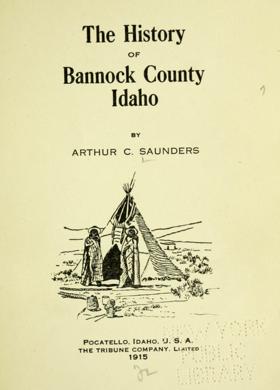
Published in 1915 by Arthur C. Saunders, The History of Bannock County, Idaho provides a localized chronicle of southeastern Idaho’s transition from a vital fur-trading crossroads to a booming agricultural and railroad hub. The volume traces the evolution of the region from the early days of the historic Fort Hall outpost through the aggressive expansion of the Oregon Short Line Railroad, which cemented the city of Pocatello as the undisputed commercial gateway of the state. Typical of early twentieth-century civic literature, the text meticulously documents the commercial achievements of white pioneers while framing the systematic reduction of the Fort Hall Indian Reservation as a necessary, triumphant precondition for modern progress. A keen insight drawn from the work is how the narrative explicitly weds regional prosperity to the legal dispossession of Indigenous lands; by celebrating the federal government's opening of Shoshone-Bannock reservation tracts to white settlement as the county’s crowning economic victory, Saunders illustrates how early frontier boosterism actively conflated the bureaucratic erasure of Native sovereignty with righteous industrial destiny.
143 pages 20 cm
ONLINE CIRC [ 1 ]
Related Online Resources
Idaho State University Special Collections
Special Collections and Archives at the Eli M. Oboler Library, Idaho State University acquires, preserves, and makes accessible research materials that document the historical, cultural, and folk life experience of Southeast Idaho, the Intermountain West, and the history of Idaho State University.
WEB LINKDigital Atlas of Idaho
Idaho's natural history online. One Digital Location for Geography, History, and the natural history of Idaho. Project funded by the Idaho State Board of Education Technology Initiative Grants.
WEB LINK
Bannock County
- City of Arimo
- Blackrock
- Cambridge
- City of Chubbuck
- Dempsey (historical)
- Downata Hot Springs
- City of Downey
- Hawkins
- City of Inkom
- City of Lava Hot Springs
- Marsh Valley
- City of McCammon
- City of Pocatello
- Portneuf
- Red Rock Junction
- Robin
- Swan Lake
- Swanlake
- Topaz (historical)
- Tyhee
- Virginia
- Zenda
Political Boundaries
Last updated: 2016-11-27