Lemhi County County
Established January 9, 1869 with its county seat at Salmon. Named for Fort Lemhi, the L.D.S. Salmon River Mission, which was named for King Lemhi in the Book of Mormon. Lewis and Clark were the first white men in this area.
Mapped Location
Lemhi County: The mapped location is an approximation and should not be used for navigation or wayfinding.
Information
General information on Lemhi County
- Feature Type: County
- County Seat: City of Salmon
- Established: Saturday, January 9, 1869
Official, historical, colloquial and alternative toponyms for Lemhi County
A brief list of names that this geographic feature has been named
| Name | Description |
|---|---|
| Lemhi County | Official |
Origin Notes and History of Lemhi County
References to Lemhi County that document the origin of its place name
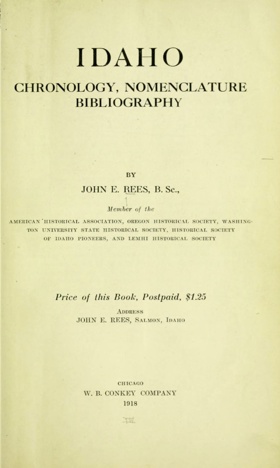
FORT LEMHI, Lemhi County.—This fort was named for Limhi (q.v.), a character in the Book of Mormon. It was never a military post, but a fortification erected to protect the Mormon people who had settled there. It was constructed of mud and built on the river bottom near a creek bank. The walls were moulded in successive forms, made of twelve inch boards, placed one above the other, giving them the appearance of being made in layers. It was nine feet high, two feet wide and more than sixteen rods square with a bastion on the northeast corner. Adjoining the wall on the north was a stockade ten rods square made of ten inch round timbers twelve feet long, set on end three feet in the ground. Within the stockade were erected about twenty-five log cabins and perhaps one hundred people lived about the premises. Stock and machinery were placed in the mud fort while the cabins were shelter and living quarters for the families. They cultivated considerable ground, raising wheat and other farm products, being the first to apply irrigation to the lands in this State. In 1857 Brigham Young, with a considerable retinue, visited this settlement. The Bannack Indians killed two members of this settlement, stole their stock and succeeded in driving them back to Utah. This fort was established in June, 1855, and abandoned in March, 1858.—BANNOCK STAKE.
Related Catalog Titles
A Bibliography for Lemhi County, County
Sacajawea's people the Lemhi Shoshones and the Salmon River country by John W. W. Mann
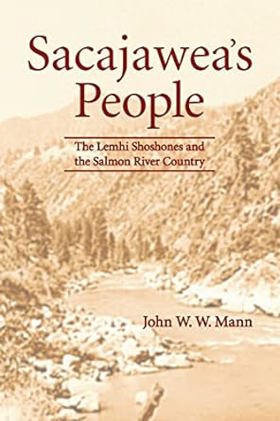
"John W.W. Mann offers an absorbing and richly detailed look at the life of Sacajawea's people before their first contact with non-Natives, their encounter with the Lewis and Clark Expedition in the early nineteenth century, and their subsequent confinement to a reservation in northern Idaho near the town of Salmon. He follows the Lemhis from the liquidation of their reservation in 1907 to their forced union with the Shoshone-Bannock tribes of the Fort Hall Reservation to the south. He describes how for the past century, surrounded by more populous and powerful Native tribes, the Lemhis have fought to preserve their political, economic, and cultural integrity. His compelling and informative account should help to bring Sacajawea's people out of the long shadow of history and restore them to their rightful place in the American story."--Jacket
1 online resource (xxiii, 258 pages) : illustrations, maps
CIRC [ 1 ]
Lewis & Clark in Lemhi County, Idaho August 12-September 4, 1805 by Richard R. Smith
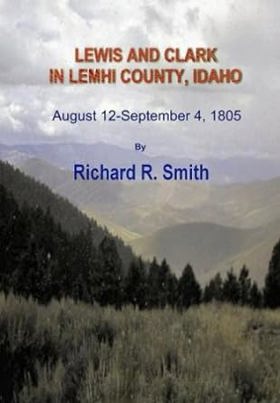
Published by historian Richard R. Smith, Lewis & Clark in Lemhi County, Idaho: August 12-September 4, 1805 meticulously chronicles the Corps of Discovery's harrowing and pivotal traverse through the rugged continental divide. The book details the expedition's difficult encounters with the geography and the Agaidika (Salmon Eater) Shoshone people, highlighting the critical diplomatic negotiations and horse trades that ultimately enabled their passage over the Bitterroot Mountains. Drawing on journal entries, cartographic records, and local terrain analysis, the text traces the exact footpaths and campsites used during this grueling three-week window. A keen insight drawn from the work is how the expedition’s survival in the Salmon River country completely inverted the explorers' geographic expectations; instead of discovering an easy water route across the continent, Lewis and Clark were forced to humble themselves before indigenous mountain pathways, realizing that the West could only be crossed through collaborative reliance on native survival expertise.
v, 56, xi pages : color illustrations, maps ; 28 cm
CIRC [ 1 ]
Fort Limhi the Mormon adventure in Oregon territory, 1855-1858 by David L. Bigler

Published by Utah State University Press, Fort Limhi: The Mormon Adventure in Oregon Territory, 1855–1858 by David L. Bigler chronicles the dramatic and ultimately ill-fated attempt by Brigham Young to establish an outlying Latter-day Saint mission in the remote wilderness of present-day Idaho. The book details the missionaries' grueling efforts to construct a fortified settlement along the Salmon River, cultivate relations with the local Bannock and Shoshone tribes, and build an expansive intermountain empire. Through meticulous archival research and pioneer journals, the text reconstructs the compounding pressures of geopolitical tension, cross-cultural friction, and a violent 1858 raid that forced the colony's sudden abandonment. A keen insight drawn from the work is how the mission exposes the friction between utopian religious expansion and indigenous territorial sovereignty; the enterprise failed not merely due to logistical isolation, but because Mormon colonizers fundamentally underestimated native resistance to having their ancestral homelands converted into a foreign ecclesiastical buffer zone.
372 pages : illustrations, maps ; 25 cm.
CIRC [ 1 ]
Centennial history of Lemhi County, Idaho by Lemhi County History Committee (Lemhi County, Idaho)
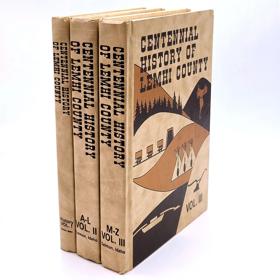
Authored and compiled by the Lemhi County History Committee, the three-volume Centennial History of Lemhi County, Idaho provides an exhaustive archival portrait of settlement, mining, and indigenous displacement in east-central Idaho's rugged mountainous terrain. The comprehensive set documents the turbulent evolution of the Salmon River country from ancestral Shoshone and Bannock homelands into a rugged frontier carved by the 1860s gold rushes, ranching, and copper mining. Through extensive pioneer diaries, family genealogies, and local records, the volumes preserve the granular details of daily survival in an isolated, high-altitude basin. A keen insight drawn from the work is how multi-volume local histories compiled by community committees function as collective acts of self-mythologizing; by meticulously cataloging every homestead and mining claim while glossing over the violent removal of the indigenous population, the collection illustrates how local memory is often curated to enshrine pioneer resilience while institutionalizing the erasure of native sovereignty.
3 volumes : illustrations, maps ; 29 cm
ONLINE CIRC [ 3 ]
Lemhi County
- Baker
- Blackbird
- Carmen
- Cobalt
- Elk Bend
- Forney
- Gibbonsville
- Gilmore
- Hahn
- Junction
- City of Leadore
- Leadville
- Leesburg
- Lemhi
- May
- Nicholia
- North Fork
- Patterson
- City of Salmon
- Shoup
- Tendoy
- Ulysses (historical)
- Williams Lake Resort
- Yellowjacket
Political Boundaries
Last updated: 2016-12-04