Teton County County
Established January 26, 1915, with its county seat at Driggs. It was named for the adjacent Teton mountains and valley. The valley was formerly known as Pierre’s Hole where Indians held their councils and trappers met for their rendezvous.
Mapped Location
Teton County: The mapped location is an approximation and should not be used for navigation or wayfinding.
Information
General information on Teton County
- Feature Type: County
- County Seat: City of Driggs
- Established: Tuesday, January 26, 1915
Official, historical, colloquial and alternative toponyms for Teton County
A brief list of names that this geographic feature has been named
| Name | Description |
|---|---|
| Teton County | Official |
Origin Notes and History of Teton County
References to Teton County that document the origin of its place name
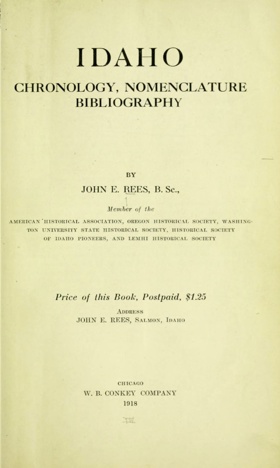
TETON.—Named for the Teton peaks (q.v). The county seat is Driggs, named, in 1888, for A. P. Driggs, a local authority of the Mormon church.
TRIOS TETON.—These are French-Canadian words meaning "three women's breasts," and were applied by the Hudson Bay trappers of Donald Mackenzie's Snake country expedition in 1819. The Shoshonis called them "Tee-win-at," meaning the '''pinnacles." The people of the Hunt-Astoria party (q.v.) were the first white persons to discover them, and as the peaks can be seen for more than a hundred miles and were used as guiding objects by this party, they called them the "Pilot Knobs." They are the most noted peaks in the Rocky Mountains, the highest, Grand Teton, can be seen a great distance and has long served as a landmark for trappers and pioneers. The Teton range is but sixty miles long and lies twenty-five miles southwest of the Yellowstone National Park. It is crossed by Teton pass about twenty miles south of Grand Teton, which was the principal thorofare across the Rocky Mountains in very early days.—ROSS, Oregon Settlers.
Related Catalog Titles
A Bibliography for Teton County, County
History of Teton Valley, Idaho by B.W. Driggs

Published in 1926 by local attorney and pioneer descendant Benjamin Woodbury Driggs, History of Teton Valley, Idaho chronicles the transformation of the high-altitude Teton Basin—historically known as Pierre's Hole—from a seasonal Indigenous gathering ground and legendary fur-trade rendezvous into a settled agricultural community. The narrative explicitly bridges two distinct eras: the romanticized, lawless epoch of early mountain men and the subsequent, highly organized colonization of the valley by Mormon (LDS) pioneers. Driggs meticulously records the foundational efforts of these early agrarian settlers, emphasizing their communal resilience in taming a harsh, isolated environment and establishing permanent civic and religious institutions on the eastern edge of Idaho.
A keen insight drawn from the work is how the narrative strategically bifurcates the frontier experience to legitimize permanent settler occupation; by romanticizing the early fur trade era as a chaotic, adventurous prelude dominated by transient white trappers and shifting Native American tribes, Driggs effectively frames the subsequent arrival of Mormon pioneers not as an invasion, but as the valley's inevitable maturation into civil order. This historiographical maneuver subtly consigns Indigenous peoples to a closed chapter of frontier antiquity, ensuring that the eventual agricultural enclosure of the Teton Valley is celebrated as the righteous, divinely ordained culmination of American progress rather than an ongoing act of territorial dispossession.
227 pages, 9 unnumbered leaves of plates
ONLINE CIRC [ 1 ]
Teton County
- Bates
- Cache
- Cedron
- Chapin
- Clawson
- Clementsville
- Darby
- City of Driggs
- Felt
- Fox Creek
- Haden (historical)
- Judkins
- Sam
- City of Tetonia
- The String
- Twin Forks
- Two Forks
- City of Victor
Political Boundaries
Last updated: 2016-12-03