Twin Falls County County
Established February 21, 1907 with its county seat at Twin Falls. Named for the nearby waterfalls on the Snake River. A station line was established at Rock Creek in 1864 for the Ben Holladay Stage Line. The Twin Falls South Side project brought water to thousands of acres of arid land in 1904 and became one of the most successful of the Carey Act irrigation projects.
Mapped Location
Twin Falls County: The mapped location is an approximation and should not be used for navigation or wayfinding.
Information
General information on Twin Falls County
- Feature Type: County
- County Seat: City of Twin Falls
- Established: Thursday, February 21, 1907
Official, historical, colloquial and alternative toponyms for Twin Falls County
A brief list of names that this geographic feature has been named
| Name | Description |
|---|---|
| Twin Falls County | Official |
Origin Notes and History of Twin Falls County
References to Twin Falls County that document the origin of its place name
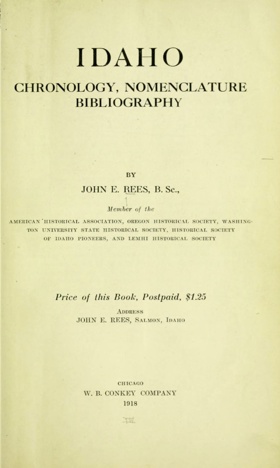
TWIN FALLS.—Named for the Little or Twin Falls of the Snake River. The county seat is Twin Falls, named for the same.
Related Catalog Titles
A Bibliography for Twin Falls County, County
Twin Falls centurybook, 1904-2004 by Mary J. Inman
Published to commemorate the city's centennial, Twin Falls Centurybook, 1904–2004 by Mary J. Inman chronicles the dramatic transformation of a windswept southern Idaho sagebrush desert into a thriving agricultural oasis. The book details the monumental irrigation engineering projects spearheaded by visionary developers like Stanley Milner and I.B. Perrine, who harnessed the Snake River to turn thousands of arid acres into fertile farmland. Through archival photographs, local biographies, and municipal records, the text captures the tenacity of early homesteaders who built a bustling community from the ground up. A keen insight drawn from the work is how planned irrigation settlements inverted the traditional timeline of frontier town-building; rather than organic towns gradually attracting infrastructure, Twin Falls was deliberately engineered into existence on paper before the water even arrived, proving that modern high-desert agriculture is an artifact of sheer corporate and hydraulic will.
v, 226 pages : illustrations, maps ; 22 cm
CIRC [ 1 ]
In the middle and on the edge the Twin Falls region of Idaho by James R. Gentry, College of Southern Idaho, Twin Falls Centennial Commission
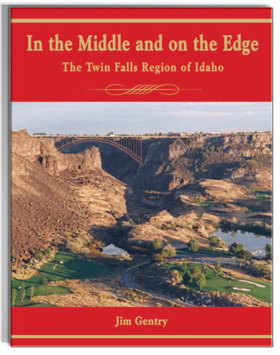
Dr. Jim Gentry arrived in Twin Falls in 1969 at the age of 23 to begin teaching history at the College of Southern Idaho. Having lived in five other states, Jim was glad to have found "his home". That love encouraged historical research and an ongoing fastination with local history. This book illustrates a concept that took shape early in Jim's study; that this region was in the middle and on the edge even before Twin Falls was founded in 1904
xvi, 413 pages : illustrations, maps ; 23 cm
CIRC [ 1 ]
History of Hansen, Idaho, 1904-1984 by Frances Harris

Twin Falls County
- Abbey (historical)
- Amsterdam
- Anderson Place
- Artesian City
- Austin (historical)
- Berger
- Bergstrom Place
- Bickel (historical)
- Bills
- City of Buhl
- City of Castleford
- Cedar
- Clover
- Curry
- Deep Creek
- Duncan Place
- Fairview
- City of Filer
- Godwin
- Greys Landing
- Hand Place
- City of Hansen
- Harrell Place
- Hoelzle Place
- City of Hollister
- Indian Jim Place
- City of Kimberly
- Knull
- May Place
- McMillan
- Milner
- City of Murtaugh
- Peavey
- Player Place
- Rock Creek
- Rock House Place
- Rogerson
- Roseworth
- Striker
- Threemile Crossing
- City of Twin Falls
- Vosburg Place
Political Boundaries
Last updated: 2016-12-03