Catalog of British Columbiana and Pacific Northwest Americana
Encyclopedia Cascadia Catalog contains book titles of mostly non-fiction Pacific Northwest Coast of North America Titles (primarially British Columbia, Idaho, Oregon and Washington State) in an easy-to-understand title catalog. If you see a link with this badge ONLINE CIRC it means that there is an online institution that provides free access to that title. In some cases there may be more than one institution hosting the title digitally.
| Catalog Title | Published |
|---|---|
|
History of the flower bulb industry in Washington State by Charles J. Gould 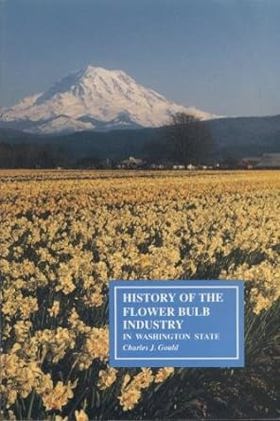
Published by the Washington State University Agricultural Experiment Station and authored by plant pathologist Charles J. Gould, History of the Flower Bulb Industry in Washington State details the remarkable mid-20th-century rise of commercial bulb production in the Pacific Northwest. The text chronicles how immigrant growers and agricultural innovators capitalized on the region's mild, maritime-influenced climate—particularly in the Puget Sound and Skagit valleys—to successfully rival traditional European floral markets. Through detailed historical accounts and horticultural data, the book documents the labor-intensive cultivation of daffodils, tulips, and iris that transformed local farmland into vibrant floral landscapes. A keen insight drawn from the work is how regional agricultural booms often rely on imported microclimates; by identifying that Western Washington's cool, damp springs closely mirrored the prized growing conditions of the Netherlands, the industry proved that niche economic success can be engineered by aligning local ecological quirks with international market demands. ix, 309 pages : illustrations, maps ; 23 cm CIRC [ 1 ]
|
1993 |
|
History of the Columbia River Valley from the Dalles to the sea by Fred Lockley 
Authored in 1928 by prominent Oregon journalist and historian Fred Lockley, History of the Columbia River Valley from the Dalles to the Sea is an exhaustive, multi-volume subscription history detailing the commercial and civic maturation of the region's most vital geographic artery. Tracing the lower Columbia corridor's evolution from the era of maritime exploration and the fur trade to the booming industrialization of Portland and Astoria, Lockley leverages his extensive career interviewing early settlers to weave personal pioneer reminiscences into a broader narrative of regional development. Like many commercial histories of its era, the primary historical account is heavily subsidized by subsequent volumes of flattering biographical sketches profiling local merchants, industrialists, and pioneer descendants, serving as a sprawling civic monument to the capitalist triumph of the local elite. A keen insight drawn from the work is how Lockley’s narrative structurally redefines the Columbia River itself, conceptually transforming it from an ancient, highly complex network of Indigenous civilization and sustenance into a mere logistical conduit for Anglo-American capitalism. By framing the "history" of the river valley almost exclusively around the establishment of trading posts, the advent of steamboat navigation, and the extraction of timber and salmon for global markets, the text actively erases millennia of Chinookan and other Native sovereignties. This historiographical maneuver successfully commodifies the landscape, validating the colonial project by teaching readers that the true destiny of the great river was not to sustain the Indigenous societies that had managed it for centuries, but to serve as a passive, exploitable highway for modern industrial empire. 3 volumes : frontispiece, illustrations, plates, portraits ; 27 cm ONLINE CIRC [ 1 ]
|
1928 |
|
History of Teton Valley, Idaho by B.W. Driggs
Published in 1926 by local attorney and pioneer descendant Benjamin Woodbury Driggs, History of Teton Valley, Idaho chronicles the transformation of the high-altitude Teton Basin—historically known as Pierre's Hole—from a seasonal Indigenous gathering ground and legendary fur-trade rendezvous into a settled agricultural community. The narrative explicitly bridges two distinct eras: the romanticized, lawless epoch of early mountain men and the subsequent, highly organized colonization of the valley by Mormon (LDS) pioneers. Driggs meticulously records the foundational efforts of these early agrarian settlers, emphasizing their communal resilience in taming a harsh, isolated environment and establishing permanent civic and religious institutions on the eastern edge of Idaho. A keen insight drawn from the work is how the narrative strategically bifurcates the frontier experience to legitimize permanent settler occupation; by romanticizing the early fur trade era as a chaotic, adventurous prelude dominated by transient white trappers and shifting Native American tribes, Driggs effectively frames the subsequent arrival of Mormon pioneers not as an invasion, but as the valley's inevitable maturation into civil order. This historiographical maneuver subtly consigns Indigenous peoples to a closed chapter of frontier antiquity, ensuring that the eventual agricultural enclosure of the Teton Valley is celebrated as the righteous, divinely ordained culmination of American progress rather than an ongoing act of territorial dispossession. 227 pages, 9 unnumbered leaves of plates ONLINE CIRC [ 1 ]
|
1926 |
|
History of southern Oregon, comprising Jackson, Josephine, Douglas, Curry and Coos counties by Albert G. Walling 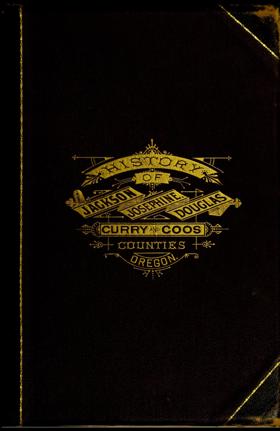
545, [1] pages, [126] leaves of plates : illustrations, folded maps, portraits ; 30 cm ONLINE CIRC [ 1 ]
|
1884 |
|
History of Portland, Oregon by H. W. Scott 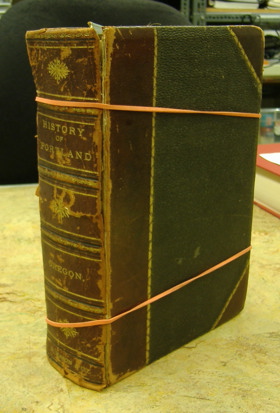
Published in 1890 and compiled by Harvey W. Scott, the formidable long-time editor of The Oregonian, History of Portland, Oregon offers a sweeping civic chronicle of the city's rise from a muddy clearing on the Willamette River to the dominant commercial metropolis of the Pacific Northwest. The exhaustive volume details early municipal struggles, infrastructural triumphs, and the fiercely competitive navigation of regional river trade, culminating in extensive biographical sketches of the city's pioneer elites. A keen insight drawn from the text is how Scott leverages his dual authority as a historian and the region's most powerful journalist to actively manufacture, rather than merely record, Portland's civic mythology. By inextricably linking the city's economic progress to the moral and financial virtues of its conservative merchant class, the book functions as a sophisticated ideological tool designed to cement the hegemony of the local business establishment while deliberately marginalizing labor movements and competing frontier narratives. 651 pages, 69 unnumbered leaves of plates : illustrations, portraits ; 26 cm ONLINE CIRC [ 1 ]
|
1890 |
|
History of Polk County, Oregon by Polk County Historical Society (Polk County, Or) 
History of Polk County, Oregon by the Polk County Historical Society is a comprehensive 1987 regional compilation detailing the pioneer heritage and civic development of this Willamette Valley community. The extensive volume features rich local family biographies, archival photographs, and detailed accounts of early settlements, agricultural growth, and municipal institutions. Ultimately, it serves as an essential genealogical and historical reference that preserves the personal stories and foundational milestones of Polk County's earliest residents. 301 pages : illustrations ; 29 cm CIRC [ 1 ]
|
1987 |
|
History of Pierce County, Washington by W. P. Bonney 
Published in 1927 by William P. Bonney, the long-serving secretary of the Washington State Historical Society, History of Pierce County, Washington is an exhaustive, multi-volume civic chronicle detailing the rapid industrial and demographic transformation of the southern Puget Sound. The text traces the region's development from the early commercial operations of the Hudson's Bay Company at Fort Nisqually and the contentious Medicine Creek Treaty, through the violent Puget Sound War of 1855–1856, culminating in the massive economic boom sparked by Tacoma securing the terminus of the Northern Pacific Railroad. Following the established model of commercial pioneer literature, the primary historical narrative is heavily subsidized by subsequent volumes of flattering biographical sketches of local merchants, politicians, and industrialists, effectively functioning as a sprawling monument to the capitalist triumph of the local elite. A keen insight drawn from the work is how the institutionalization of local history was utilized to posthumously litigate and justify the most controversial acts of frontier violence; by framing the Puget Sound War and the deeply contested execution of Nisqually Chief Leschi as tragic but necessary assertions of territorial law, Bonney's narrative effectively absolves the pioneer government of its aggressive, fraudulent land seizures. By anchoring the legal origins of Pierce County in the triumph of martial and judicial order over Indigenous resistance, the text actively sanitizes the violent foundations of Tacoma's industrial prosperity, demanding that readers accept the systemic dispossession of the Nisqually and Puyallup peoples not as a localized atrocity, but as the unavoidable, legally sanctioned price of modern civic civilization. 3 volumes : illustrations, portraits ; 28 cm CIRC [ 2 ]
|
1927 |
|
History of Pend Oreille County by Tony Bamonte, Suzanne Bamonte 
Authored by regional historians Tony and Suzanne Bamonte, History of Pend Oreille County chronicles the rugged development of northeastern Washington through an extensive compilation of historic photographs and archival narratives. The book details the arduous transition of the remote river valley from an indigenous seasonal hunting ground and fur-trading route into a bustling hub of timber harvesting, hardrock mining, and steam-boat navigation. Through its detailed local chronicle, the text captures the tenacity of the pioneer families and industrial workers who carved out permanent settlements along the treacherous banks of the Pend Oreille River. A keen insight drawn from the work is how river systems in the Inland Northwest served simultaneously as lifelines and barriers; while the waterway provided the only viable transportation corridor for hauling timber and supplies out of the dense mountainous terrain, its unpredictable rapids and waterfalls also enforced an intense geographic isolation that kept the county's communities tethered to boom-and-bust resource economies for generations. xv, 271 pages : illustrations, maps, portraits ; 29 cm CIRC [ 1 ]
|
1996 |
|
History of Oregon Territory by Thomas Jefferson Farnham 
The ""History Of Oregon Territory"" is a book written by Thomas Jefferson Farnham in 1844. It provides a detailed account of the exploration and settlement of the Oregon Territory, which at the time included present-day Oregon, Washington, Idaho, and parts of Montana and Wyoming. The book covers the early expeditions of Lewis and Clark, as well as the later efforts of fur traders and missionaries to establish a presence in the region. Farnham also describes the conflicts between the Native American tribes and the white settlers, as well as the political tensions between the United States and Great Britain over control of the territory. 105 pages : illustrations, maps ; 24 cm CIRC [ 1 ]
|
1981 |
|
History of Oregon literature by Alfred Powers , Bernard Hinshaw (Illustrator)
7 preliminary leaves, [3]-809 pages (including frontispiece) : portraits, plates, facsimiles ; 23 cm ONLINE CIRC [ 1 ]
|
1935 |
|
History of Oregon literature by Alfred Powers , Bernard Hinshaw (Illustrator)
7 preliminary leaves, [3]-809 pages (including frontispiece) : portraits, plates, facsimiles ; 23 cm CIRC [ 1 ]
|
1935 |
|
History of Oregon by Hubert Howe Bancroft
The more remote in Oregon affairs has been given in my History of the Northwest Coast, which is indeed a part of the History of Oregon, as elsewhere explained. The later volumes deal with events which occurred within the memory of men now living; they are wrought out from yet more original sources, a large proportion of the facts herein presented never having before appeared in print. 2 volumes : illustrations (maps) folded map ; 24 cm ONLINE CIRC [ 2 ]
|
1888 |
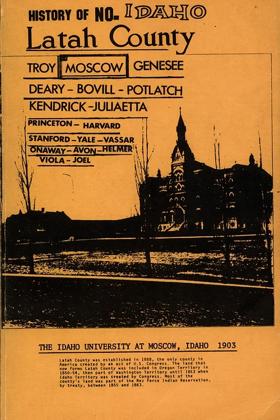
From the forward by Simon K. Benson: “This new addition of Early History of North Idaho, but more particular the history of Latah County, Moscow (Paradise City) 1871, Troy (Huff Gulch) our first home after World War II. Some of the history first came out in a limited edition in 1903. I have republished with permission and the desire of many of the families, and chiefly as a tribute to my father-in-law Guy Senter (now deceased). “The book is a valuable reference work on early Northern Idaho and Latah County history from the explorations into the old Oregon territory, of which the counties of Northern Idaho were once a part. “This book can bring knowledge, enjoyment and memories for anyone who reads it. Books can have a wide distribution and bring joy as an ideal gift. “Perhaps everyone who ever lived in Latah County or had a parent or grandparent who did, can once again relive the nostalgic, exciting pages of the past. ‘Let’s live to give, learn, love, and remember.’” (276 pages) 276 pages : illustrations, portraits ; 21 cm CIRC [ 0 ]
|
1973 |
|
History of Kellogg, Idaho, 1885-2002 by Ray Chapman 
History of Kellogg, Idaho, 1885-2002 by Ray Chapman provides a localized account of a legendary Silver Valley mining town, drawing on the author's decades of firsthand experience working for the prominent Bunker Hill Company. The narrative traces the community's origins back to the famous 1885 "Jackass Legend," when prospector Noah Kellogg and his wandering burro purportedly discovered the ore deposits that sparked the region's massive boom. Chapman details the profound social and economic evolution of the Coeur d'Alene Mining District, exploring the growth of its prolific lead, zinc, and silver industries through the twentieth century. Ultimately, the book captures how this isolated Idaho enclave navigated over a century of economic triumphs, industry closures, and complex environmental legacies tied to one of the nation's largest mining operations. 59 pages : illustrations, map ; 28 cm CIRC [ 1 ]
|
2002 |
|
History of Idaho's Silver Valley 1878-2000 by Ray Chapman 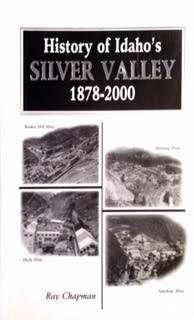
Authored by Ray Chapman, History of Idaho's Silver Valley 1878-2000 chronicles the dramatic economic boom, labor struggles, and environmental transformations of northern Idaho's mineral-rich Coeur d'Alene mining district. The book traces the region's trajectory from the late 19th-century gold and silver rushes through the explosive rise of hard-rock industrial mining, bitter union-management conflicts, and the eventual twentieth-century transition toward environmental cleanup and post-industrial reinvention. Drawing on local archives, mining records, and community lore, the text captures how rugged mountain canyons shaped a fierce, insular culture forged by subterranean labor. A keen insight drawn from the work is how the boom-and-bust cycle of extraction creates a profound psychological duality in mining towns; while the constant threat of economic collapse fosters intense, radical solidarity among workers, it simultaneously leaves the community perpetually tethered to the physical and financial scars of an exhausted landscape. 116 pages : illustrations, map ; 22 cm CIRC [ 1 ]
|
2000 |
|
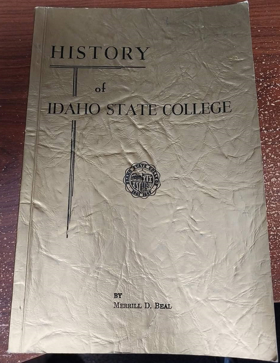
History of Idaho State College by Merrill D. Beal
|
1952 |
|
History of Idaho by Hiram T. French
Authored by agricultural academic Hiram T. French, History of Idaho is a sweeping, multi-volume encyclopedic account that traces the state’s rapid transition from a rugged mining frontier to a structured, resource-rich engine of the American West. The exhaustive text chronicles the early era of fur trapping and frantic gold rushes before heavily emphasizing the steady, "civilizing" forces of agricultural development, massive irrigation projects, and the establishment of civic institutions. Like many subscription histories of the era, the work bolsters its grand narrative of manifest destiny with hundreds of glowing biographical sketches of the state’s prominent politicians, merchants, and pioneering patriarchs. A keen insight drawn from the work is how the commercial mechanics of the early 20th-century "subscription history" genre fundamentally dictated the state's official historical record; by literally selling pages of history to the highest-bidding local elites, French’s volumes seamlessly merged civic boosterism with personal vanity, cementing a regional mythology where aggressive land speculation and ecological extraction were permanently rebranded as honorable pioneer virtues. 3 volumes : illustrations, plates, portraits ; 28 cm ONLINE CIRC [ 3 ]
|
1914 |
|
History of Idaho by Leonard J. Arrington 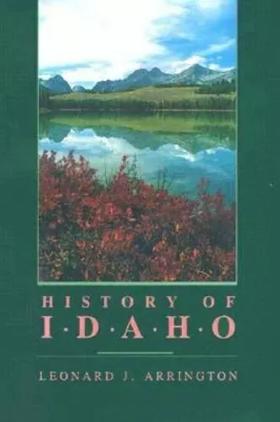
Authored by renowned regional historian Leonard J. Arrington, History of Idaho provides a comprehensive two-volume chronicle of the Gem State, tracing its evolution from an arid indigenous homeland and fur-trapping frontier into a modern agricultural and industrial powerhouse. The book meticulously examines the sweeping economic forces that shaped the state, from the 1860s gold rushes and the grueling labor struggles of the Coeur d'Alene mining district to the vast reclamation projects that turned the Snake River Plain into fertile farmland. Through exhaustive archival research and a deep appreciation for the state's diverse topography, Arrington captures the rugged independence of a population shaped by immense geographical isolation. A keen insight drawn from the work is how Idaho's unique historical trajectory was forged by a perpetual tension between radical extraction capitalism and fierce pioneer individualism; by highlighting how outside corporate mining and logging syndicates clashed with self-reliant local homesteaders, the history reveals that the state's legendary political conservatism was born out of a deep-seated defensive reaction against distant corporate and federal exploitation. 2 volumes : illustrations (some color) ; 24 cm CIRC [ 1 ]
|
1994 |
|
History of Idaho the gem of the mountains by James H. Hawley
Authored in 1920 by former governor and prominent frontier attorney James H. Hawley, History of Idaho: The Gem of the Mountains is a massive, multi-volume subscription history chronicling the state's rapid evolution from a rugged mining territory into an organized industrial powerhouse. Drawing heavily upon his own political career and pioneer experiences, Hawley weaves a triumphalist narrative that traces the early fur trade and violent frontier conflicts through to the establishment of robust civic and legal institutions. Like many regional histories of the era, the primary text is heavily subsidized by hundreds of flattering biographical sketches of local merchants, ranchers, and politicians, transforming the publication into a commercial vanity project for the state's ruling elite. A keen insight drawn from the work is how the authorship of a former state executive explicitly weaponized the concept of legal order to validate colonial conquest; by framing the violent dispossession of Idaho's Indigenous tribes and the aggressive extraction of natural resources as necessary milestones in the righteous march toward constitutional civilization, Hawley’s narrative effectively uses the veneer of state law to legally absolve the pioneer generation of its systemic ruthlessness. 4 volumes : frontispiece, illustrations (plates), map, portraits ; 29 cm ONLINE CIRC [ 4 ]
|
1920 |
|
History of Hood River County, Oregon, 1852-1982 by Hood River County Historical Society
|
1982 |
|
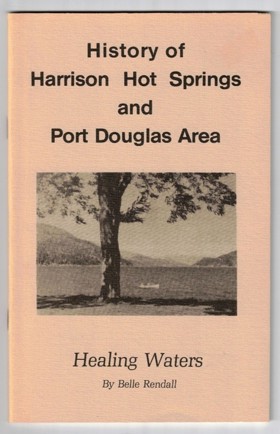
History of Harrison Hot Springs and Port Douglas area healing waters by Belle Rendall, Harrison Lake Historical Society
|
1981 |
|
History of Hansen, Idaho, 1904-1984 by Frances Harris
History of Hansen, Idaho, 1904-1984 by Frances Harris is a detailed 1984 local history, published locally in southern Idaho, that captures the foundational settlement and grassroots development of this small Twin Falls County community. The book chronicles the dramatic transformation of the arid Magic Valley region following the massive early 20th-century Snake River irrigation projects—sparked by the Carey Act and the completion of the nearby Milner Dam—which successfully converted the high desert sagebrush plains into a highly productive agricultural hub. By meticulously compiling pioneer reminiscences, family genealogies, and the civic records of early schools, churches, and businesses, Harris preserves the grit and resilience of the town's founders. Ultimately, it serves as an invaluable, community-focused resource for genealogists and regional historians seeking an intimate look at the agricultural heritage and rural settlement patterns that defined the early 20th-century pioneer experience in southern Idaho. 100 pages : illustrations, map, portraits ; 23 cm CIRC [ 1 ]
|
1985 |
|
History of Custer County, Idaho .. by Jesse R. Black
Published in 1900, Jesse R. Black's History of Custer County, Idaho provides a concise chronicle of the region's establishment in 1880 and its rapid transition from untamed wilderness to a bustling frontier hub. The narrative details the volatile boom-and-bust cycles of the gold and silver rushes that birthed high-altitude mining towns like Bonanza and Custer, while also documenting the severe challenges faced by early settlers. A keen insight drawn from the text is how the area's violent early history—marked by profound geographic isolation, harsh mountain elements, and bloody conflicts with Native American tribes—forged a fiercely resilient pioneer culture built entirely around rapid resource extraction. Ultimately, this brief volume serves as a vital historical snapshot of the fleeting but transformative mining boom that defined central Idaho's rugged pioneer era. 1 preliminary leaf, 21 pages, 1 leaf 20 cm ONLINE CIRC [ 1 ]
|
1900 |
|
History of British Columbia from its earliest discovery to the present time by Alexander Begg 
Published in 1894, Alexander Begg's comprehensive volume chronicles the political and economic evolution of British Columbia, tracing its trajectory from early maritime exploration and the fur trade era to its eventual confederation with Canada. A keen insight drawn from the text is how Begg’s narrative functions simultaneously as a historical record and a piece of deliberate economic boosterism, actively framing the region's transition from a guarded Hudson's Bay Company monopoly into a civilized province as a triumph of British imperial progress designed to attract settlers and investment. The author meticulously details the transformative impacts of the Fraser River and Cariboo gold rushes, the administrative leadership of James Douglas, and the critical unifying role of the Canadian Pacific Railway. Ultimately, the book stands as an exhaustive, albeit heavily pro-colonial, late 19th-century archive documenting the foundational events that integrated a rugged frontier into the Canadian dominion. xvii, [7]-568 pages : illustrations, folded map, portraits ; 23 cm ONLINE CIRC [ 1 ]
|
1894 |
|
History of British Columbia Bancroft's works, vol. xxxii by Hubert H. Bancroft 
Published in 1887 as the thirty-second volume of his colossal western history series, Hubert Howe Bancroft’s History of British Columbia meticulously traces the region's development from late 18th-century maritime explorations through its 1871 integration into the Canadian Confederation. The narrative provides an exhaustive account of the Hudson's Bay Company's autocratic rule under Chief Factor James Douglas, the disruptive influx of American prospectors during the Fraser River Gold Rush, and the subsequent political unification of the mainland and Vancouver Island. A keen insight drawn from the volume is how Bancroft—an American historian steeped in the ideology of Manifest Destiny—inherently filters the Canadian colonial experience through a distinctly U.S. nationalist lens. By frequently contrasting the paternalistic, corporate monopoly of the British administration with the chaotic, democratic individualism of American miners, the text inadvertently functions as a fascinating comparative study of two competing imperial philosophies vying for economic and cultural dominance across the 19th-century Pacific Northwest. xxxi, 792 pages : maps ONLINE CIRC [ 1 ] CIRC [ 1 ]
|
1887 |