Snohomish County County
The county was created out of Island County on January 14, 1861 and is named for the Snohomish tribe.
Mapped Location
Snohomish County: The mapped location is an approximation and should not be used for navigation or wayfinding.
Information
General information on Snohomish County
- Feature Type: County
- County Seat: City of Everett
- Established: Monday, January 14, 1861
Official, historical, colloquial and alternative toponyms for Snohomish County
A brief list of names that this geographic feature has been named
| Name | Description |
|---|---|
| Snohomish County | Official |
Origin Notes and History of Snohomish County
References to Snohomish County that document the origin of its place name

SNOHOMISH, name of a city, county, river, and tribe of Indians. The name was first applied to the Indians. Rev. Myron Eells says the word refers to "a style of union among them." (American Anthropologist, for January, 1892.) Dr. Charles M. Buchanan, for many years Indian Agent at Tulalip, says: "I have never met an Indian who could give a meaning to the word Snohomish, though I have made twenty-one years of inquiry." He says the tribe was dominant in the region about the present City of Everett and he has a theory, though no Indian has ever corroborated it. In the native language the word is Sdoh-doh-hohbsh. In the same language Sdohbsh means man. "Might not the word be the plural form signifying 'the men, the warriors, the braves.' They dominated their confederation, you know." (In Names MSS. Letters 141 and 155.) The word has been variously spelled. On December 9, 1824, John Work, of the Hudson's Bay Company, wrote it "Sinnahamis." ("Journal," in Washington Historical Quarterly, Volume III., page 213.) The Wilkes Expedition, 1841, charted the river as "Tuxpam River." (Hydrography, Volume XXIII., Atlas, chart 67.) In 1847, Captain Henry Kellett charted the river as "Sinahomis River." (British Admiralty Chart 1911.) The same spelling was used by the United States Coast Survey in 1854. (United States Public Documents, Serial Number 784, chart 51.) The present spelling was adopted by the Surveyor General of Washington Territory in 1857. (United States Public Documents, Serial Number 877.) Snohomish City was founded by K C. Ferguson and K F. Cady about 1860. (H. H. Bancroft, Works, Volume XXXI., page 367.)
Related Catalog Titles
A Bibliography for Snohomish County, County
Maritime names of Washington by Richard W. Blumenthal
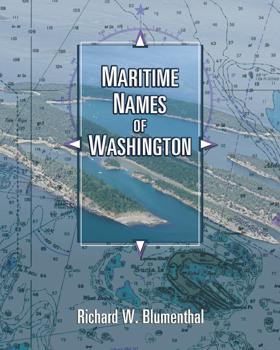
Maritime Names of Washington is a wonderful companion if you are a boating enthusiast or simply curious about Washington’s maritime history. This book is a scholarly study on the origins of place names for our coastal and inland waters. It covers every name that appears on current nautical charts, from the Pacific Coast to the Strait of Juan de Fuca, the San Juans, and Puget Sound from Port Townsend to Olympia. It includes every named island, bay, point, inlet, pass, harbor, rock, channel, strait, canal, peninsula, sound, and shoal. The book also features many local and historical names that are not shown on the charts. The manuscript generally identifies the individual who named the place, when, why, and for whom. It also identifies the chart where the name first appeared and the early settlement history of many places. The manuscript is richly annotated and uses many quotes from the observations of our earliest explorers to give readers a glimpse of what Puget Sound country looked like 200+ years ago. Each of our early explorations is discussed in detail as they relate to individual place names. The book contains 170 pictures and 44 historical nautical charts from 1790 to 1900 that show many of the names
ix, 501 pages : illustrations, maps, charts ; 26 cm
CIRC [ 1 ]
Tulalip, from my heart an autobiographical account of a reservation community by Harriette Shelton Dover
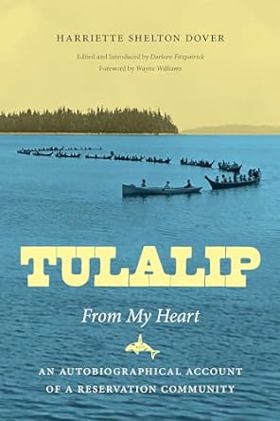
"In Tulalip, from My Heart, Harriette Shelton Dover describes her life on the Tulalip Reservation and recounts the myriad problems tribes faced after resettlement. Born in 1904, Dover grew up hearing the elders of her tribe tell of the hardships involved in moving from their villages to the reservation on Tulalip Bay: inadequate food and water, harsh economic conditions, and religious persecution outlawing potlatch houses and other ceremonial practices. Dover herself spent ten traumatic months every year in an Indian boarding school, an experience that developed her political consciousness and keen sense of justice. The first Indian woman to serve on the Tulalip board of directors, Dover describes her story in a personal, often fierce style, revealing her tribe's powerful ties and enduring loyalty to land now occupied by others." -- Publisher website
xxxiv, 307 pages : illustrations, maps ; 24 cm
CIRC [ 1 ]
A sound defense military sites, lighthouses, and memorials of Puget Sound by Nancy L. McDaniel

"A Sound Defense" is a comprehensive description of military sites of Puget Sound. Military historical sites in the twelve counties (Whatcom, Skagit, Snohomish, San Juan, Island, King, Pierce, Thurston, Mason, Kitsap, Clallam and Jefferson) are described with an emphasis on the unique things which happened there. Over 150 pictures and maps are included. Nancy McDaniel, Colonel, USAF, MSC (Retired) is a Washington State native and brings a love of the area and combines that with a perspective on the contributions that the military has had on Western Washington. "A Sound Defense" describes blockhouses built during the Indian conflicts. It addresses "The Pig War" and the politics of the international relationships which helped establish the boundaries of the United States. Forts built to protect Puget Sound as a result of the decisions of the Endicott Board are described along with the personalities of the commanders and personnel who were assigned there. Long forgotten installations established to provide early warning of approaching enemy aircraft are prominent in this comprehensive book. Lighthouses throughout the area are highlighted with the inclusion of historical photos and stories of early lightkeepers. Most importantly, "A Sound Defense" recognizes the contributions of military personnel throughout the years by the inclusion of memorials and facilities dedicated to recognizing their service to the country.
xvi, 365 pages : illustrations, maps ; 23 cm
CIRC [ 1 ]
Pioneers of the Stillaguamish by Dennis Conroy, Carol Husby Ronken
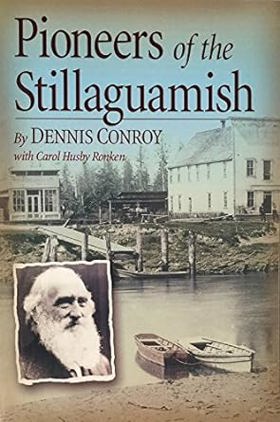
Published by local historians Dennis Conroy and Carol Husby Ronken, Pioneers of the Stillaguamish compiles extensive genealogical records, historical photographs, and pioneer recollections to chronicle the early European-American settlement of the Stillaguamish River valley in Washington. The book details the arduous process of clearing dense old-growth timber, establishing homesteads, and building rudimentary roads and schools along the unpredictable river corridor during the late 19th and early 20th centuries. By centering the struggles and daily lives of ordinary families, the text preserves the foundational social fabric of communities like Arlington and Stanwood. A keen insight drawn from the work is how local pioneer histories capture the immense cognitive dissonance of frontier expansion; by meticulously detailing the relentless destruction of ancient forests to plant farms, the text unwittingly reveals how the triumph of civilization for homesteaders was simultaneously an act of catastrophic ecological erasure for the valley's original inhabitants
viii, 149 pages : illustrations, maps ; 23 cm
CIRC [ 1 ]
Mill town footlights the theaters of Everett, Washington by David Dilgard, Everett Public Library
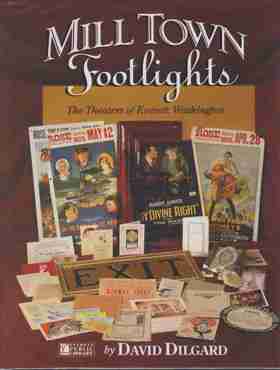
Published in local editions by historian David Dilgard and the Everett Public Library, Mill Town Footlights: The Theaters of Everett, Washington chronicles the vibrant, bustling entertainment history of a booming turn-of-the-century industrial city. The book details the rise and fall of Everett’s historic playhouses, vaudeville houses, and nickelodeons, illustrating how cultural institutions thrived amidst the grit, smoke, and labor strife of a quintessential Pacific Northwest mill town. Drawing on rich archival photographs and local ephemera, the text traces how early residents sought out sophisticated theatrical escapism as a vital counterbalance to grueling industrial labor. A keen insight drawn from the work is how the rapid emergence of high-culture entertainment in an isolated timber hub demonstrates that rough-edged frontier economies were deeply hungry for civic refinement, using the performing arts to rapidly project an image of metropolitan permanence and respectability onto a raw landscape
iv, 116 pages : illustrations ; 29 cm
CIRC [ 0 ]
The Sky Valley. Volume 2 a photographic history by Buddie Williams

Authored by local historian Buddie Williams, The Sky Valley, Volume 2: A Photographic History continues the visual documentation of Washington's rugged Skykomish River corridor through a rich collection of historic photographs and archival ephemera. The volume captures the dramatic transformation of towns like Index, Sultan, and Startup as they evolved from raw logging camps and mining outposts into established, tight-knit communities framed by the Cascade Mountains. Through vintage images of steam locomotives, timber mills, high-water floods, and local school children, the text portrays the relentless daily labor required to carve civilization out of a steep, flood-prone river valley. A keen insight drawn from the work is how visual archives of mountain valleys expose the inherent fragility of industrial frontier settlements; the recurring imagery of swollen rivers and swept-away bridges reminds readers that human infrastructure in the Pacific Northwest was always engaged in a precarious, high-stakes negotiation with an overwhelmingly powerful natural topography.
28 pages : illustrations ; 26 cm
CIRC [ 1 ]
Darrington, mining town/timber town by Elizabeth S. Poehlman
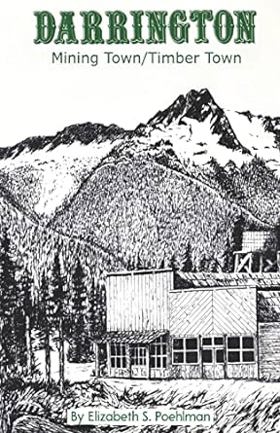
The cast of characters in Elizabeth Poehlman’s book, Darrington: Mining Town/Timber Town reads like a Wild West novel set in Paul Bunyan country. But this is no novel – Poehlman has written a memorable small-town history. The book starts in the late 1800s with the struggles of Chief Wawetkin and the Sauk-Suiattle Indians to deal with the onset of miners and settlers throughout their homelands deep in what would soon be renamed the North Cascades mountains in the new state of Washington. Subsequent chapters feature gold-fevered miners (and a revenge murder); a hotel owner who asked to be deputized for a half hour to deal with a knife-wielding drunk the sheriff couldn’t handle; the town doctor who kept a bear cub as a pet; the “sky pilot” minister who was too scared to preach in the rough railroad logging camps, opting to show slides instead; the Tarheels who followed the timber industry from North Carolina and brought their love of bluegrass and moonshine; the Depression-era housewife who distrusted banks and stashed her family’s savings around her waist in a hidden money belt – enough to almost pay off their land and house. Darrington, as Poehlman learned while living there, may be backwoods, but never boring.
176 pages : illustrations ; 21 cm
CIRC [ 1 ]
Voices from Everett's first century by Snohomish County Museum and Historical Association
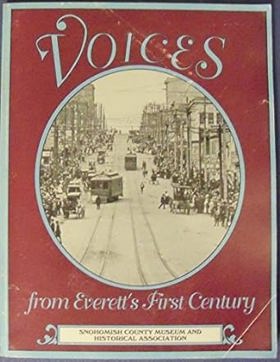
Oversize softbound social history of Everett, WA 1892-1994. 217 pages; illustrated with b/w historical photos of Everett and Snohomish County
vii, 217 pages : illustrations ; 28 cm
CIRC [ 1 ]
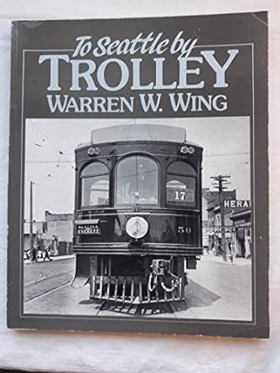
Riverside remembers books I, II & III by Greater Riverside Organization (Everett, Wash)
Memory lanes of Old Everett and its East Riverside by Helmer Malstrom, David Dilgard
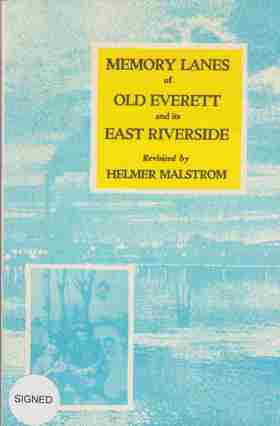
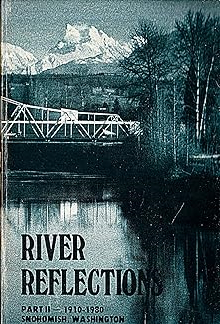
River reflections Part II - 1910 - 1980 by Snohomish Historical Society
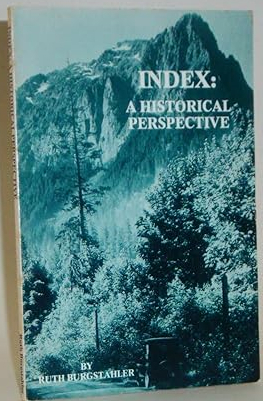
Index a historical perspective by Ruth Burgstahler
Monte Cristo by Philip R. Woodhouse, Robert L. Wood
River reflections Snohomish City, 1859 to 1910 : a popular narrative history of Snohomish City by Snohomish Historical Society

The Stanwood story Volume Two by Alice Essex
Mill town a social history of Everett, Washington, from its earliest beginnings on the shores of Puget Sound to the tragic and infamous event known as the Everett Massacre by Norman H. Clark
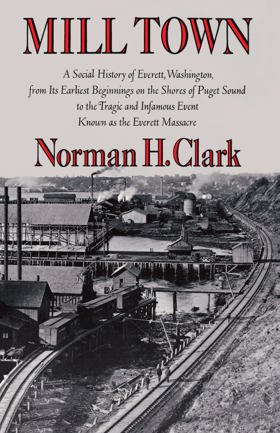
A social history of Everett, Washington, from its earliest beginnings to the tragic and infamous event on November 5, 1916, which came to be known as the Everett Massacre
viii, 267 pages, 12 unnumbered pages of plates : illustrations ; 21 cm
CIRC [ 1 ]
Edmonds, the gem of Puget Sound a history of the city of Edmonds by Ray V. Cloud
An Illustrated history of Skagit and Snohomish Counties, their people, their commerce and their resources with an outline of the early history of the State of Washington, endorsed as authentic by local committees of pioneers by The Interstate Publishing Company
Published by the Interstate Publishing Company, An Illustrated History of Skagit and Snohomish Counties offers a sweeping, encyclopedia-style chronicle of early pioneer settlement and economic development in northwestern Washington. The extensive volume traces the rapid transformation of the region's dense primeval forests and fertile river valleys into thriving hubs of the timber, agricultural, and maritime industries. Through exhaustive biographical sketches of prominent families—explicitly endorsed as "authentic" by local pioneer committees—the text serves as a monumental archive documenting the civic ambition and commercial resource extraction that defined the Puget Sound hinterlands. A keen insight drawn from the work is how the overt endorsement by pioneer committees reveals the manufactured nature of early frontier historiography; by tightly controlling the published narrative to validate their own commercial successes, the region's founding elite actively engineered a sanitized, triumphant origin story designed to cement their social authority and attract future investment.
1117 pages : portraits ; 29 cm
ONLINE CIRC [ 1 ]
Snohomish County
- Alderwood Manor
- Andron
- City of Arlington
- Arlington Heights
- Arlington Junction
- Barco
- Bedal
- Beverly Acres
- City of Bothell
- City of Brier
- Bromart
- Bryant
- Casino Corner
- Cathan
- Cathcart
- Cavalero Corner
- Cedar Valley
- Cicero
- Clearview
- Town of Darrington
- Echo Lake
- Edgecomb
- City of Edmonds
- English
- Esperance
- City of Everett
- Everett Junction
- Fairmont
- Firdale
- Florence
- Fobes Hill
- Forest Glade
- Fortson
- Fryelands
- Galena
- Getchell
- City of Gold Bar
- Grace
- City of Granite Falls
- Halford
- Halterman
- Hazel
- High Rock
- Hyland
- Town of Index
- Jamison Corner
- John Sam Lake
- Jordan
- Kennard Corner
- Kruse
- Kruse Junction
- Lake Bosworth
- Lake Goodwin
- Lake Ketchum
- Lake Roesiger
- City of Lake Stevens
- Lake Stickney
- Lakewood
- Larimers Corner
- Lochsloy
- City of Lynnwood
- Machias
- Maltby
- Martha Lake
- City of Marysville
- May Creek
- McKees Beach
- Meadowdale
- City of Mill Creek
- Mission Beach
- City of Monroe
- Monte Cristo
- City of Mountlake Terrace
- City of Mukilteo
- Murphys Corner
- Nelsons Corner
- Norman
- North Creek
- North Lynnwood
- North Marysville
- North Stanwood
- North Sultan
- Osborn Corner
- Oso
- Pearson Eddy
- Picnic Point
- Pilchuck
- Pilchuck
- Priest Point
- Rees Corner
- Reiter
- Riverside
- Robe
- Roosevelt
- Rowan
- Seattle Heights
- Seattle Hill
- Serene
- Shaker Church
- Silvana
- Silvana Terraces
- Silver Firs
- Silverton
- Sisco
- Sisco Heights
- City of Snohomish
- Sobey
- South Snohomish
- Spee-Bi-Dah
- City of Stanwood
- Startup
- Stimson Crossing
- City of Sultan
- Sunny Shores
- Swede Heaven
- Thrashers Corner
- Three Lakes
- Totem Park
- Trafton
- Tulalip
- Tulalip Bay
- Tulare Beach
- Tulker
- Turner Corner
- Verlot
- Wagner
- Warm Beach
- Weallup Lake
- West Lake Stevens
- White Horse
- Wintermutes Corner
- Woodruff
- Woods Creek
- City of Woodway
Political Boundaries
Last updated: 2025-09-23