Kitsap County County
Kitsap County was formed out of King County, Washington, and Jefferson County, Washington on January 16, 1857 and is named for Chief Kitsap of the Suquamish Tribe. Originally named Slaughter County, it was soon renamed.
Mapped Location
Kitsap County: The mapped location is an approximation and should not be used for navigation or wayfinding.
Information
General information on Kitsap County
- Feature Type: County
- County Seat: City of Port Orchard
- Established: Friday, January 16, 1857
Official, historical, colloquial and alternative toponyms for Kitsap County
A brief list of names that this geographic feature has been named
| Name | Description |
|---|---|
| Kitsap County | Official |
Origin Notes and History of Kitsap County
References to Kitsap County that document the origin of its place name

KITSAP COUNTY was created by the Washington Territorial Legislature in an act approved January 16, 1857. It was then named Slaughter County in honor of Lieutenant W. A. Slaughter, United States Army, who had been killed on December 4, 1855. The people of the county were given the privilege of choosing another name, if they wished, at the next general election. They chose the name of one of the hostile chiefs, whose tribe occupied part of the land in the new county. Seattle was a greater chief of the same tribe. He and most of his tribe remained friendly during the war. Kitsap, a war chief and medicine man, went over to the hostiles. When the war on Puget Sound went against the Indians, Kitsap, with Chief Leschi and others, went across the Cascades. In communications dated June 18 and October 4, 1856, Governor Stevens asked Colonel George Wright, commanding the Columbia River district, to deliver Chiefs Leschi, Nelson, Kitsap, Quieinuth and Stehi for trial by civil authorities. They had been indicted for several murders. On October 16, 1856, Colonel Wright ordered Major Garnett at Fort Simcoe to deliver the chiefs as requested. Chief Leschi was convicted and executed. Chief Kitsap was eventually acquitted. While in the guardhouse at Fort Steilacoom he had been taken ill and was given some medicine in the form of a red liquid. He got well and at once added red liquid to his equipment as a medicine man. After he had returned to his people, three of his warriors became ill. He mixed some of the red paint used for war decorations in water and gave the red medicine. The three men died and their relations were furious. They waited. On April 18, 1860, Chief Kitsap, while drunk, was enticed to a vacant cabin and shot. His body was cut to pieces. (Elwood Evans, in History of the Pacific Northwest: Oregon and Washington, Volume I, pages 508-509.) Rev. Myron Eells says the word means "brave" and is accented heavily on the last syllable as if the "i" were omitted from the first syllable. (American Anthropologist, January, 1892.)
Related Catalog Titles
A Bibliography for Kitsap County, County
Maritime names of Washington by Richard W. Blumenthal
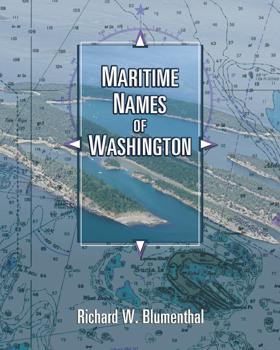
Maritime Names of Washington is a wonderful companion if you are a boating enthusiast or simply curious about Washington’s maritime history. This book is a scholarly study on the origins of place names for our coastal and inland waters. It covers every name that appears on current nautical charts, from the Pacific Coast to the Strait of Juan de Fuca, the San Juans, and Puget Sound from Port Townsend to Olympia. It includes every named island, bay, point, inlet, pass, harbor, rock, channel, strait, canal, peninsula, sound, and shoal. The book also features many local and historical names that are not shown on the charts. The manuscript generally identifies the individual who named the place, when, why, and for whom. It also identifies the chart where the name first appeared and the early settlement history of many places. The manuscript is richly annotated and uses many quotes from the observations of our earliest explorers to give readers a glimpse of what Puget Sound country looked like 200+ years ago. Each of our early explorations is discussed in detail as they relate to individual place names. The book contains 170 pictures and 44 historical nautical charts from 1790 to 1900 that show many of the names
ix, 501 pages : illustrations, maps, charts ; 26 cm
CIRC [ 1 ]
People of North Kitsap Peninsula by Hansville Historical Society
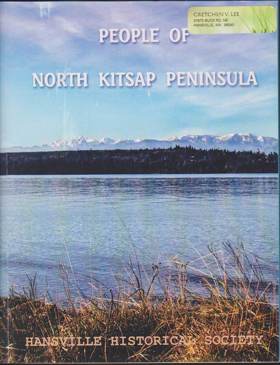
It is a history of the communities and families of the North Kitsap area beginning with the S'Klallam Tribe and moving north. Communities included are S'Klallam Tribe, Eglon, Hansville, Point No Point, Skunk Bay, Twin Spits, Foulweather Bluff, Cliffside, Driftwood Key, and Shore Woods. In addition to the community histories, personal histories of early families are included. --description from Hansville Historical Society Website
198 pages : illustrations ; 28 cm.
CIRC [ 0 ]
A sound defense military sites, lighthouses, and memorials of Puget Sound by Nancy L. McDaniel

"A Sound Defense" is a comprehensive description of military sites of Puget Sound. Military historical sites in the twelve counties (Whatcom, Skagit, Snohomish, San Juan, Island, King, Pierce, Thurston, Mason, Kitsap, Clallam and Jefferson) are described with an emphasis on the unique things which happened there. Over 150 pictures and maps are included. Nancy McDaniel, Colonel, USAF, MSC (Retired) is a Washington State native and brings a love of the area and combines that with a perspective on the contributions that the military has had on Western Washington. "A Sound Defense" describes blockhouses built during the Indian conflicts. It addresses "The Pig War" and the politics of the international relationships which helped establish the boundaries of the United States. Forts built to protect Puget Sound as a result of the decisions of the Endicott Board are described along with the personalities of the commanders and personnel who were assigned there. Long forgotten installations established to provide early warning of approaching enemy aircraft are prominent in this comprehensive book. Lighthouses throughout the area are highlighted with the inclusion of historical photos and stories of early lightkeepers. Most importantly, "A Sound Defense" recognizes the contributions of military personnel throughout the years by the inclusion of memorials and facilities dedicated to recognizing their service to the country.
xvi, 365 pages : illustrations, maps ; 23 cm
CIRC [ 1 ]
Indianola a community memoir by Sarah M. Berry, Joan R. Henderson, Indianola Beach Improvement Club History Committee
Authored by Sarah M. Berry and Joan R. Henderson alongside the Indianola Beach Improvement Club History Committee, Indianola: A Community Memoir chronicles the evolution of the historic waterfront enclave on Washington’s Kitsap Peninsula. The book traces the area’s transformation from an indigenous gathering place and a 20th-century mosquito-fleet resort destination into a tight-knit, fiercely protective seasonal and year-round community. Drawing on archival photographs, diaries, and local records, the text preserves the distinct social traditions and ferry-dependent isolation that shaped generations of cabin owners and residents. A keen insight drawn from the work is how recreational enclaves foster a unique brand of communal preservation; by relying on shared infrastructure like community docks and improvement clubs, residents turned their collective isolation into a deliberate tool for shielding their waterfront heritage from rapid commercial overdevelopment.
128 pages : illustrations, maps ; 21 x 27 cm
CIRC [ 1 ]
Seabeck tide's out, table's set by Fredi Perry, Michael Jay Mjelde, Larry Hill, Victoria Rowe
History of Seabeck, Washington (state) covers the early Native American history, exploration by British and American navigators, and continues on to the development of the harbor as the site of a lumber mill and shipbuilding center. Topics include water transportation, hotels, saloons, store, post office, schools, cemetery, Seabeck Christian Conference Center, and surrounding communities. Included are census and cemetery records, maps, legends, and an extensive index. This is the second printing.--
242 pages : illustrations, maps ; 28 cm
CIRC [ 1 ]
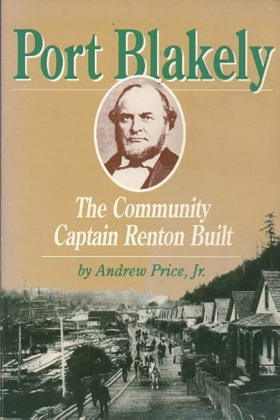
Port Blakely the community Captain Renton built by Andrew Price
Time, tide, and timber a century of Pope & Talbot by Edwin T. Coman, Helen M. Gibbs
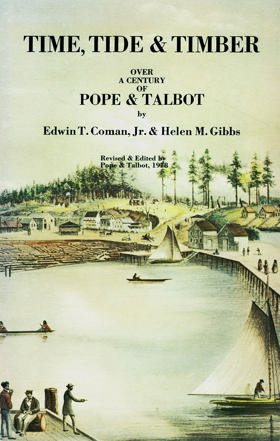
Published in 1949 by Stanford University Press and authored by business historians Edwin T. Coman Jr. and Helen M. Gibbs, Time, Tide, and Timber: A Century of Pope & Talbot is an authorized corporate history chronicling the first hundred years of one of the Pacific Northwest’s most influential timber and shipping conglomerates. Commissioned by the company to commemorate its centennial, the volume traces the enterprise from its modest origins in 1849, when founders Andrew J. Pope and Captain William C. Talbot arrived in Gold Rush San Francisco from East Machias, Maine, to launch a lumber and lighterage business. The text details the firm's subsequent expansion into the Puget Sound region, its establishment of massive sawmills at Port Gamble, its extensive fleet of coastal and transoceanic sailing ships, and its eventual evolution into a sprawling modern corporate empire spanning forestry, real estate, and global maritime trade.
73 pages : illustrations ; 23 cm
CIRC [ 1 ]
Kitsap County history a story of Kitsap County and its pioneers by Kitsap County Historical Society Book Committee

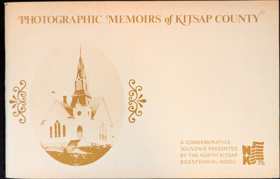
Photographic memoirs of Kitsap County a commemorative souvenir by North Kitsap Bicentennial Association
They Cast a Long Shadow. A History of the Nonwhite Races on Bainbridge Island by Brian, Ed Roberts, Bainbridge Island School District 303, WA
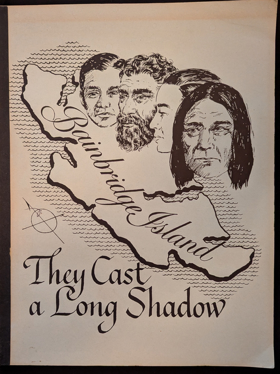
Written as a curriculum aid for students in the Bainbridge Island, Washington school district, this collection of stories about the Japanese, the Chinese, the Hawaiians, the Filipinos, the Vietnamese, and the American and Canadian Indians is an attempt to explain "what life is like for people who look different". The stories all relate the history of each of these ethnic groups on Bainbridge Island, an agricultural community, from the time of their arrival through the present. Accounts of individual's experiences from each group and black and white photographs are used to illustrate the stories. (PR)
122
CIRC [ 1 ]
Manchester memories (1871-1971) by Edith Jones Hillstrom
Bainbridge landings by Allen Beach
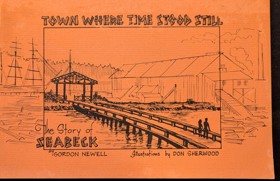
Town where time stood still the story of Seabeck by Gordon R. Newell, Don Sherwood
Kitsap County
- Agate Point
- Bainbridge
- Bainbridge Grange
- City of Bainbridge Island
- Bangor
- Banner
- Battle Point
- Bethel
- Breidablick
- City of Bremerton
- Bremerton Junction
- Brownsville
- Burley
- Central Valley
- Charleston
- Chico
- Colby
- Colchester
- Conifer Park
- Country Lane
- Creosote
- Crosby
- Crystal Springs
- Eagledale
- East Bremerton
- East Port Orchard
- Eastwood
- Eglon
- Eldorado Hills
- Enetai
- Erlands Point
- Fairview
- Ferncliff
- Fernwood
- Fletcher Bay
- Fort Ward
- Four Corners
- Fragaria
- Gilberton
- Glenwood
- Gorst
- Hansville
- Harper
- Hawley
- Hintzville
- Hite Center
- Holly
- Huckle Ridge
- Illahee
- Indianola
- Jackson Park
- Johansons Corner
- Kariotis
- Keyport
- Kingston
- Kitsap Lake
- Lawters Beach
- Lemolo
- Lincoln
- Little Boston
- Lofall
- Lynwood Center
- Madrona Heights
- Madrona Point
- Manchester
- Manette
- Manitou Beach
- Manzanita
- Meadowdale
- Naval Depot Junction
- Navy Yard City
- Nellita
- Olalla
- Olympic View
- Orchard Heights
- Parkwood
- Parkwood East
- Pearson
- Point White
- Port Blakely
- Port Gamble
- Port Madison
- City of Port Orchard
- City of Poulsbo
- Retsil
- Rocky Point
- Rollingbay
- Rose Point
- Scandia
- Seabeck
- Seabold
- Sheridan
- Sherman Heights
- Silverdale
- South Beach
- South Colby
- Southworth
- Striebels Corner
- Sunnyslope
- Sunset Farm
- Suquamish
- Tolo
- Tracyton
- Treemont
- Trikkala
- Twin Spits
- Venice
- Vinland
- Virginia
- Warrenville
- Waterman
- Waterman Point
- Wautauga Beach
- West Blakely
- West Port Madison
- Westwood
- Wildcat Lake
- Wildwood
- Yeomalt
Political Boundaries
Last updated: 2025-09-23