William O. Douglas 1898-1980
The longest-serving Justice in the history of the U.S. Supreme Court, raised in Yakima, Washington. He was a fierce advocate for civil liberties and a passionate environmentalist who helped preserve vast wilderness areas in the Pacific Northwest.
Biographical Overview
- Lived from 1898 to 1980
- Born: Jan 1, 1898, Maine, MN
- Died: Jan 1, 1980, Washington, D.C.
Historical Events
- No referenced events linked
Bibliography for William O. Douglas
A listing of books related by subject
The environmental justice William O. Douglas and American conservation by Adam M. Sowards
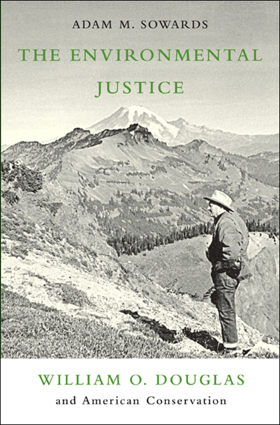
From the late 1940s to the mid-1970s, American conservation politics underwent a transformation — and Supreme Court Justice William O. Douglas was at the heart of this shift toward modern environmentalism. The Environmental Justice explores how Douglas, inspired by his youthful experiences hiking in the Pacific Northwest, eventually used his influence to reshape American conservation thought, politics, and law. One of the nation’s most passionate conservationists, Douglas wrote eloquent testimonies to the value of wilderness and society’s increasing need for it, both in his popular books and in his heartfelt judicial opinions celebrating nature and condemning those who would destroy it. He led public protests in favor of wilderness. He worked tirelessly to secure stronger legal protections for the environment, coordinating with a national network of conservationists and policymakers. As a sitting Supreme Court Justice, Douglas brought both prestige and the enormous symbolic power of legal authority to conservation crusades at a time when the nation's laws did not favor environmental protection. He understood the need for national solutions that included public involvement and protections of minority interests; the issues were nationally important and the forces against preservation were strong. In myriad situations Douglas promoted democratic action for conservation, public monitoring of government and business activities, and stronger laws to insure environmental and political integrity.
x, 198 pages : illustrations, maps ; 23 cm
Desiderata
Nature's justice writings of William O. Douglas by William O. Douglas, James O'Fallon

As the longest serving Justice in the history of the U.S. Supreme Court, William O. Douglas was known for writing a host of dissenting opinions. He was also a prolific writer off the bench, a man whose work was as much concerned with nature as with law. This collection brings together writings that represent the wide range of Douglas's interests. It includes selections from his autobiographical and political books, and opinions from landmark cases—all reflecting not only his love of justice but also his roots in the Northwest and his lifelong commitment to the environment. Several selections from Douglas's first book Of Men and Mountains portray his abiding love of the outdoors—particularly the Northern Cascades—and the rugged people who live there. These personal writings warmly recall events of his youth and celebrate the power of the mountains to renew the human spirit. Other selections evoke Douglas's professional activities: as a New Deal insider and Supreme Court Justice, a champion of civil liberties and the rights of minorities, a strong internationalist, and an unflagging supporter of environmental issues. These latter writings include passages from My Wilderness and his dissenting opinion in Sierra Club v. Morton arguing that trees have legal standing to bring lawsuits. These writings demonstrate that Douglas never shied from controversy—whether over interpretation of the Fourteenth Amendment or the choice between flies and bait for trout fishing—and offer inspiration for both environmentalists and all who yearn for a more just society. Whether extolling the joys of the wild or defending the rights of citizens, Douglas shows in this work that he truly was Nature's Justice—and one of a kind.
x, 310 pages : illustrations ; 24 cm.
Desiderata
Of men and mountains by William O. Douglas
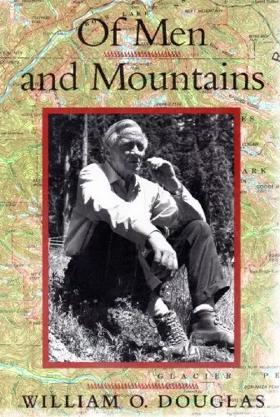
William O. Douglas’s autobiographical Of men and mountains explores the physical and spiritual resilience forged within the rugged alpine landscapes of the Cascade Range and the agricultural foothills of the Yakima Valley. Set against the formidable backdrop of Mount Adams, the Goat Rocks, and the Tieton River basin, the narrative details how early outdoorsmen, sheepherders, indigenous groups, and pioneers cooperatively navigated this demanding high-altitude wilderness. By chronicling his own physical recovery through grueling backcountry expeditions alongside these scattered mountain inhabitants, Douglas illustrates how shared endurance in the unforgiving Pacific Northwest high country created a unique, deeply rooted frontier kinship. Ultimately, the book demonstrates that testing oneself against these towering volcanic peaks and isolated river valleys was essential not only for personal survival but for establishing a lasting community identity intimately tied to the region's dramatic geography.
xiv, 338 pages : map ; 23 cm
Non-circulating [ 1 ]
The Court years, 1939-1975 the autobiography of William O. Douglas by William O. Douglas
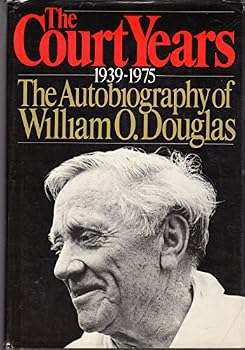
William O. Douglas served on the Supreme Court of the United States for over 36 years, from 1939 to 1975, the longest term of any Justice. His tenure was marked by an unyielding and brilliantly executed determination to- as he frequently put it- "keep the government off the backs of the people." Together with Hugo Black, Justice Douglas was responsible for many of the Supreme Court decisions which extended the protection of the Due Process Clause of the Constitution; limited the power of the large corporations; protected the maverick and the dissident from government harassment; extended and guarded the civil rights of blacks, of women and of other minorities; safeguarded American public lands and resources from those who would plunder them ... and on ... and on. He wrote more dissenting opinions (and wrote them faster) than any other Justice, and yet many of those dissents were later reflected in legislation or else in the majority opinions of the Court itself. Timely, newsworthy, historically important, This book is the personal record of that great lifelong struggle. It continues the memoirs Justice Douglas began so eloquently in his best-selling 'Go East, Young Man.' For the first time in the history of the Supreme Court, one of the Justices- himself- has set about to give the judicial history of the great issues of American life and to show how these issues were dealt with in the Conference Room and "among the Brethren." With a deep understanding of the Court process, with a pungent wit and an intimate knowledge both of the law and of those who interpreted it, Douglas reveals the Supreme Court as it has never been seen before. -- from Book Jacket
xi, 434 pages, 8 unnumbered leaves of plates : illustrations ; 24 cm
Desiderata
Go East, young man the early years : the autobiography of William O. Douglas by William O. Douglas
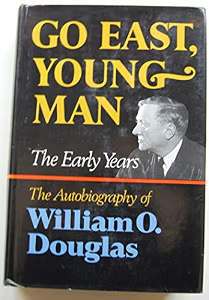
William O. Douglas’s Go East, Young Man: The Early Years provides an evocative personal and geographic record of central Washington during its early twentieth-century industrial and agricultural transformation. Growing up in the Yakima Valley, Douglas details how his physical recovery from childhood illness unfolded across the rugged trails and ridgelines of the Cascade foothills surrounding Mount Adams (Pahto)—a mountainous landscape whose alpine meadows and river valleys had long been stewarded by the Yakama Nation. The narrative documents the rapid superimposition of federal reclamation projects, extensive irrigation canal systems, and transcontinental rail corridors onto ancestral Yakama territory, fundamentally converting native sagebrush rangelands and seasonal root-gathering grounds into intensive commercial fruit orchards. Douglas’s accounts of working the local hop yards and harvest fields alongside Yakama families, itinerant farmhands, and Industrial Workers of the World organizers highlight the shared physical labor and complex social interdependencies that anchored the valley’s resource economy. Ultimately, the autobiography illustrates how this intimate immersion in an engineered Western landscape—caught between corporate agricultural expansion and an enduring Indigenous plateau geography—fundamentally forged the environmental ethic and defense of Indigenous treaty rights that Douglas would later champion on the United States Supreme Court.
xv, 493 pages : illustrations ; 24 cm
Desiderata
Entry Details
Related Online Resources
- No external online resources or related links found
Last updated: 2026-10-07