City of Yakima Yakima County, Washington
Mapped Location
City of Yakima: The mapped location is an approximation and should not be used for navigation or wayfinding.
Information
General information on City of Yakima
- Feature Type: Incorporated
Official, historical, colloquial and alternative toponyms for City of Yakima
A brief list of names that this geographic feature has been named
| Name | Description |
|---|---|
| City of Yakima | Official |
| Yakima | Official |
Origin Notes and History of City of Yakima
References to City of Yakima that document the origin of its place name
YAKIMA, one of the most extensively used geographic terms in the State of Washington, is applied to a county, city, river, valley, pass in the Cascade Range, Indian tribe and Indian reservation. As in many other cases the name was first applied to the river and the natives who occupied the land drained by the river. Lewis and Clark, 1805-1806, give the name as "Tapteal," which they spell in several ways. Elliott Coues, the scholarly editor of their journals, gives a number of synonyms, such as "Eyakama." (History of Lewis and Clark Expedition, Volume II., page 641 and Volume III., page 973.) John H. Lynch, of Yakima, quotes the pioneer Jack Splawn as authority for "lake water" as the meaning of Yakima. (In Names MSS. Letter 302.) Henry Gannett says the word means "blackbear." (Origin of Certain Place Names in the United States, page 332.) The Bureau of American Ethnology says the word means "runaway" and that the native name for the tribe was "Waptailmim" meaning "people of the narrow river." (Handbook of American Indians, Volume II, pages 983-984.) David Thompson, of the North West Company of Montreal referred to the Indians on July 8, 1811, as "Skaemena." ("Journal," edited by T. C. Elliott, in Oregon Historical Society Quarterly, Volume XV., page 56.) Alexander Ross was with the Astorians, 1811, though his book Adventures of the First Settlers on the Oregon or Columbia River was not published until 1849, in which he uses the name "Eyakema." ("Early Western Travels" edition, Volume VII., page 141.) The Wilkes Expedition, 1841, refers to the river by the name as now spelled. (Narrative, Volume IV., page 428.) The same is true of the railroad explorers in 1853, though they call the upper portion of the river "Yahinse." (Pacific Railroad Reports, Volume I., pages 377-389.) In framing the treaty of June 9, 1855, Governor Isaac I. Stevens referred to the river and tribe as "Yakama." (Charles J. Kappler, Indian Affairs, Volume II., "Treaties," pages 698-702.)
Yakima County was established by an act of the Territorial Legislature approved January 21, 1865. Hubert Howe Bancroft describes an interesting epoch as follows: "Yakima City was incorporated December 1, 1883. Twelve months later, when it had 400 inhabitants, the surveyors of the Northern Pacific railroad laid out the town of North Yakima, four miles distant from the old town, upon a broad and liberal scale, and proposed to the people of the latter that if they would consent to be removed to the new town they should he given as many lots there as they possessed in the old, and have besides their buildings moved upon them without cost to the owners. Such an agreement in writing was signed by a majority of the citizens, and in the winter and spring of 1884-1885 over 100 buildings were moved on trucks and rollers, hotels, a bank, and other business houses doing their usual business en route. This was a good stroke of policy on the part of the railroad, general land commissioner, and the company, as it definitely settled opposition, both to the new town and the corporation, which also received a year's growth for North Yakima in ninety days' time." (Works, Volume XXXI., pages 298-300.) By act of the State Legislature approved January 30, 1917, and to go into effect on January 1, 1918, the city was permitted to drop the word "North" from its name. The same Legislature also changed the name of the older town of Yakima to Union Gap.
A Selected Bibliography of City of Yakima, Yakima County, Washington
A compilation of essential readings detailing the history, geography, and culture of the region.
Hidden history of Yakima by Ellen Allmendinger

"Forgotten events, buildings, businesses and people helped shape Yakima. Vice dominated the city's early landscape when it was called North Yakima. Gambling halls and saloons like the Alfalfa Saloon bustled, while hotels such as the Sydney and Empire offered respite. Primitive circuses, underground tunnels, South Front Street opium dens and the arrival of a crossdresser named Nell Pickerell created further strife. City hall's understaffed police force and overcrowded jail complicated matters. Fires in 1890 and 1907 consumed several of the early structures--sometimes twice--keeping firefighters frayed. The Asian community thrived despite racial tensions until the forced evacuation of Japanese residents in 1942. Author Ellen Allmendinger uncovers what remains overlooked and veiled from sight." -- Amazon.com viewed May 15, 2020
126 pages : illustrations ; 23 cm.
Non-circulating [ 1 ]
Yakima, a centennial reflection, 1885-1985 by George M. Martin, Paul Schäfer, William E. Scofield, Yakima Centennial Commission
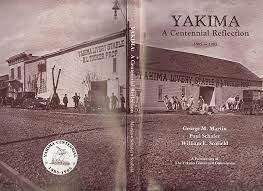
Yakima, a Centennial Reflection, 1885-1985 by George M. Martin, Paul Schäfer, and William E. Scofield is a comprehensive 1985 local history, published by the Yakima Centennial Commission, that commemorates the foundational growth and civic evolution of this central Washington city. The book chronicles the region's dramatic transformation from an arid sagebrush frontier into a globally recognized agricultural powerhouse, driven by the arrival of the Northern Pacific Railway and the implementation of massive, federally funded irrigation projects in the Yakima Valley. The authors meticulously detail the unique early history of the town—including the literal, physical relocation of early pioneer buildings from the original settlement to the new "North Yakima" townsite to meet the railroad tracks—alongside a century of industrial expansion in the apple, hop, and broader agricultural sectors. Ultimately, richly illustrated with archival photographs and grassroots community documentation, it serves as an indispensable resource for regional historians seeking to understand the infrastructural ambition, pioneer resilience, and agrarian heritage that defined the commercial heart of central Washington.
x, 233 pages : illustrations ; 23 cm
Non-circulating [ 1 ]
Magic Valley the story of St. Joseph Academy and the blossoming of Yakima by Ellis Lucia, Sisters of Charity of Providence
Published in 1976, Ellis Lucia’s Magic Valley chronicles the founding of St. Joseph Academy by the Sisters of Providence and its profound influence on the early development of Yakima, Washington. The narrative intertwines the institutional history of this pioneer Catholic school with the broader agricultural and civic expansion of the region. The book offers the keen insight that these frontier nuns functioned as critical civic architects, establishing the essential educational and social infrastructure that allowed a rugged agrarian settlement to successfully "blossom" into a cohesive, enduring community.
48 pages : illustrations, facsimiles ; 21 x 23 cm
Desiderata
Go East, young man the early years : the autobiography of William O. Douglas by William O. Douglas
William O. Douglas’s Go East, Young Man: The Early Years provides an evocative personal and geographic record of central Washington during its early twentieth-century industrial and agricultural transformation. Growing up in the Yakima Valley, Douglas details how his physical recovery from childhood illness unfolded across the rugged trails and ridgelines of the Cascade foothills surrounding Mount Adams (Pahto)—a mountainous landscape whose alpine meadows and river valleys had long been stewarded by the Yakama Nation. The narrative documents the rapid superimposition of federal reclamation projects, extensive irrigation canal systems, and transcontinental rail corridors onto ancestral Yakama territory, fundamentally converting native sagebrush rangelands and seasonal root-gathering grounds into intensive commercial fruit orchards. Douglas’s accounts of working the local hop yards and harvest fields alongside Yakama families, itinerant farmhands, and Industrial Workers of the World organizers highlight the shared physical labor and complex social interdependencies that anchored the valley’s resource economy. Ultimately, the autobiography illustrates how this intimate immersion in an engineered Western landscape—caught between corporate agricultural expansion and an enduring Indigenous plateau geography—fundamentally forged the environmental ethic and defense of Indigenous treaty rights that Douglas would later champion on the United States Supreme Court.
xv, 493 pages : illustrations ; 24 cm
Desiderata
Yakima, Washington Jubilee, 1885-1960 by Click Relander, George M. Martin , Yakima Diamond Jubilee, Inc (Issuing body), Yakima Diamond Jubilee
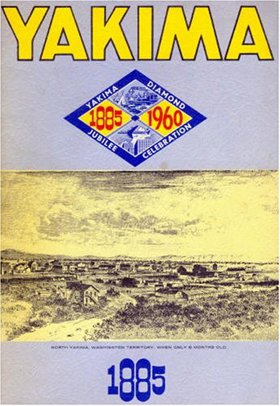
Click Relander and George M. Martin’s Yakima, Washington Jubilee, 1885-1960 chronicles the dramatic agricultural transformation of an arid, sun-baked basin trapped within the profound rain shadow of the towering Cascade Range. The narrative maps how the severe climatic realities of this sprawling sagebrush steppe forced early pioneers to execute massive hydrological projects, systematically diverting the glacier-fed Yakima River into extensive, life-sustaining irrigation networks. By detailing the physical relocation of the entire pioneer settlement to intercept the newly constructed Northern Pacific Railway, the text illustrates how a total reliance on engineered waterways and mechanized overland transit strictly dictated the region's economic viability. Ultimately, the account demonstrates that artificially mastering this localized hydrology to conquer a punishing high-desert climate was the absolute prerequisite for transitioning a barren inland expanse into a lucrative, globally recognized agricultural epicenter.
iv, 25, [12], 26-50, [2] pages : illustrations, portraits ; 25 cm
Non-circulating [ 1 ]
Yakima County
- Ahtanum
- Alfalfa
- American River
- Artesian
- Ashue
- Birchfield
- Blackrock (historical)
- Blacks Corner
- Brace
- Brownstown
- Buena
- Byron
- Cliffdell
- Cougar Valley
- Cowiche
- Donald
- East Selah
- Elliott Ave
- Emerald
- Eschbach
- Farron
- Flint
- Givens Corner
- Gleed
- Goose Prairie
- City of Grandview
- City of Granger
- Gromore
- Town of Harrah
- Harwood
- Holtzinger
- Liberty
- Lichty
- City of Mabton
- Midvale
- City of Moxee
- Town of Naches
- Nass
- Nile
- Outlook
- Parker
- Parrott Crossing
- Pinecliff
- Pomona
- Pomona Heights
- Rimrock
- Rupple
- Satus
- Sawyer
- City of Selah
- Silver Beach
- Summitview
- City of Sunnyside
- Tampico
- Tasker
- Terrace Heights
- City of Tieton
- Tietonview Grange
- City of Toppenish
- City of Union Gap
- Venner
- City of Wapato
- Washington Park
- Weikel
- Wenas
- Wesley Junction
- White Swan
- Wiley City
- Willy Dick Crossing
- City of Yakima
- Yethonat
- City of Zillah
Political Boundaries
Last updated: 2017-06-26