Town of Cathlamet Wahkiakum County, Washington
Cathlamet (KATH-LA-muht), county seat of Wahkiakum County, got its name from the Kathlamet Indians, a Chinook tribe. The tribal name comes from the Chinook word "calamet," meaning "stone" and was given to the tribe because they lived along a stretch of rocky river bed. Cathlamet was sighted in 1792 by Lt. W.R. Broughton, while verifying Capt. Robert Gray’s reported discovery of the Columbia River. In 1805, the Lewis & Clark Expedition found the Kathlamet and Wahkiakum tribes living here during their Northwest Expedition and they camped at the present day Vista Park in Skamokawa where they traded with the Indians. James Birnie of Hudson Bay Company settled here in 1846 and named the area Birnie’s Retreat. The name was later changed to Cathlamet in 1851. Other communities in Wahkiakum County include Puget Island, Skamokawa, Grays River, Rosburg, and Deep River.
Mapped Location
Town of Cathlamet: The mapped location is an approximation and should not be used for navigation or wayfinding.
Information
General information on Town of Cathlamet
- Feature Type: Incorporated
- Incorporated: Monday, February 4, 1907
Official, historical, colloquial and alternative toponyms for Town of Cathlamet
A brief list of names that this geographic feature has been named
| Name | Description |
|---|---|
| Town of Cathlamet | Official |
| Cathlamet | Official |
Origin Notes and History of Town of Cathlamet
References to Town of Cathlamet that document the origin of its place name
The Wahkiakums, who lived in the ancient Indian village on the Elokomon Slough, near Cathlamet, returned to the ancient townsite after the panic was over, but only to leave shortly after the coming of the Lewis and Clark expedition. This people gave their name to the County of Wahkiakum, within which Cathlamet is situated. What final catastrophe compelled the Wahkiakums to leave their ancient village is not known, but charred timbers and burned and blackened soil on the site of the old town point almost certainly to fire as the final scourge of the Indians on the Elokomon Slough.
One of the effects of this earlier decimation of the people was a scattering of all of the Indians of the Lower Columbia River Valley. They fled from their homes and temporarily settled in any place that provided them with the means of livelihood or that promised exemption from the plague that afflicted them. In this way Cathlamets, whose home was originally upon the Oregon side of the Columbia River, below Puget Island, after wanderings that are not recorded, finally settled upon the present site of Cathlamet and near the place of the ancient Indian town, and from this people the modern town derives its name.
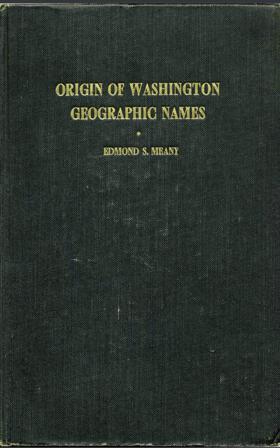
CATHLAMET, a city on the Columbia River, in Wahkiakum County. Lewis and Clark, 1805-1806, wrote the name "Cathlamah." Rev. Myron Eells says the word is evidently from the Indian word calamet, meaning "stone," and 'was given to the river because it has a stony bed along its whole course. (American Anthropologist, January, 1892.) Henry Ganett says the name is from the tribe of Indians known as Kathlamet. (Place Names in the United States.) The channel of the Columbia River north of Puget Island is known as Cathlamet Channel. Dr. W. Fraser Tolmie, of the Hudson's Bay Company, writes in 1833 of having arrived at Kahelamit village. (Washington Historical Quarterly, Volume III., page 232.)
Related Catalog Titles
A Bibliography for Town of Cathlamet, Wahkiakum County, Washington
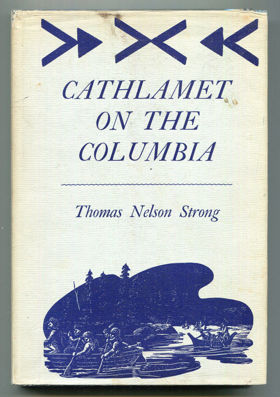
Cathlamet on the Columbia Recollections of the indian people and short stories of early pioneer days in the valley of the lower Columbia river. by Thomas Nelson Strong
Published in 1906, Thomas Nelson Strong’s Cathlamet on the Columbia provides a vivid historical account of early pioneer life along the lower Columbia River during the mid-to-late 19th century. The book chronicles the foundational days of the Cathlamet settlement in Washington State, highlighting the complex interactions between incoming settlers and the indigenous Chinookan tribes. Through personal recollections and short stories, Strong documents the region's cultural shifts, the tragic decline of local Native American populations due to disease, and the rugged realities of frontier survival. It remains a valuable primary source for understanding the social and environmental transformation of the Pacific Northwest prior to heavy industrialization.
xv, 170 pages, 1 unnumbered leaf of plates : colour, mounted illustration ; 21 cm
ONLINE CIRC [ 1 ] CIRC [ 1 ]
Related Online Resources
Wahkiakum County
- Altoona
- Brookfield
- Carlson Landing
- Town of Cathlamet
- Dahlia
- Deep River
- Eagle Cliff
- East Cathlamet
- Eden
- Flandersville
- Grays River
- Oneida
- Rosburg
- Skamokawa
- Sleepy Hollow
- State Camp
- Svensens Landing
- Waterford
Political Boundaries
Last updated: 2025-09-23