City of Baker City Baker County, Oregon
Mapped Location
City of Baker City: The mapped location is an approximation and should not be used for navigation or wayfinding.
Information
General information on City of Baker City
- Feature Type: Incorporated
Official, historical, colloquial and alternative toponyms for City of Baker City
A brief list of names that this geographic feature has been named
| Name | Description |
|---|---|
| City of Baker City | Official |
| Baker City | Official |
A Selected Bibliography of City of Baker City, Baker County, Oregon
A compilation of essential readings detailing the history, geography, and culture of the region.
Flagstaff Hill on the national historic Oregon Trail, Baker City, Oregon an interpretive guide by James R. Evans, Bert Webber

Published by historians James R. Evans and Bert Webber, Flagstaff Hill on the National Historic Oregon Trail, Baker City, Oregon: An interpretive guide serves as an informative companion to one of the most prominent overland trail sites in the American West. The book explores the dramatic geography and historic significance of Flagstaff Hill, which overlooks the historic ruts carved by thousands of covered wagons descending toward the Snake River valley. Utilizing archival photographs, maps, and trail diaries, the guide details the grueling final stretches of the Oregon Trail where pioneers faced exhaustion, disease, and the daunting transition from wilderness trekkers to exhausted settlers. A keen insight drawn from the work is how interpretive monuments freeze a complex historical tragedy into a romanticized pioneer narrative; by elevating Flagstaff Hill as a scenic monument to manifest destiny, the site risks reducing a violent process of indigenous displacement into a sanitized spectacle of rugged perseverance.
143 pages : illustrations, maps ; 22 cm
Non-circulating [ 1 ]
Powerful rockey the Blue Mountains and the Oregon Trail, 1811-1883 by John W. Evans, Eastern Oregon State College
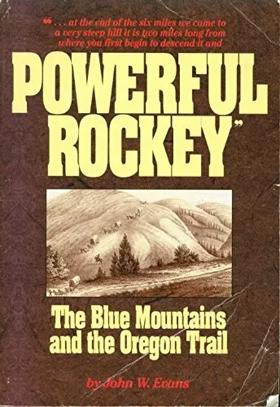
John W. Evans’s Powerful rockey: the Blue Mountains and the Oregon Trail, 1811-1883 explores the formidable geographic barriers and the profound overland adaptation required to navigate the final, grueling alpine stretches of the western migration route in northeastern Oregon. The narrative illustrates how the severe environmental realities of this rugged topography—defined by steep, densely timbered ridges, deep river ravines, and the sudden, harsh elevation gains rising abruptly from the arid eastern plains—required immense physical resilience and shared, cooperative labor from exhausted nineteenth-century emigrants. By detailing the gradual transition from precarious indigenous footpaths utilized by early fur trappers to the cooperative clearing of widened wagon roads and subsequent commercial toll routes, the text highlights how overcoming this massive geological hurdle was a defining, communal crucible for pioneers. Ultimately, the account demonstrates that patiently conquering the severe inclines of the Blue Mountains and collaboratively establishing vital supply settlements in the surrounding valleys were essential steps in transforming a treacherous wilderness barrier into an enduring, deeply rooted conduit for the civic and agricultural expansion of the Pacific Northwest.
xv, 374 pages : illustrations, maps ; 26 cm
Non-circulating [ 1 ]
Thirty-one years in Baker County. A history of the county from 1861 to 1893 by Isaac Hiatt

Published in 1893, Isaac Hiatt’s regional history chronicles the first three decades of pioneer settlement in Baker County, Oregon, beginning with the foundational 1861 gold strike at Griffin's Gulch. The narrative documents the rapid influx of prospectors, the establishment of the explosive boomtown of Auburn, and the region's subsequent economic transition toward permanent agriculture and civic development centered in Baker City. Hiatt provides valuable firsthand perspectives on frontier justice, early political organization, and the inevitable, often violent conflicts with indigenous populations as white settlers claimed the eastern Oregon landscape. A keen insight drawn from the text is how its granular account of Auburn's meteoric rise and subsequent total collapse vividly illustrates the fragile, transient nature of frontier mining booms, demonstrating that long-term regional stability relied entirely on the less glamorous pivot to agrarian permanence.
208 pages 22 cm
Non-circulating [ 1 ]
Baker County
- Auburn (historical)
- Audrey (historical)
- City of Baker City
- Bourne
- Bridgeport
- Brownlee
- Cableville (historical)
- Carroll (historical)
- Carson
- China Town
- Clarksville
- Conner Creek (historical)
- Cornucopia
- Cracker City (historical)
- Durkee
- Encina
- Erwin (historical)
- Estes (historical)
- City of Greenhorn
- City of Haines
- City of Halfway
- Hereford
- Homestead
- City of Huntington
- Hutchinson
- Jett (historical)
- Jimtown
- Keating
- Lime
- Little Alps
- McEwen
- New Bridge
- Oxbow
- Oxbow (historical)
- Parkersville (historical)
- Pine
- Pine Creek
- Pleasant Valley
- Pocahontas (historical)
- City of Richland
- Robinette
- Rock Creek
- Rye Valley
- Sparta
- City of Sumpter
- Sunset
- City of Unity
- Weatherby
- Whitney (historical)
- Wingville
Political Boundaries
Last updated: 2025-09-23