Umatilla County County
Umatilla County traces its creation in 1862 to the regional gold rushes, which spawned the riverport of Umatilla City and brought stockraisers to the lush grasslands.
Although Lewis and Clark and the Oregon Trail pioneers passed through Umatilla County, it did not bloom until the arrival of the railroad in 1881 and the development of dryland wheat farming.
Mapped Location
Umatilla County: The mapped location is an approximation and should not be used for navigation or wayfinding.
Information
General information on Umatilla County
- Feature Type: County
- County Seat: City of Pendleton
- Established: Saturday, September 27, 1862
Official, historical, colloquial and alternative toponyms for Umatilla County
A brief list of names that this geographic feature has been named
| Name | Description |
|---|---|
| Umatilla County | Official |
A Selected Bibliography of Umatilla County, County
A compilation of essential readings detailing the history, geography, and culture of the region.
Pendleton a short history of a real western town by Keith F. May, Christina Rae May
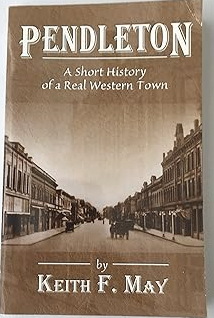
Published by Keith F. May and Christina Rae May, Pendleton: A Short History of a Real Western Town explores the dynamic evolution of this iconic Oregon community from its origins as a frontier trading post into a bustling agricultural and cultural hub. The book chronicles the town's rich heritage, highlighting the impact of the Oregon Trail, the arrival of the railroad, and the establishment of its famous woolen mills and annual Round-Up celebration. Through local anecdotes and historical highlights, the authors capture the rugged spirit and enduring character that distinguish Pendleton from standard suburban settlements. A keen insight drawn from the text is how communities like Pendleton leverage theatrical traditions like the rodeo not just for entertainment, but as vital cultural anchors that allow a changing rural economy to publicly perform and preserve its foundational mythos.
124 pages : illustrations, maps, portrait ; 22 cm
Non-circulating [ 1 ]
Powerful rockey the Blue Mountains and the Oregon Trail, 1811-1883 by John W. Evans, Eastern Oregon State College
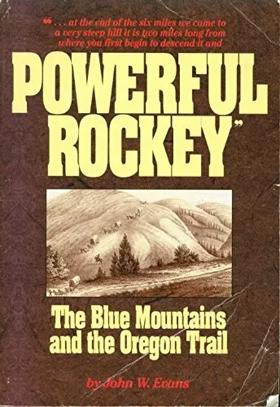
John W. Evans’s Powerful rockey: the Blue Mountains and the Oregon Trail, 1811-1883 explores the formidable geographic barriers and the profound overland adaptation required to navigate the final, grueling alpine stretches of the western migration route in northeastern Oregon. The narrative illustrates how the severe environmental realities of this rugged topography—defined by steep, densely timbered ridges, deep river ravines, and the sudden, harsh elevation gains rising abruptly from the arid eastern plains—required immense physical resilience and shared, cooperative labor from exhausted nineteenth-century emigrants. By detailing the gradual transition from precarious indigenous footpaths utilized by early fur trappers to the cooperative clearing of widened wagon roads and subsequent commercial toll routes, the text highlights how overcoming this massive geological hurdle was a defining, communal crucible for pioneers. Ultimately, the account demonstrates that patiently conquering the severe inclines of the Blue Mountains and collaboratively establishing vital supply settlements in the surrounding valleys were essential steps in transforming a treacherous wilderness barrier into an enduring, deeply rooted conduit for the civic and agricultural expansion of the Pacific Northwest.
xv, 374 pages : illustrations, maps ; 26 cm
Non-circulating [ 1 ]
Episode of the west the Pendleton Round-Up, 1910-1951 : facts and figures by E. N. Boylen

Episode of the west the Pendleton Round-Up, 1910-1951: facts and figures examines the cultural consolidation and equestrian traditions situated within the vast, semi-arid high desert plains and rolling bunchgrass prairies of northeastern Oregon's Umatilla River valley. Boylen details how the region's sweeping topography—specifically the expansive, sun-baked grazing lands, the rugged foothills of the Blue Mountains, and the wide, open spaces necessary for massive livestock operations—strictly dictated the margins of regional agriculture and fostered a deeply entrenched ranching culture. By mapping the transformation of this specific arid landscape into a celebrated arena of frontier exhibition, the narrative highlights how the sheer scale of the inland plateau directly shaped the grand equestrian spectacles and deeply rooted indigenous traditions of the famous rodeo. Ultimately, this civic and statistical record serves as a localized spatial history, demonstrating how the expansive, wide-open geography of this Pacific Northwest interior fundamentally defined the rugged, culturally intertwined, and fiercely pastoral character of the Pendleton community.
92, [6] pages : illustrations, portraits ; 21 cm
Non-circulating [ 1 ]
Historic sketches of Walla Walla, Whitman, Columbia and Garfield counties, Washington Territory, and Umatilla County, Oregon by Frank T. Gilbert
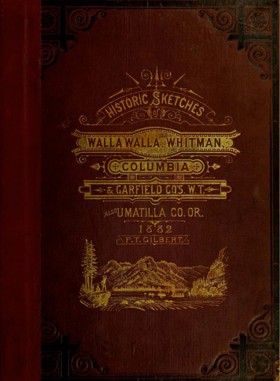
Published in 1882, Frank T. Gilbert's expansive regional history chronicles the rapid transformation of the Inland Empire—spanning eastern Washington and northeastern Oregon—from indigenous territory and fur-trade outposts to an agrarian powerhouse. The narrative meticulously details the violent conflicts of the Cayuse and Yakima Indian Wars, the establishment of early pioneer settlements, and the subsequent explosion of the region's lucrative dry-land wheat economy. A keen insight drawn from the text is how it perfectly exemplifies the Gilded Age "subscription history" model, where the grand, often brutal narrative of westward conquest was explicitly monetized by pairing regional chronicles with flattering biographical portraits of the affluent farmers and merchants who financed the publication. Consequently, while the volume remains an indispensable civic and genealogical archive, its historical framing intentionally sanitizes the systematic displacement of Native American tribes to celebrate the inevitable triumph of white, capitalist agriculture in the Columbia Basin.
447, [2], [449]-488, [12], 66 pages, [63] leaves of plates : illustrations, portraits ; 31 cm
ONLINE Circulation [ 1 ]
Umatilla County
- City of Adams
- Albee (historical)
- City of Athena
- Bingham Springs
- Bucks Corners
- Cayuse
- Charlestown
- Cobb
- Cold Springs
- Cold Springs Junction
- Crockett
- Duncan
- City of Echo
- Ferndale
- Fulton
- Gibbon
- Glendale
- Green Meadows
- Gurdane
- City of Helix
- City of Hermiston
- Hidaway Springs
- Hinkle
- Holdman
- Kirkpatrick
- Lehman Springs
- McKay
- Meacham
- City of Milton-Freewater
- Mission
- Nolin
- Nye
- Ordnance (historical)
- City of Pendleton
- City of Pilot Rock
- Power City
- Rieth
- Riverside
- City of Stanfield
- Sunnyside
- Tollgate
- Tutuilla
- City of Ukiah
- Umapine
- City of Umatilla
- Waterman
- City of Weston
Political Boundaries
Last updated: 2013-01-08