Camano Island Feature
Mapped Location
Camano Island: The mapped location is an approximation and should not be used for navigation or wayfinding.
Information
General information on Camano Island
- Feature Type: Feature
Official, historical, colloquial and alternative toponyms for Camano Island
A brief list of names that this geographic feature has been named
| Name | Description |
|---|---|
| Camano Island | Official |
Related Catalog Titles
A Bibliography for Camano Island, Feature
A father and an island reflections on loss by O. Alan Weltzien
As author Ann Ronald notes, "Simultaneously a paean to his father and a personal memoir about a changing landscape caught by a ‘rising tide of affluence,’ Alan Weltzein’s A Father and an Island:Reflections on Loss, echoes my own Pacific Northwest youth—the endless saltwater summers, the quirky behavior of a bookworm, the sweet sharp tang of blackberry cobbler, the fierce games of badminton, the beachcombing days of discovery, the blessedness of parents well loved. Anyone who’s grown up in and around Puget Sound will find familiar memories triggered on every delicious page. Some sweet,some nostalgic, some downright sad, they’re all here in this poignant remembrance of things past." Northwest author Mary Clearman Blew writes, "In this moving tribute to his father and his family’s home on a Puget Sound island,Alan Weltzein returns us to a time when summers were glorious and children played all day long on beaches that were still unexploited and unrestricted—a pleasure to read." Weltzien's memoir is an essential book for Northwest Letters.
288 pages ; 22 cm
CIRC [ 1 ]
Getting to the water's edge on Whidbey & Camano islands by Sarah Schmidt, Dan Pederson, Stacey Neumiller, WSU Beach Watchers, Washington State University Extension
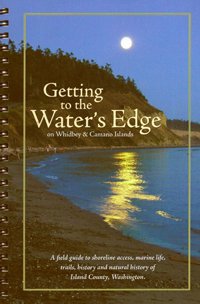
Published by Washington State University Extension and the WSU Beach Watchers, Getting to the Water’s Edge on Whidbey & Camano Islands serves as an exhaustive field guide to public shoreline access, marine life, and coastal trails across Island County. Compiled through extensive community research, the book details dozens of specific beaches, boat launches, and parks while weaving in rich context on local geology, natural history, and indigenous heritage. It bridges the gap between a practical recreational map and an environmental manual by emphasizing responsible stewardship of the fragile Salish Sea ecosystem. A keen insight drawn from the work is how citizen-science guidebooks function as powerful grassroots conservation tools; by meticulously cataloging public access points and educating visitors on local ecological sensitivities, the text transforms recreational day-trippers into active defenders of the regional shoreline.
ix, 166 pages : color illustrations, color maps ; 22 cm
CIRC [ 1 ]
Last updated: 2025-09-23