Whidbey Island Feature
Mapped Location
Whidbey Island: The mapped location is an approximation and should not be used for navigation or wayfinding.
Information
General information on Whidbey Island
- Feature Type: Feature
Official, historical, colloquial and alternative toponyms for Whidbey Island
A brief list of names that this geographic feature has been named
| Name | Description |
|---|---|
| Whidbey Island | Official |
Related Catalog Titles
A Bibliography for Whidbey Island, Feature
Hiking close to home Whidbey, Fidalgo, and Guemes Islands : 2023 edition by Maribeth Crandell
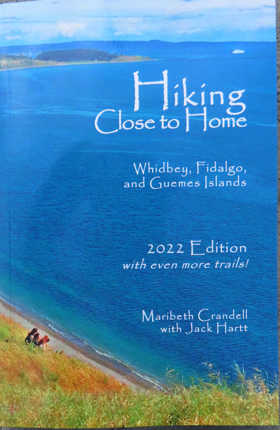
Forests, fields, beaches and bluffs -- our islands provide plenty of options for just about any hiking ability. You don't have to go very far. Explore your own backyard with this handy guide to more than seventy hikes that are Close to Home. Maribeth Crandell has over twenty years of experience as a hiking guide in the Pacific Northwest. For decades she's made Whidbey and Fidalgo Islands her home. Jack Harrt managed Deception Pass State Park for 14 years and now works with trail organizations in Skagit County. Here they share some of their favorite local trails with you."--Page 4 of cover
xii, 160 pages : color illustrations, color maps ; 22 cm
CIRC [ 1 ]
Whidbey Island's special places and the people who love them by Dan Pedersen

Through ten people, Pedersen tells the stories of 10 different places. The names are recognizable to many: Ranger Rick Blank at Deception Pass State Park, Roger Sherman on Central Whidbey, and Elliott Menasche, an authority on South Whidbey State Park, for example. In simple feature stories he smoothly describes the places and the people who treasure them. It’s an easy read, but surprisingly informative even for long-time islanders. You may not have known, for example, that the oldest tree on the island, located in Deception Pass State Park, recently celebrated its 860th birthday.
63 pages : color illustrations, color map ; 22 x 28 cm
CIRC [ 1 ]
Getting to the water's edge on Whidbey & Camano islands by Sarah Schmidt, Dan Pederson, Stacey Neumiller, WSU Beach Watchers, Washington State University Extension

Published by Washington State University Extension and the WSU Beach Watchers, Getting to the Water’s Edge on Whidbey & Camano Islands serves as an exhaustive field guide to public shoreline access, marine life, and coastal trails across Island County. Compiled through extensive community research, the book details dozens of specific beaches, boat launches, and parks while weaving in rich context on local geology, natural history, and indigenous heritage. It bridges the gap between a practical recreational map and an environmental manual by emphasizing responsible stewardship of the fragile Salish Sea ecosystem. A keen insight drawn from the work is how citizen-science guidebooks function as powerful grassroots conservation tools; by meticulously cataloging public access points and educating visitors on local ecological sensitivities, the text transforms recreational day-trippers into active defenders of the regional shoreline.
ix, 166 pages : color illustrations, color maps ; 22 cm
CIRC [ 1 ]
A history of Whidbey's Island (Whidbey Island), State of Washington by George Albert Kellogg, Island County Historical Society

Published by the Island County Historical Society and authored by early pioneer descendant George Albert Kellogg, A History of Whidbey's Island, State of Washington chronicles the foundational decades of Puget Sound's largest island through the eyes of those who settled it. The book details the arrival of the first European-American homesteaders, maritime trading exploits, encounters with local Indigenous populations, and the arduous establishment of agriculture and civic infrastructure across the mid-to-late 19th century. Drawing on firsthand accounts, local lore, and early archival records, the text preserves the gritty, self-reliant spirit of a community forged in maritime isolation. A keen insight drawn from the work is how pioneer-authored local histories functioned as acts of cultural legitimation; by meticulously recording the trials of early settlement, authors like Kellogg sought to rapidly replace a deep, ancient indigenous geography with a heroic, permanent Anglo-American narrative of progress.
183 pages : maps, portrait ; 21 cm
CIRC [ 1 ]
A maritime history of central Whidbey Island. Part 1, The sinking of the Calista by Roger M. Sherman
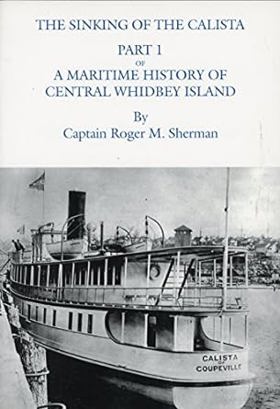
Authored by maritime historian Roger M. Sherman, A Maritime History of Central Whidbey Island, Part 1: The sinking of the Calista details the dramatic local shipping losses and aquatic commerce that shaped the marine highway of Washington's Puget Sound. The volume centers on the fateful shipwreck of the steamer Calista, exploring the intricate mechanics of early 20th-century coastal navigation, passenger travel, and the relentless dangers posed by shifting winds and hidden reefs. Through detailed archival research, contemporary newspaper accounts, and maritime logs, the text brings to light the perilous conditions faced by the small vessels that served as the primary lifeblood of island communities. A keen insight drawn from the work is how maritime disasters served as tragic catalysts for regulatory and technological reform in inland sea transport; the loss of vessels like the Calista forced an unyielding reckoning with corporate safety standards, transforming public attitudes toward the accountability of commercial navigation lines operating in dangerous Pacific Northwest waters.
xii, 144 pages : illustrations, maps ; 26 cm
CIRC [ 1 ]
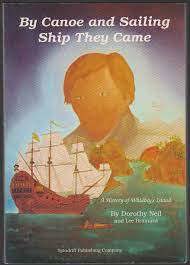
By canoe and sailing ship they came a history of Whidbey's Island by Dorothy Neil, Lee Brainard
South Whidbey and its people Volume 3: Langley, The Village by the Sea by Lorna Cherry, South Whidbey Historical Society

Langley, The Village by the Sea: A gleam in the eye of a teen-age German boy becomes a South Whidbey village. The village becomes a town and the town becomes a city
volumes : illustrations ; 26 cm
CIRC [ 1 ]
South Whidbey and its people Volume 2 by Lorna Cherry, South Whidbey Historical Society

Towns are begun. Immigrants and pioneers gouge a living from pristine Whidbey forests. Roads are built, and civilization creates a unified society
volumes : illustrations ; 26 cm
CIRC [ 1 ]
South Whidbey and its people Volume 1 by Lorna Cherry, South Whidbey Historical Society

How it was formed. Indians - the first inhabitants. Early explorers and the arrival of settlers. The giant mammoths that once roamed here. And much, much, more.
volumes : illustrations ; 26 cm
CIRC [ 1 ]
"A particular friend, Penn's Cove" a history of the settlers, claims, and buildings of central Whidbey Island by Jimmie Jean Cook
Amazing compendium documenting central Whidbey from the Native Americans, early settlers, pioneer family information and photographs.
148 pages illustrations 28 cm
CIRC [ 1 ]
Last updated: 2015-08-21