American Camp Feature
Mapped Location
American Camp: The mapped location is an approximation and should not be used for navigation or wayfinding.
Information
General information on American Camp
- Feature Type: Feature
Official, historical, colloquial and alternative toponyms for American Camp
A brief list of names that this geographic feature has been named
| Name | Description |
|---|---|
| American Camp | Official |
A Selected Bibliography of American Camp, Feature
A compilation of essential readings detailing the history, geography, and culture of the region.
The Pig War the last Canada-US border conflict by Rosemary Neering
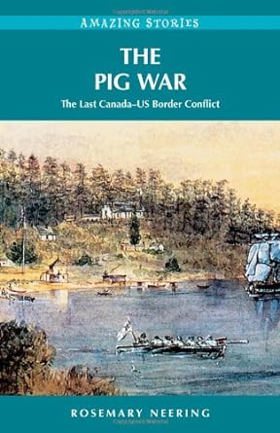
On May 15, 1859, an American settler on San Juan Island shot a pig belonging to the Hudsons Bay Company. This seemingly insignificant act was the spark that almost set aflame the strangest of many confrontations between Britain and the United States on the northwest coast of North America. On one side of the border dispute over the strategically located San Juan Islands was Governor James Douglas, determined to protect the interests of the Hudsons Bay Company and prove the military superiority of Britain. On the other side was General William Selby Harney, spoiling for a fight and believing in Americas manifest destiny to rule the continent. In this lively account of the conflict that became known as the Pig War, Rosemary Neering traces the events that led to the standoff in the San Juans and brings to life the memorable characters who played leading roles in the drama. The book is an excellent travel companion to anyone visiting the San Juans and the original American and British camps that are open to the public.
142 p. : ill., maps, ports. ; 22 cm.
Non-circulating [ 1 ]
The Pig War and other experiences of William Peck soldier 1858-1862, U.S. Army Corps of Engineers : the journal of William A. Peck, Jr. by William A. Peck, C. Brewster Coulter, Bert Webber
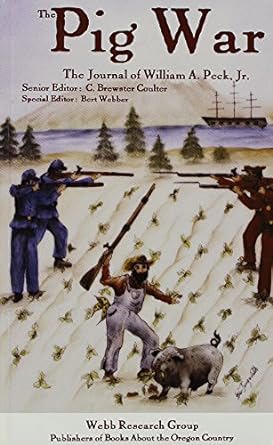
Edited by C. Brewster Coulter and Bert Webber, The Pig War and Other Experiences of William Peck, Soldier 1858-1862 presents the remarkable personal journal of a U.S. Army engineer stationed in the Pacific Northwest during a tense geopolitical standoff. The book chronicles Private William A. Peck's daily life, military duties, and keen observations surrounding the infamous 1859 San Juan Island boundary dispute between the United States and Great Britain. Through these rare primary documents, the text captures the stark isolation, raw camp conditions, and quiet diplomacy that characterized an uneasy international borderlands garrison. A keen insight drawn from the work is how military journals humanize imperial brinkmanship; by filtering an international crisis through the mundane daily chores and reflective musings of an ordinary soldier, the narrative reveals that historical flashpoints are often lived not as grand historical dramas, but as tedious, freezing waits in remote wilderness outposts.
x, 236 pages : illustrations, maps ; 21 cm
Non-circulating [ 1 ]
San Juan saga a unique history of the San Juan Islands and the Pig War told in words and pictures from the long-running historical pageant by Emelia L. Bave
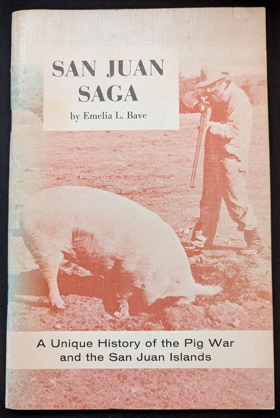
San Juan saga: a unique history of the San Juan Islands and the Pig War examines the strategic military occupation and precarious pioneer settlement of a deeply contested, heavily forested archipelago situated at a critical aquatic chokepoint of the Salish Sea. Bave details how the region's formidable physical barriers—specifically the treacherous tidal currents of the Haro and Rosario straits, the rugged, rocky shorelines, and the severe aquatic isolation from mainland authorities—strictly dictated the margins of international diplomacy and early homesteading. By mapping the tense military standoff and the arduous daily labor of isolated settlers navigating this fractured marine topography, the narrative highlights the immense logistical endurance required to maintain sovereign claims within this demanding maritime environment. The profound geographic ambiguity of the navigable water routes initially forced both British and American forces into a strict reliance on the deepwater marine highway for troop deployment and basic survival, completely anchoring their strategic encampments to the precise, defensive contours of the island's sheltered bays and sweeping, wind-battered prairies. Ultimately, this theatrical and historical record serves as a deeply localized spatial history, demonstrating how the complex aquatic geography and immense navigational significance of this Pacific Northwest frontier fundamentally shaped the fiercely resilient, highly contested character of the San Juan archipelago.
x, 25 pages : illustrations ; 24 cm
Non-circulating [ 1 ]
Last updated: 2012-03-19