Catalog of British Columbiana and Pacific Northwest Americana
Encyclopedia Cascadia Catalog contains book titles of mostly non-fiction Pacific Northwest Coast of North America Titles (primarially British Columbia, Idaho, Oregon and Washington State) in an easy-to-understand title catalog. If you see a link with this badge ONLINE CIRC it means that there is an online institution that provides free access to that title. In some cases there may be more than one institution hosting the title digitally.
| Catalog Title | Published |
|---|---|
|
Hiking Oregon's history by William L. Sullivan, Navillus Press 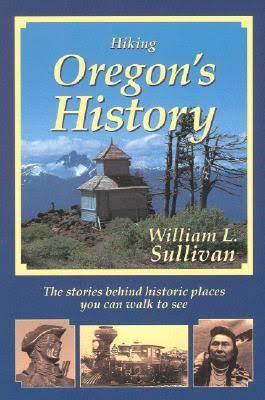
This guidebook tells the stories behind 56 of the state's most scenic historic sites. Come follow Lewis and Clark's trail across Tillamook Head. Ride with Chief Joseph on his tragic retreat through Hells Canyon. Discover paths to fire lookouts, lighthouses, and abandoned gold mines. Relive legends, discoveries, scandals, and triumphs that rocked the West. Come hike Oregon's history! -- Amazon 319 pages : illustrations, maps ; 23 cm CIRC [ 1 ]
|
1999 |
|
Hiking from Portland to the coast an interpretive guide to 30 trails by James D. Thayer 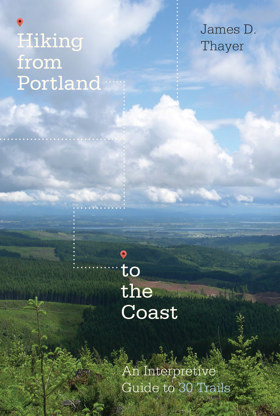
A guidebook for both experienced and casual hikers, Hiking from Portland to the Coast explores the many trails and logging roads that crisscross the northern portion of Oregon’s Coast Range. While showcasing convenient “looped” routes, it also describes complete throughways connecting Portland to the coastal communities of Seaside and Tillamook. Designed to both inform and entertain, each of the 30 trails described includes a “backstory” highlighting the rich histories of Native Americans, white settlers, loggers, and railroad operators. While suitable for hikers, equestrians, and bikers, many of these trails have never been surveyed for recreational use. All are meticulously surveyed and described here, alongside detailed and annotated maps. Some trails are located on private timber holdings, accessible only by paid permit, while access to others is free. In most cases vehicular traffic is not permitted; neither is camping, littering, or making fires. From time to time, access may be restricted due to fire danger or commercial activity. The maps, notes, and tips provided in Hiking from Portland to the Coast will be invaluable for those adventurers who wish to wander far from the beaten track. Less intrepid explorers will find plenty of short and scenic exploratory hikes in the forests that parallel Highway 26 to Seaside or Highway 6 to Tillamook. 272 pages : illustrations, maps ; 24 cm CIRC [ 0 ]
|
2016 |
|
Hiking close to home Whidbey, Fidalgo, and Guemes Islands : 2023 edition by Maribeth Crandell 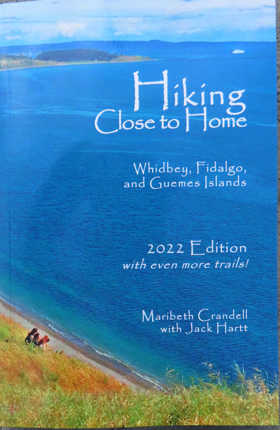
Forests, fields, beaches and bluffs -- our islands provide plenty of options for just about any hiking ability. You don't have to go very far. Explore your own backyard with this handy guide to more than seventy hikes that are Close to Home. Maribeth Crandell has over twenty years of experience as a hiking guide in the Pacific Northwest. For decades she's made Whidbey and Fidalgo Islands her home. Jack Harrt managed Deception Pass State Park for 14 years and now works with trail organizations in Skagit County. Here they share some of their favorite local trails with you."--Page 4 of cover xii, 160 pages : color illustrations, color maps ; 22 cm CIRC [ 1 ]
|
2022 |
|
Highlights of Seattle's history illustrated by James R. Warren, William R. McCoy , Historical Society of Seattle and King County (Publisher)
|
1982 |
|
High Desert, Higher Costs bend and the housing crisis in the american west by Jonathan Bach 
Nestled against the Cascade Mountains, former lumber town Bend, Oregon, entices residents who long to live in a wonderland of sagebrush and forests. But like so many other communities across the West, Bend has too few homes for everyone clambering for access. In High Desert, Higher Costs, Jonathan Bach takes a closer look at the housing crisis in this mid-sized city that is both the population center for rural Central Oregon and a major recreation area. Bach uses Bend as a lens into the growing housing crisis in the region, where residents and tourists alike prize access to outdoor recreation, and housing issues have been brewing for decades. Like other cities in Montana, Idaho, and Colorado, Bend serves as a gateway to popular natural areas while also experiencing a limited amount of new housing, increasing populations, amenity migrants in the age of remote work, depressed or stagnating wages, and a widening gulf between homeowners and renters. High Desert, Higher Costs introduces us to regular people—from the former political candidate evicted during COVID-19 to the nonprofit worker hoping to build apartments for the houseless—who struggle to call Bend home. Bach explores the causes of these issues and the political, legal, economic, and cultural factors influencing them, and also offers potential solutions for current and future residents to build their lives now, and in the years to come, in Bend and throughout the American West. 6x9 inches, 200 pages, 10 black-and-white photos CIRC [ 0 ]
|
2025 |
|
Hidden history of Yakima by Ellen Allmendinger 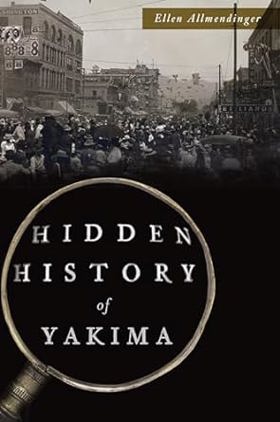
"Forgotten events, buildings, businesses and people helped shape Yakima. Vice dominated the city's early landscape when it was called North Yakima. Gambling halls and saloons like the Alfalfa Saloon bustled, while hotels such as the Sydney and Empire offered respite. Primitive circuses, underground tunnels, South Front Street opium dens and the arrival of a crossdresser named Nell Pickerell created further strife. City hall's understaffed police force and overcrowded jail complicated matters. Fires in 1890 and 1907 consumed several of the early structures--sometimes twice--keeping firefighters frayed. The Asian community thrived despite racial tensions until the forced evacuation of Japanese residents in 1942. Author Ellen Allmendinger uncovers what remains overlooked and veiled from sight." -- Amazon.com viewed May 15, 2020 126 pages : illustrations ; 23 cm. CIRC [ 1 ]
|
2018 |
|
Heritage of the Wallowas life as it was by Ethel Halsey Scott 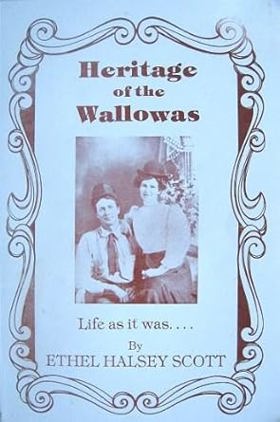
Ethel Halsey, daughter of Bill Halsey (born 1873) and Vergie Bell Pinkley (born 1886), was born in the early 1900s. She tells of her life with her husband, Noel Scott, and her children and extended family and friends and neighbors, weaving these with the history of the Wallowa, Oregon area iii, 153 pages : illustrations ; 23 cm CIRC [ 1 ]
|
1980 |
|
Here there nowhere paintings by Michael Brophy, Jonathan Raban, William L. Lang, Randy Gragg 
Michael Brophy has painted the Pacific Northwest landscape for over two decades, from sumptuously rendered panoramas of clearcuts and slag heaps to comic-book-scaled noir tableaus of the characters who reshaped the region 150 years ago. This large-scale monograph brings 15 of his most historically expansive paintings to date together with writings on the artistic and cultural history of the Northwest landscape by essayist Jonathan Raban and historian William L. Lang. The influences on Brophy’s painting stretch from Goya and Velasquez to Robert Colescott and George Baselitz. He has riffed on everything from obscure Wobbly songs to Chinook jargon dictionaries to the writings of Stewart Holbrook. But Here There Nowhere marks a bold new direction in Brophy’s work. More sweeping in scope and minimalist in style, the paintings portray what he calls the "Big Empty," the dramatic, vacant spaces of the Northwest's eastern deserts and western coast but with an eye toward the coming endgame of Manifest Destiny. Raban's essay, Battleground of the Eye, traces two centuries of artistic conflict between the verdant, people-free Northwest most painters chose to portray vs. the fully populated and exploited landscape that actually existed. Lang's essay, An Insatiable Hunger: The Consuming Myth of the Northwest, probes the changing mythology of Pacific Northwest landscape as it has progressed from an apparently infinite resource for extractive industries to a playground for an expanding consumer class. Designer John Laursen has translated the sweeping power of Brophy's work to the scale of a 12-by-12-inch book with the 200-line reproductions imaged direct to plate and printed by Portland’s award-winning Millcross Litho. 49 pages : color illustrations ; 30 x 31 cm CIRC [ 0 ]
|
2007 |
|
Here on the edge how a small group of World War II conscientious objectors took art and peace from the margins to the mainstream by Steve McQuiddy 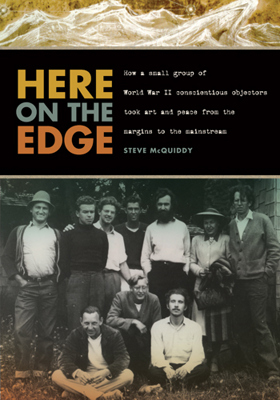
The fascinating story of one conscientious objector camp located on the rain-soaked Oregon Coast, Civilian Public Service (CPS) Camp #56. As home to the Fine Arts Group at Waldport, the camp became a center of activity where artists and writers from across the country focused their work not so much on the current war, but on what kind of society might be possible when the shooting finally stopped. They worked six days a week planting trees, crushing rock, building roads, and fighting forest fires in exchange for only room and board. At night, they published books under the imprint of the Untide Press. They produced plays, art, and music all during their limited non-work hours, with little money and few resources. After the war, camp members went on to participate in the San Francisco Poetry Renaissance of the 1950s, which heavily influenced the Beat Generation of Jack Kerouac, Allen Ginsberg, and Gary Snyder who in turn inspired Ken Kesey and his Merry Pranksters, leading the way to the 1960s upheavals epitomized by San Francisco s Summer of Love. As camp members engaged in creative acts, they were plowing ground for the next generation, when a new set of young people, facing a war of their own in Vietnam, would populate the massive peace movements of the 1960s viii, 326 pages : illustrations ; 26 cm CIRC [ 0 ]
|
2013 |
|
Here on the Coast reflections from the Rainbelt by Howard White 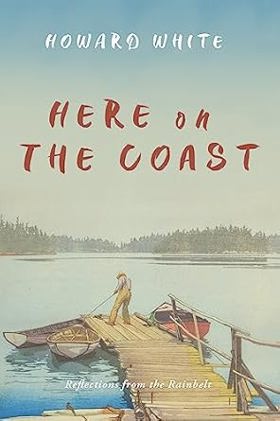
"No matter where people live on the BC coast, says Howard White, they have certain shared experiences: frustration with rain and ferries, familiarity with gumboots, bumbershoots, seagull droppings and barnacles in the wrong places. But each little community clings to its own sense of uniqueness and considers itself the true West Coast. As a case in point, White offers fifty funny sketches of life as he has come to know it in sixty-odd years of living along that hundred-mile stretch of monsoon-prone shoreline ironically known as the Sunshine Coast. Included is what must be one of the most admiring testaments ever written about the virtues of the old-time outhouse; fond remembrances of saltwater fishing when a bad day meant you didn't hook something in twenty minutes; and explorers who stooped to naming islands after favourite racehorses. We also meet a bouquet of characters, including a lyrical logger known as Pete the Poet; a diabolical seagoing remittance man; the saintly Quaker philosopher Hubert Evans and White's barrier-busting Aunt Jean who taught him the advantages of 'scientifically enlarging the truth.' Along with accounts of waste disposal wars and wry observations on modern technology, Here On the Coast offers a West Coast counterpart to such favourites as Letters From Wingfield Farm and Sunshine Sketches of a Little Town."-- Provided by publisher xiv, 205 pages : illustrations ; 23 cm CIRC [ 0 ]
|
2021 |
|
Her finest hour shipbuilding in the Portland area during World War II (1941-1945) by Robert R. La Du 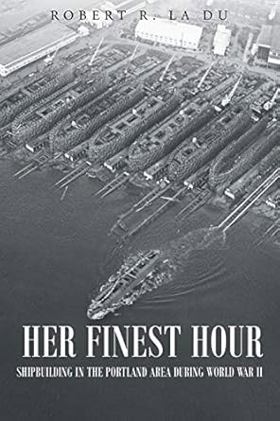
This work describes the monumental accomplishments of the World War II shipyards in Portland, Oregon, and Vancouver, Washington. Working twenty-four hours a day, seven days a week, they built and launched thousands of vessels--Liberty ships, Victory ships, tankers, aircraft carriers, submarine chasers, and many kinds of landing craft--to help defeat the Axis powers and preserve the way of life of the free world. Robert La Du viewed firsthand these activities from his home overlooking shipyards on the Willamette River. His father worked at Albina shipyard, his sister worked at Henry Kaiser's Swan Island shipyard, and he himself, as a high school student, worked nights at Commercial Iron and Steel shipyard. These experiences inform and enhance the pages of Her Finest Hour. 170 pages : illustrations ; 22 cm CIRC [ 0 ]
|
2016 |
|
Henry M. Jackson a life in politics by Robert Gordon Kaufman 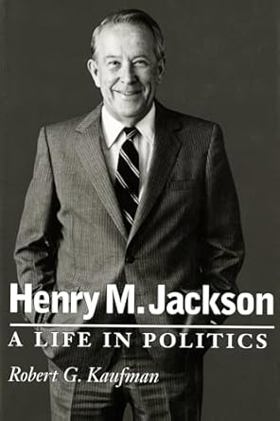
Henry M. Jackson ranks as one of the great legislators in American history. With a Congressional career spanning the tenure of nine Presidents, Jackson had an enormous impact on the most crucial foreign policy and defense issues of the Cold War era, as well as a marked impact on energy policy, civil rights, and other watershed issues in domestic politics. Jackson first arrived in Washington, D.C., in January 1941 as the Democratic representative of the Second District of Washington State, at the age of 28 the youngest member of Congress. “Scoop” Jackson won reelection time and again by wide margins, moving to the Senate in 1953 and serving there until his death in 1983. He became a powerful voice in U.S. foreign policy and a leading influence in major domestic legislation, especially concerning natural resources, energy, and the environment, working effectively with Senator Warren Magnuson to bring considerable federal investment to Washington State. A standard bearer for the New Deal-Fair Deal tradition of Roosevelt and Truman, Jackson advocated a strong role for the federal government in the economy, health care, and civil rights. He was a firm believer in public control of electric and nuclear power, and leveled stern criticism at the oil industry’s “obscene profits” during the energy crisis of the 1970s. He ran for the presidency twice, in 1972 and 1976, but was defeated for the nomination first by George McGovern and then by Jimmy Carter, marking the beginning of a split between dovish and hawkish liberal Democrats that would not be mended until the ascendance of Bill Clinton. Jackson’s vision concerning America’s Cold War objectives owed much to Harry Truman’s approach to world affairs but, ironically, found its best manifestation in the actions taken by the Republican administration of Ronald Reagan. An early and strong supporter of Israel and of Soviet dissidents, he strongly opposed the Nixon/Kissinger policy of detente as well as many of Carter’s methods of dealing with the Soviet Union. Robert Kaufman has immersed himself in the life and times of Jackson, poring over the more than 1,500 boxes of written materials and tapes that make up the Jackson Papers housed at the University of Washington, as well as the collections of every presidential library from Kennedy through Reagan. He interviewed many people who knew Jackson, both friends and rivals, and consulted other archival materials and published sources dealing with Jackson, relevant U.S. political history and commentary, arms negotiation documents, and congressional reports. He uses this wealth of material to present a thoughtful and encompassing picture of the ideas and policies that shaped America’s Cold War philosophy and actions. x, 548 pages, 24 unnumbered pages of plates : portraits ; 23 cm CIRC [ 0 ]
|
2015 |
|
Henry J. Kaiser builder in the modern American West by Mark S. Foster, William H. Goetzmann 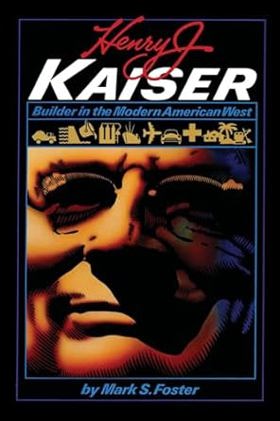
In the 1940s Henry J. Kaiser was a household name, as familiar then as Lee Iacocca and Donald Trump are now. Like a Horatio Alger hero, Kaiser rose from lower-middle-class origins to become an enormously wealthy entrepreneur, building roads, bridges, dams, and housing. He established giant businesses in cement, aluminum, chemicals, steel, health care, and tourism. During World War II, his companies built cargo planes and Liberty ships. After the war, he manufactured the Kaiser-Frazer automobiles. Along the way, he also became a major force in the development of the western United States, including Hawaii. Henry J. Kaiser: Builder in the Modern American West is the first biography of this remarkable man. Drawing on a wealth of archival material never before utilized, Mark Foster paints an evenhanded portrait of a man of driving ambition and integrity, perhaps the ultimate "can-do" capitalist. He covers Kaiser's entire life (1882-1967), emphasizing many business ventures. He demonstrates that Kaiser was the prototypical "frontier" entrepreneur who often used government and union support to tame the "wilderness." xiv, 358 pages, 32 unnumbered pages of plates : illustrations ; 25 cm. CIRC [ 0 ]
|
1989 |
|
Henry & self a British gentlewoman at the edge of empire by Kathryn Bridge 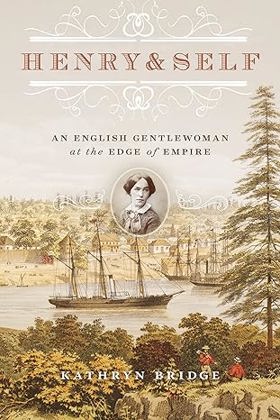
"An intimate portrait of privilege and struggle, scandal and accolade, from the Old World to the new colonies of Vancouver's Island and British Columbia. At the age of 33, Sarah Crease left behind her home in England to travel with her young family to a farflung outpost of the British Empire on the Pacific coast of North America. The detailed journals, letters and artwork she would create over the next half-century as she and her husband, Henry, established themselves in the New World, offer a rich window into the private life and views of an English colonist in British Columbia. In a world where history is still primarily told by men, Henry and Self is a woman's story told in her own words. But it is also a story of the times she lived in, and the ways in which her class, social standing and role as a settler shaped her relationships with the world around her. Henry & Self is the personal story of a remarkable woman who lived through nearly a century of British colonial history, but also a unique first-person perspective on the beliefs and motivations that shaped that history."-- Provided by publisher 234 pages : illustrations, maps ; 23 cm CIRC [ 0 ]
|
2019 |
|
Hells heroes how an unlikely alliance saved Idaho's Hells Canyon by Chris Carlson , Rick Johnson 
There is a story. There is a story of how Hells Canyon was saved. A story about this special place and special people who care about it. Brock Evans has written that real epics, are not about the deeds of gods and goddesses...Epics are what ordinary people do, rising to scary and demanding occasions and stumbling through them no matter what. Hells Canyon has epic written all over it. One of the West's great rivers slices through it. The rising bluffs and mountains create one of the deepest gorges on earth. The Seven Devils look down from a height of 7,000 feet above the Snake River. But the real epic is in the story of the people who love the place, and of those who worked to save it. 208 pages : color illustrations ; 23 cm CIRC [ 0 ]
|
2018 |
A story of the deepest canyon on the North American continent, together with historical sketches of Idaho, interesting information of the state, Indian Wars and mythology, poetry and stories. You asked for it. Here it is, a reprint of the revised edition of “Hell’s Canyon”. I hope you will find it just as valuable as the original printing. The Publisher 575 p. illus., ports., maps. 24 cm. CIRC [ 1 ]
|
1984 |
|
Helen Dawe's Sechelt by Helen Dawe 
As we enter the 1990s, we mark the 100th anniversary of the decade which saw the establishment of a white settlement at Sechelt, British Columbia. The first of those settlers, Thomas John Cook, was the grandfather of Helen Dawe, who established for herself a reputation as the foremost chronicler of Sechelt history. Helen Dawe's Sechelt brings together her work on the founding and development of a community that has since become the hub of the Sunshine Coast. The book features a personal and anecdotal view of many of Secheit's founders, both white and Indian, and contains over 120 vintage photographs, taken from one of the most impressive private collections in the province. The result is much more than a local history. It is both a case study of how modem British Columbia was built, and a personal introduction to some of the people who were its builders. 150 pages : illustrations ; 29 cm CIRC [ 1 ]
|
1990 |
|
Heaven on the half shell the story of the oyster in the Pacific Northwest by David G. Gordon , Samantha Larson , MaryAnn Barron Wagner 
Heaven on the Half Shell offers a thoroughly researched and richly illustrated history of the Pacific Northwest’s beloved bivalve, the oyster. Starting with the earliest evidence of sea gardens and clam beds from 11,500 years ago, this book covers the history of oyster cultivation through contemporary aquaculture in coastal Washington, Oregon, British Columbia, northern California, and southeastern Alaska. Generations of oyster farmers, Native and non-Native, have weathered many challenges to continue the harvest. Their vivid individual accounts are braided together with significant history, such as the major contributions of Japanese immigrants prior to World War II and the 1994 Rafeedie decision that affirmed shellfish harvesting rights held by Northwest tribes. The book also sheds light on the innovations that made oysters an enduringly popular food, from the creation of so-called sexless oysters that could be consumed year-round to breakthroughs in contemporary oyster cuisine. Now fully updated and expanded—and chock-full of “oysterabilia”—this classic text shares new insights on emerging challenges to the oyster farmer’s life as well as increased coverage of the roles of women and contemporary tribes in building this cultural tradition, past and present. Newcomers and aficionados alike will also be delighted by the carefully selected recipes, both historic and contemporary, from the region’s top chefs. As the old saying goes, when the tide is out, the table is set. xiii, 228 pages : illustrations (chiefly color), maps, 19 x 23 cm CIRC [ 0 ]
|
2023 |
|
Heave to! You'll drown yourselves! by Stan Allyn
|
1984 |
|
Haunting British Columbia ghostly tales from the past by Mike McCardell 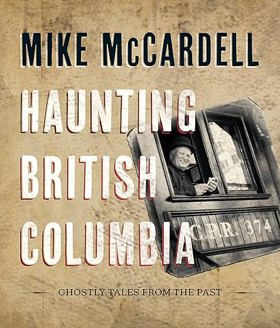
"Broadcaster and bestselling author Mike McCardell haunts British Columbia's past in order to summon spellbinding tales of Western Canada. Reprising his 2013 bestseller Haunting Vancouver, Mike McCardell summons the ghost of real-life pioneer Jock Linn to provide hair-raising and humorous versions of what really happened during some of the formative events that shaped British Columbia. In Haunting British Columbia, McCardell's ghostly narrator explains how Victoria became BC's capital (spoiler, it's all because Governor James Douglas couldn't stand waiting for a ferry); how Gassy Jack gave birth to Vancouver by running a beloved saloon, and more importantly how gassy he really was; and much, much more. As the thousands who follow McCardell's long-running human-interest features on the evening news know, he has a fascination with the provincial past as well as an uncanny ability to unearth captivating and forgotten stories. Richly illustrated with archival photos and ghostly doodles, Haunting British Columbia is as fun to read as it is a revealing tour of what really happened in those bygone days. And it's all true... well, almost."-- Provided by publisher 224 pages : illustrations, portraits ; 24 cm CIRC [ 0 ]
|
2021 |
|
Hastings Mill the historic times of a Vancouver community by Lisa Anne Smith 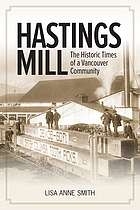
"In the summer of 1865 when Captain Edward Stamp began to organize the construction of a small sawmilling operation on the south shore of Burrard Inlet, he likely never realized that a future metropolis was in the making. The fledgling Stamp's Mill, later to become known as Hastings Mill, was Vancouver's first community -- a townsite inhabited by an eclectic mix of colourful characters from widely diverse backgrounds. Life centered on the iconic Hastings Mill Store, where one came to obtain groceries, hardware, mail and the warmth of human interaction around an oil drum fire. Historic times aplenty unfolded at Hastings Mill. Here residents rallied to assist victims of the Great Vancouver Fire in 1886. Cargo loads of lumber of legendary size and quality were shipped to markets near and far. Dominion Day festivities were celebrated in fine style on a sports field of mill sawdust. Indigenous occupants of the region engaged in mill employment and commerce. Chinook jargon was widely spoken, the multi-lingual trade language of the era. When time and local demographics ultimately spelled the death knell for the sawmill and its weathered structures in 1930, an unlikely group of determined ladies rose to the challenge of saving the Hastings Mill Store, Vancouver's oldest building."-- Back cover xiii, 329 pages : illustrations, map ; 23 cm CIRC [ 0 ]
|
2021 |
|
Harvest Wobblies the Industrial Workers of the World and agricultural laborers in the American West, 1905-1930 by Greg Hall 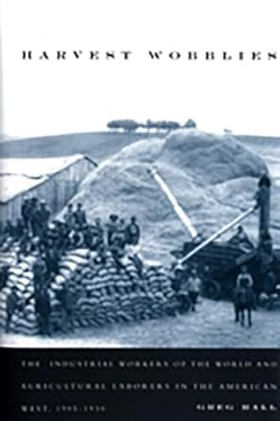
Increased Mechanization and the expansion of new markets transformed the face of American farming in the early decades of the twentieth century, especially in the American West. These changes demanded a new kind of agricultural worker--gone was the local farmhand, replaced by a cheap and temporary labor force of migrant and seasonal workers. Greg Hall's fascinating book analyzes how "harvest Wobblies," members of the Industrial Workers of the World (IWW), organized these men, women, and sometimes children who had become so essential and yet so exploited on the farms of the West. Although harvest Wobblies worked in nearly all the western states, their stongholds were the Great Plains, California, and the Pacific Northwest, regions where harmers developed monocrop agriculture and where seasonal labor was indispensable come harvest time. Like their IWW brethren in logging camps and mines, the harvest Wobblies combined an effort to improve the lives of workers with harger revolutionary goals. Harvest Wobblies personified most of the indelible features of IWW membership: they were the militant casual laborers of the American West, riding the rails, living in hobo jungles, preaching revolution, and facing repression with innovative strategies, impassioned speech, humor, and song. Through trial and error, Wobbly organizers eventually implemented the idea of an industrial union in agriculture and helped the IWW to establish itself as a powerful force to be reckoned with by employers in the West. In tracing the rise and the eventual fall of the harvest Wobblies, Greg Hall examines the diverse and changing nature of the agricultural work force. He offers a social and cultural history of a union uniquely suited to organizing tens of thousands of migrant and seasonal workers. Harvest Wobblies will appeal to a broad audience of readers interested in labor history, the American West, U.S. agricultural history, and the history of the WWI. 279 pages : illustrations, map ; 24 cm CIRC [ 0 ]
|
2001 |
|
Harvest heritage agricultural origins and heirloom crops of the Pacific Northwest by Richard D. Scheuerman , Alexander C. McGregor , John Clement (Photographer) 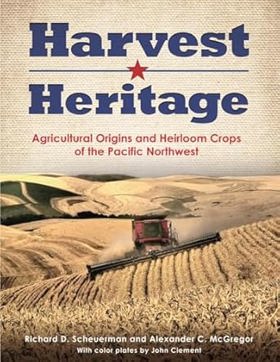
"Using imported heirloom grains and fruits, Spanish explorers, fur traders, missionaries, and some Native Americans planted subsistence gardens in the Pacific Northwest. After immigration surged in 1843, it took a surprisingly short time for the region's fertile lands to become a commercial agricultural powerhouse. Demand for food exploded with the industrial revolution as well as the urbanization of Europe and eastern America, and the doors of international export opened wide. Agribusiness expanded to meet the need. By 1890, advancements in mechanization, seed quality, irrigation and sustainable practices had spurred a farming boom. Columbia Basin irrigation and the development of synthetic fertilizers, as well as Cooperative Extension efforts and impressive work by agricultural researchers, greatly boosted regional production. This text explores the people, history, and major influences that shaped and transformed the Pacific Northwest's flourishing agrarian economy." Provided by publisher xiii, 186 pages : illustrations (some color) ; 28 cm CIRC [ 0 ]
|
2013 |
|
Harney County, Oregon, and its range land by George Francis Brimlow
|
1951 |
|
Harney County an historical inventory by Royal G. Jackson, Jennifer A. Lee, Harney County Historical Society (Or)
|
1978 |