City of Portland Multnomah County, Oregon
Mapped Location
City of Portland: The mapped location is an approximation and should not be used for navigation or wayfinding.
Information
General information on City of Portland
- Feature Type: Incorporated
Official, historical, colloquial and alternative toponyms for City of Portland
A brief list of names that this geographic feature has been named
| Name | Description |
|---|---|
| City of Portland | Official |
| Portland | Official |
Origin Notes and History of City of Portland
References to City of Portland that document the origin of its place name

PORTLAND, was named for Portland, Maine, in 1845, by Francis W. Pettygrove. Whether the name should be Portland or Boston was decided by Pettygrove and A. L. Lovejoy by the toss of a copper coin. Pettygrove was born at Calais, Maine, in 1812, and came to Oregon by sea in 1843 with a stock of merchandise. He built a warehouse at Champoeg, had a store in a log house at the southwest corner of Front and Washington streets, Portland, and a store called the Red House in Oregon City. There is uncertainty about the exact date that Portland was established. William Johnson and his Indian wife had a cabin as early as 1842 near what is now Southwest Macadam Avenue and Curry Street, but Johnson apparently had no notion of starting a town and his house was some distance south of the locality that became Portland in 1845. Etienne Lucier may have settled in what was later East Portland as early as 1829, but this was not in the original Portland townsite. A. L. Lovejoy and William Overton landed at the site of Portland in November, 1848, on the way from Fort Vancouver to Oregon City. That winter they returned and took a land claim of 640 acres. Lovejoy was the first proprietor, and Overton, his hired man. Overton took a share of land for his services, and in 1844 sold it to Pettygrove for fifty dollars. The subsequent history of Overton is un- known. In the winter of 1844, the first building was erected at the foot of Washington Street. In 1845, Lovejoy and Pettygrove laid off sixteen blocks of the townsite and named the place Portland by the process mentioned above. Captain John Couch of Newburyport, Massachusetts, had been in the Columbia River trade and soon recognized the strategic importance of the locality of Portland. He made settlement in the place in 1845-46, and became an important addition to the community. In the fall of 1845, Lovejoy sold his interest to Benjamin Stark and moved to Oregon City. Daniel H. Lownsdale located on what later was called the King claim, and built a tannery. In September, 1848, Lownsdale bought out Pettygrove, then in sole possession of the 640 acres, for $5000 in tanned leather. The sale included a wharf at the foot of Washington Street, which was built in 1846. In 1851 Pettygrove became one of the founders of Port Townsend, Washington, where he died October 5, 1887. Lovejoy was born in Massachusetts in 1808 and came to Oregon first in 1842, went to Bents Fort on the Arkansas with Dr. Marcus Whitman and came to Oregon again in 1843. He died in Portland September 10, 1882. For references to Pettygrove and Lovejoy, see Scott's History of the Oregon Country, volume II, pages 266 and 319. For references to Captain Couch, ibid., volume I, page 301. For synopsis of first hundred years of Portland history by the compiler, see the Oregon Sunday Journal, August 15, 1943. Portland post office was established November 8, 1849, with Thomas Smith first postmaster. At that time Astoria and Oregon City already had post offices and the Salem office was established the same day.
Related Catalog Titles
A Bibliography for City of Portland, Multnomah County, Oregon
Portland's audacious champion how Bill Naito overcame anti-Japanese hate and became an intrepid civic leader by Erica Naito-Campbell , Oregon State University Press (Publisher)
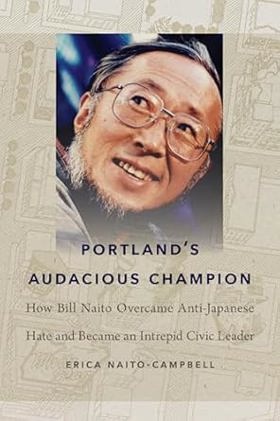
"William "Bill" Sumio Naito (1925-1996) was a remarkable and visionary individual--the Portland-born son of Japanese immigrants who became one of the city's most significant business and civic leaders. Every day thousands of people drive on Naito Parkway alongside Portland's Waterfront Park, yet little has been written about the man for whom it was named. In this first biography, Erica Naito-Campbell, Bill's granddaughter, shows how his story is also the story of Portland, the city he loved. Naito's life, from the Great Depression and World War II through Portland's rebirth in the 1970s and its profound growth, tracked most of the major events in the city and was the catalyst for many of them. Through hard-earned success in importing and real estate with his brother Sam, Naito came to wield considerable power in the city, and his leadership led to much of what we consider iconic Portland today: the "Portland Oregon" sign near the Burnside Bridge, the annual Christmas tree in Pioneer Courthouse Square, and Harbor Drive's conversion to Waterfront Park. Naito's name became synonymous with civic leadership, whether it was growing Portland's urban tree canopy, revitalizing its downtown, or preserving historic buildings. But less is known about his difficult childhood--with a father who worked twelve-hour days and a mother whose treatment of him was harsh at best--and the racism he endured during World War II. After the expulsion of Japanese Americans following Pearl Harbor and his military service in Occupied Japan, Naito overcame great emotional turmoil to return to Portland and become one of its greatest change-makers."-- Provided by publisher
x, 278 pages : illustrations, map, portraits ; 23 cm
CIRC [ 0 ]
Forest park exploring Portland's natural sanctuary by Marcy Cottrell Houle
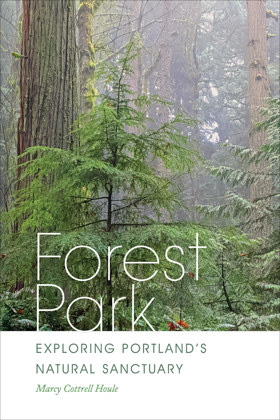
"Situated in the rugged hills west of downtown Portland, Forest Park is the nation's premier urban natural sanctuary. It supports essential habitat for hundreds of native plants and animals, including species at risk, and is one of the largest city parks in the world. While extending critical ecosystem services to the region, it covers miles of outstanding hiking trails, all within minutes of the downtown core. Forest Park: Exploring Portland's Natural Sanctuary showcases this treasure in a new light, offering a compendium of the most up-to-date and comprehensive information available. Twenty-one hikes covering seventy-five miles bring a full awareness of the park's outstanding attributes. Hikes are grouped by theme to encourage people to explore Forest Park's watersheds, geology, lichens and mosses, vegetation, amphibians and reptiles, pollinators, native wildlife, and wildlife corridors. Beautiful photographs and full-color maps accompany each trail description. Forest Park is a shining example of the Pacific Northwest western hemlock community-an ecosystem unique among all temperate forests of the world. It is also an exciting model for a future Urban Biodiversity Reserve, a concept that would recognize the park's scientific, natural, and cultural qualities. Forest Park will help all visitors discover the beauty and wonders of this extraordinary natural resource"-- Provided by publisher
xv, 216 pages : color illustrations, color maps ; 23 cm
CIRC [ 0 ]
Building Portland 150 years of outstanding architecture in today's central Portland by Victor Graf
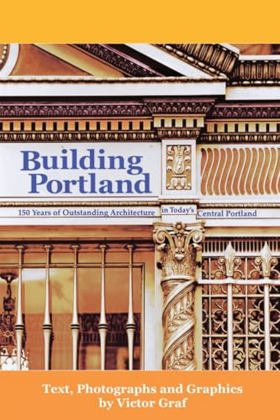
"A treasure trove of facts and factoids, original photos, people, events, weird and picturesque Portland... Your indispensable reference and compact field guide to the great architecture in the one square mile of today's central Portland." --Back cover
viii, 106 pages : chiefly color illustrations, map, charts ; 23 cm
CIRC [ 0 ]
They never asked senryū poetry from the WWII Portland Assembly Center by Shelley Baker-Gard , Michael J. Freiling , Satsuki Takikawa , Duane Watari, Portland Assembly Center (Portland, Or)
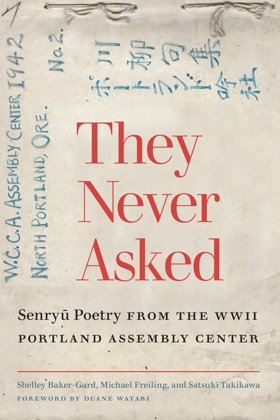
In 1942, after Executive Order 9066 was issued, Japanese families were removed from their homes in Oregon and the Yakima Valley and sent to the Portland International Livestock Exposition Center, where they were housed in converted animal stalls. The Wartime Civil Control Administration forcibly held these Japanese Americans at the Portland Assembly Center until September 1942, when they were transferred to newly built permanent incarceration camps at Minidoka, Heart Mountain, and Tule Lake. The Japanese American communities in Oregon and southern Washington were relatively small and many of the detainees knew each other; they drew on existing family and community networks to help each other through the long summer, living in inhumane conditions under the constant threat of violence. Several members of Bara Ginsha, a Portland poetry group, decided to continue their work while imprisoned at the center, primarily by writing senryū, a type of Japanese poetry related to haiku. They Never Asked is a collection of work produced by Bara Ginsha members in the WCCA camp, based on a journal kept by Masaki Kinoshita. The senryū collected here were written by a group of twenty-two poets, who produced hundreds of poems. Individually, the poems reflect the thoughts and feelings the authors experienced while being detained in the center; collectively, they reflect the resilience and resistance of a community denied freedom. Editors Shelley Baker-Gard, Michael Freiling, and Satsuki Takikawa present translations of the poems alongside the originals, supplemented by historical and literary context and a foreword by Duane Watari, Masaki Kinoshita’s grandson.
xiv, 185 pages : illustrations, portraits ; 23 cm
CIRC [ 0 ]
Protest city Portland's summer of rage by Rian Dundon (Author, Photographer), Donnell Alexander, Carmen P. Thompson (Writer of introduction)
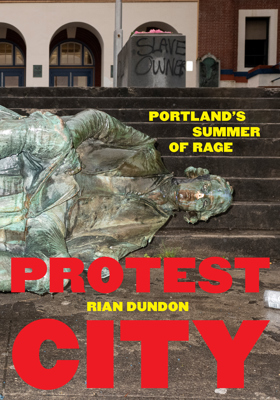
"In the months leading up to the 2020 presidential election, Portland made national news with nightly social justice protests, often met with violent response by counter protestors and law enforcement. Though frequently regarded as a progressive hub, Portland has a long history of racial inequality and oppression, and the city's entrenched divisions gained new attention during the Trump years. The photographs in Protest City present a visceral visual record of this significant moment in Portland's history. Rian Dundon, who has been photographing the rise of extreme politics on the West Coast since 2016, lived only a short walk from the protests that erupted after the murder of George Floyd. For one hundred days, Dundon enmeshed himself in the demonstrations with an unobtrusive point-and-shoot camera. The result is a graphic portrayal of how social movements become politicized, how spectacle serves as a subtext to change in the digital age, and how modern protests blur distinctions among performance, ritual, and surveillance. As he follows the progress of Portland's conflicts, Dundon draws connections to Oregon's legacy as a stronghold of white supremacist extremism and interrogates the role of whiteness in racial justice movements. Dundon's striking photos recreate the immediacy and impact of the protests, while a foreword by journalist Donnell Alexander and introduction by historian Carmen P. Thompson contextualize the uprising's sociopolitical background. A chronology and author's note are also featured"-- Page 4 of cover
xxviii, 187 pages : color illustrations ; 26 cm
CIRC [ 0 ]
Planning the Portland urban growth boundary the struggle to transform Trend City by Sy Adler , Oregon State University Press (Publisher)
"In this companion volume to his 2012 book Oregon Plans: The Making of an Unquiet Land-Use Revolution, Sy Adler offers readers a deep analysis of Portland's Urban Growth Boundary. As part of Oregon's land-use system, urban areas are required to define a UGB, a line containing urban sprawl and separating it from agricultural land and open space. In Planning the Portland Urban Growth Boundary, Adler argues that acknowledging the Portland growth boundary in 1979 was the most significant decision the Oregon Land Conservation and Development Commission has ever made, and, more broadly, is a significant milestone in American land-use planning. Planning the Portland Urban Growth Boundary primarily covers the 1970s, the period during which the initial boundary was planned at the regional level and acknowledged as compliant with Oregon's statewide Urbanization goal. Adler's central argument is that while state and regional planning institutions were established in response to concerns about sprawl, planners working for those institutions had to confront the reality that various plans developed and implemented by city and county governments around the Portland metro would instead allow the sprawling to continue. Regional planners labeled these as "Trend City" plans, and sought to transcend and transform them during the 1970s and thereafter. Adler discusses the dynamics of these partially successful efforts and the conflicts that characterized the development of the UGB during the 1970s-between different levels of government, and between public, private, and civic sector advocates. When the regional UGB is periodically reviewed, these conflicts continue, as debates about values and technical issues related to forecasting future amounts of population, economic activity, and the availability of land for urban development over a twenty-year period roil the boundary planning process"-- Provided by publisher
ix, 261 pages : map ; 23 cm
CIRC [ 0 ]
Portland public sculptors monuments, memorials and statuary, 1900-2003 by Fred F. Poyner
"This book is a non-fiction study of the lives of ten different sculptors and the key public sculptures each contributed to the landscape and identity of Portland, Oregon, between 1900 and 2003. Each chapter examines the history of how these artworks were created, the challenges each sculptor faced, and how these artworks in a variety of sculpture media have contributed to the public arts scene of Portland into the twenty-first century. For its discussion of historical sculpture unique to Portland, a researched examination is made into those subjects selected by each sculptor, where influences of national identity, patriotism, symbolic representation, and the lives of each sculptor help to better understand the history and forces at work which brought these sculptures into existence. Interviews with two of the sculptors offer personal insights into their creative process: from the studio design to final installation in Portland. From Roland Hinton Perry and Alice Cooper, to James Lee Hansen and Raymond Kaskey, sculptures ranging from bronze castings of U.S. presidents, to other historical and allegorical figures in copper and marble, the author provides an in-depth review and presentation of Portland's public art as never seen before"-- Publisher's website
128 pages : illustrations (some color), portraits ; 24 cm
CIRC [ 0 ]
Eleanor Baldwin and the Woman's Point of View new thought radicalism in Portland's Progressive Era by Lawrence M. Lipin
"Eleanor Baldwin and the Woman's Point of View is an intellectual biography of a long-forgotten radical female journalist in Portland, whose daily women's columns provide a window into the breadth of intellectual radicalism in Progressive Era journalism. Baldwin was one of an early generation of female journalists who were hired to lure female readers to the daily newspaper's department store advertisements. Instead of catering to the demands of consumerism, Baldwin quickly brought an anti-capitalist, antiracist agenda to her column, "The Woman's Point of View." She eschewed household hints and instead focused on the immorality of capitalists and imperialists while emphasizing the need for women to become independent and productive citizens. A century before the Occupy movement and the Women's March, Baldwin spoke truth to power. Imbued with a New Thought spirituality that presumed progressive thought could directly affect material reality, she wrote to move history forward. And yet, the trajectory of history proved as hard to forecast then as now. While her personal story seems to embody a modern progressivism, blending abolition with labor reform and anti-banker activism--positions from which she never wavered--her path grew more complicated as times changed in the aftermath of World War I, when she would advocate on behalf of both the Bolsheviks and the Ku Klux Klan. In this deeply researched and nuanced account of Eleanor Baldwin's intellectual journey, historian Larry Lipin reveals how even the most dedicated radical can be overcome by unforeseen events. Eleanor Baldwin and the Woman's Point of View restores a missing chapter in Portland's Progressive Era history and rescues this passionate, intriguing, and quixotic character from undeserved obscurity."-- Provided by publisher
xiv, 253 pages : illustrations ; 23 cm
CIRC [ 0 ]
Aboard the Portland a history of the Northwest Steamers by Rebecca Harrison
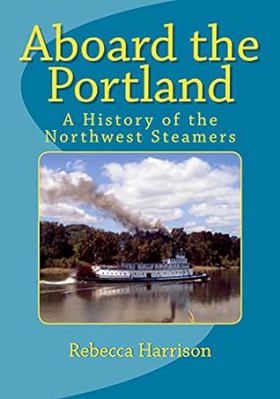
In her latest book, Rebecca Harrison takes you back in time over 150 years to ride the grand Columbia and Willamette Rivers on the the sternwheelers of the mid 1800's. Meticulously researched, Aboard the Portland: A history of the Northwest Steamers tells the exciting story of these trade and transport ships, and explores how the Portland survived time and harsh work to become one of the last operating steam sternwheelers in America
1 online resource (171 pages : black and white illustrations)
CIRC [ 1 ]
Her finest hour shipbuilding in the Portland area during World War II (1941-1945) by Robert R. La Du
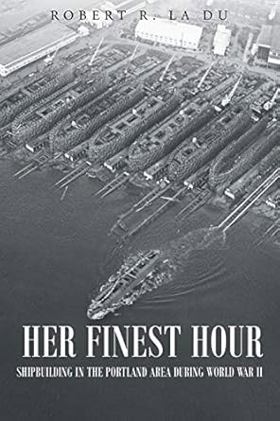
This work describes the monumental accomplishments of the World War II shipyards in Portland, Oregon, and Vancouver, Washington. Working twenty-four hours a day, seven days a week, they built and launched thousands of vessels--Liberty ships, Victory ships, tankers, aircraft carriers, submarine chasers, and many kinds of landing craft--to help defeat the Axis powers and preserve the way of life of the free world. Robert La Du viewed firsthand these activities from his home overlooking shipyards on the Willamette River. His father worked at Albina shipyard, his sister worked at Henry Kaiser's Swan Island shipyard, and he himself, as a high school student, worked nights at Commercial Iron and Steel shipyard. These experiences inform and enhance the pages of Her Finest Hour.
170 pages : illustrations ; 22 cm
CIRC [ 0 ]
The Portland Black Panthers empowering Albina and remaking a city by Lucas N. N. Burke , J. L. Jeffries
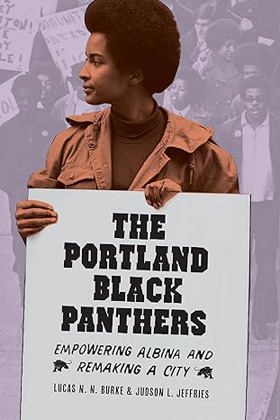
Portland, Oregon, though widely regarded as a liberal bastion, also has struggled historically with ethnic diversity; indeed, the 2010 census found it to be “America’s whitest major city.” In early recognition of such disparate realities, a group of African American activists in the 1960s formed a local branch of the Black Panther Party in the city’s Albina District to rally their community and be heard by city leaders. And as Lucas Burke and Judson Jeffries reveal, the Portland branch was quite different from the more famous—and infamous—Oakland headquarters. Instead of parading through the streets wearing black berets and ammunition belts, Portland’s Panthers were more concerned with opening a health clinic and starting free breakfast programs for neighborhood kids. Though the group had been squeezed out of local politics by the early 1980s, its legacy lives on through the various activist groups in Portland that are still fighting many of the same battles. Combining histories of the city and its African American community with interviews with former Portland Panthers and other key players, this long-overdue account adds complexity to our understanding of the protracted civil rights movement throughout the Pacific Northwest.
283 pages, 16 unnumbered pages of plates : illustrations, maps ; 24 cm
CIRC [ 0 ]
Portlandness a cultural atlas by David Banis , Hunter Shobe , Corinna Kimball-Brown (Cartographer), Randy Morris (Cartographer), Jon Franczyk (Cartographer), Daniel E. Coe (Cartographer), Kirk McEwen (Cartographer), Joan Lundell (Book designer)
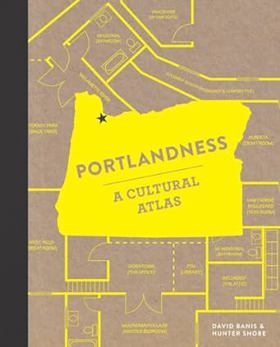
Summary: In 150 inforgraphic maps, two leading geographers explore Portland, Oregon, through unexpected topics such as city chickens, wild coyote encounters, food-truck trends, and coffee culture. Each map starts with the gathering of at least one data set about a given topic, then translating that into visual form which blends traditional cartographic skills with modern graphic design
190 pages : illustrations (chiefly color), color maps, color plans ; 26 cm
CIRC [ 1 ]
This is Portland by Alexander Barrett
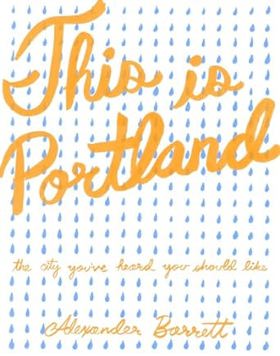
A firsthand look at one of the world’s most livable cities, this fun take on the guidebook genre explores the atmosphere of Portland, Oregon, versus detailing its landmarks and restaurants. It both explains and embraces how beautiful and ridiculous Portland life can be, and includes essays on everything from the rain and bicycling to beards and tater tots. With its approachable and often hilarious tone, this book is perfect for anyone who wants to learn more about the city that is earning its way onto more and more top cities lists each year.
62 pages : illustrations, map
CIRC [ 1 ]
Portland in three centuries the place and the people by Carl Abbott
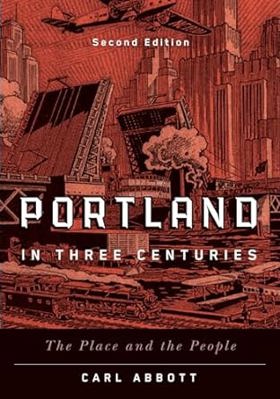
A compact and comprehensive history of Portland from first European contact to the twenty-first century, Portland in Three Centuries introduces the women and men who have shaped Oregon’s largest city. The expected politicians and business leaders appear, but Carl Abbott also highlights workers and immigrants, union members and dissenters, women at work and in the public realm, artists and activists, and other movers and shakers. Incorporating social history and contemporary scholarship in his narrative, Abbott examines current metropolitan character and issues, giving close attention to historical background. He explores the context of opportunities and problems that have helped to shape the rich mosaic that is Portland. This revised and updated second edition includes greater attention to the Indigenous peoples of the Portland region, Portland’s communities of color, and the challenges of recent years that have thrust Portland into the national spotlight. A highly readable character study of a city, and enhanced by more than sixty historic and contemporary images, Portland in Three Centuries will appeal to readers interested in Portland, in Oregon, and in Pacific Northwest history.
192 pages : illustrations, maps ; 26 cm
CIRC [ 1 ]
Wild in the city exploring the intertwine, the Portland-Vancouver region's network of parks, trails, and natural areas by Michael C. Houck, M. J. Cody, Audubon Society of Portland
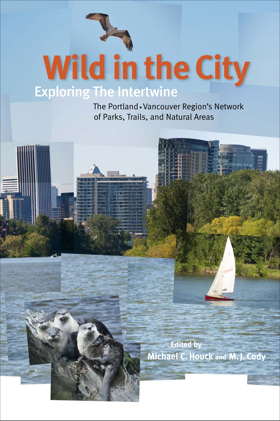
The second edition of the highly acclaimed Wild in the City brings more than one hundred of the best parks, trails and natural areas to your fingertips. This comprehensive “must-have” reference will be the go-to field guide for hikers, cyclists, paddlers, bird watchers, and nature enthusiasts. This revised and updated edition contains new maps organized according to watershed and includes twenty-eight unique “rambles” that explore multiple sites for recreation, wildlife viewing, or simply contemplating the joys of nature. New natural history essays by Ursula K. Le Guin, Kim Stafford, Robin Cody, Judy BlueHorse Skelton, Robert Michael Pyle, Jonathan Nicholas, and Richard Louv, author of Last Child in the Woods, offer fresh perspectives on the little pockets and expansive corridors of Portland’s wild environs. The book also examines the innovative strategies that cities, agencies, and nonprofits are using to create an ecologically sustainable metropolitan region. This invaluable resource will be an essential guide for educators and parents who want to explore the region’s natural wonders with their students and children. Included are tips on living with wildlife, as well as a new section that provides essential information on how urban living and green spaces intersect.
xx, 427 pages : illustrations, maps ; 23 cm
CIRC [ 0 ]
Dark rose organized crime and corruption in Portland by Robert C. Donnelly
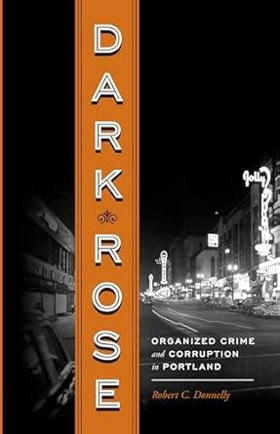
In April 1956, Portland Oregonian investigative reporters Wallace Turner and William Lambert exposed organized crime rackets and rampant corruption within Portland’s law enforcement institutions. The biggest scandal involved Teamsters officials and the city’s lucrative prostitution, gambling, and bootlegging operations. Turner and Lambert blew the cover on the Teamsters’ scheme to take over alcohol sales and distribution and profit from these fringe enterprises. The Rose City was seething with vice and intrigue. The exposé and other reports of racketeering from around the country incited a national investigation into crime networks and union officials headed by the McClellan Committee, or officially, the U.S. Senate Select Committee on Improper Activities in the Labor or Management Field. The commission discovered evidence in Portland that helped prove Teamsters president Dave Beck’s embezzlement of union funds and union vice president Jimmy Hoffa’s connection to the mob. Dark Rose reveals the fascinating and sordid details of an important period in the history of what by the end of the century had become a great American city. It is a story of Portland’s repeated and often failed efforts to flush out organized crime and municipal corruption - a familiar story for many mid-twentieth-century American cities that were attempting to clean up their police departments and municipal governments. Dark Rose also helps explain the heritage of Portland’s reform politics and the creation of what is today one of the country’s most progressive cities.
xiii, 202 pages : illustrations ; 22 cm
CIRC [ 0 ]
Beauty of the city A.E. Doyle, Portland's architect by Philip Niles
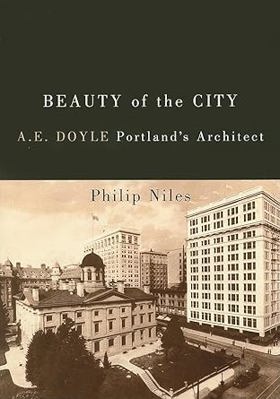
The Central Library, Benson Hotel, Reed College, the Meier & Frank building, the U.S. National Bank—these are just a few of the grand Portland icons designed by Albert E. Doyle. During a period of rapid growth in Portland, Oregon, after the Lewis & Clark Centennial Exposition and before the Great Depression, Doyle (1877-1928) was the city’s most important architect. Beauty of the City is the first biography of this celebrated architect. Doyle’s career was short, just twenty-one years. Yet everywhere Portland retains his imprint. Many of Doyle’s classical, often white terra-cotta buildings became venerable city landmarks. He also designed Portland residences, Neahkahnie beach cottages, and houses and banks in Oregon and Washington. Using A. E. Doyle’s own diaries and letters and his firm’s records, historian Philip Niles traces the architect’s life and times in the context of the burgeoning cityscape. As Portland expanded beyond its frontier origins and provincialism, Doyle helped introduce Eastern and European sophistication. Indeed, his refined sensibility influenced the development of the Northwest Regional Style by Pietro Belluschi and John Yeon, among others. Doyle set the standard for elegance and proportion that later architects adapted to more modern styles—his standard defines Portland’s vibrant core and contributes to the city’s beauty as much today as it did 80 years ago. Readers interested in Northwest history and culture will appreciate this compelling and richly illustrated biography of “Portland’s architect.” Likewise, architectural historians and those seeking to better understand Portland’s architectural heritage will enjoy reading of Doyle’s contributions to this celebrated cityscape. “All new things built with the idea of preserving the beauty of the city and adding to it." -A. E. Doyle
xvi, 278 pages : illustrations, map ; 26 cm
CIRC [ 0 ]
An architectural guidebook to Portland by Bart King
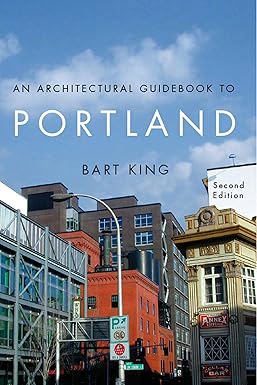
Portland strikes a graceful balance between the rich traditions of its past and the creative developments of modern architecture. Written for both layperson and professional, An Architectural Guidebook to Portland is filled with history and photos that demonstrate why this city is one of the most admired in the nation. Portland's civic planning, historic preservation, and overall attractiveness are all explored in detailed profiles of structures ranging from 19th-century cast-iron front buildings to sleek modern skyscrapers. Now revised and updated to reflect Portland's explosive growth in the 21st century, this second edition includes an added focus on the development of "green buildings" and sustainable design, a chapter on downtown bridges, and expanded coverage of the city's vibrant neighborhoods. With over 250 entries that tell the stories behind Portland's celebrated cityscape, this comprehensive guide is an indispensable resource for visitors and Portlanders alike. Don't miss Bart King's Architecural Guide to Portland, a mobile site for the Web and mobile devices, which features rotating content from the book.
viii, 320 pages : illustrations, maps ; 23 cm
CIRC [ 0 ]
Portland people, politics, and power, 1851-2001 by Jewel Beck Lansing
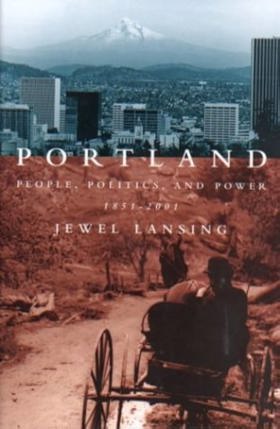
This is the definitive book on Portland's political history, beginning in 1845 when a 16-lot townsite was laid out on the bank of the Willamette River and continuing through the sesquicentennial of Portland city government. Jewel Lansing has amassed a treasure trove of information on Portland's civic and political life, which she presents in a lively volume, organized around accounts of the successive reigns of Portland's mayors. The story is rich in anecdotes that bring to life the unique individuals and controversial issues of Portland's distant and more recent past. Lansing shows that Portland's path to its present place as the 28th largest city in the United States, with a deserved reputation as one of the nation's most livable cities, has not always been smooth. Corruption, profiteering, and wide-open vice characterized the City of Roses at the turn of the 20th century, and every era has had its own controversies and rivalries: disputes over railroad franchises and rights-of-way, women's suffrage, public versus private power, the Chinese Exclusion Act, Prohibition, and the siting of freeways, to name just a few. Anyone with an interest in Portland, and in learning more about the individuals, events, and issues that have shaped it, will find this comprehensive history fascinating and informative. About the author: Jewel Lansing served as the elected City of Portland Auditor from 1983 to 1986 and as Multnomah County Auditor from 1975 to 1982. She was the author of eight books, including two about women and politics, and a murder mystery set in Portland City Hall. She is honored on Portland's Walk of the Heroines for her pioneering role as a woman in government and politics and her outstanding civic contributions.
xii, 576 pages : illustrations, map ; 24 cm
CIRC [ 1 ]
Portland, then & now by Linda Dodds, Carolyn M. Buan
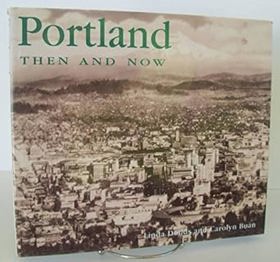
Celebrating America's favorite cityscapes, this series combines historic interest and contemporary beauty. Then and Now features fascinating archival photographs contrasted with specially commissioned, full-color images of the same scene today. A visual lesson in the historic changes of our greatest urban landscapes
144 pages : chiefly illustrations (some color) ; 26 x 29 cm
CIRC [ 1 ]
A municipal mother Portland's Lola Greene Baldwin, America's first policewoman by Gloria E. Myers
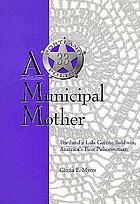
On April 1, 1908, Lola G. Baldwin, aged forty-eight, was sworn in "to perform Police Service" for the city of Portland, Oregon. She was the first woman hired by an American municipality to carry out regular enforcement duties. In telling Lola Baldwin's story, Gloria Myers examines the social and cultural impulses that gave rise to the policewoman idea. The Progressive Era redefined the role of women in society; Baldwin's career benefited from the Progressive belief that women could ameliorate urban evil as they had earlier civilized the household. The need for the urban policewoman arose out of concern for the moral and physical welfare of families, single working women, and children living in the cities. Supported by socially active women's organizations and informed by the ideals of "social hygiene," the first policewoman led a crusade against urban vice, deviance, and corruption in the Rose City. Preventive policing strategies developed by "municipal mothers" like Baldwin aid and influence policing policies to this day
viii, 232 pages : illustrations ; 24 cm
CIRC [ 0 ]
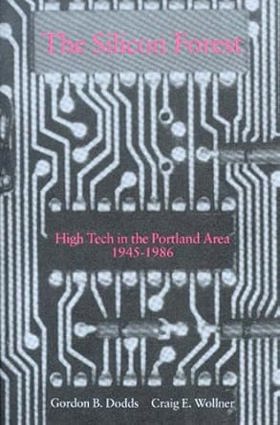
The silicon forest High Tech in the Portland Area 1945-1986 by Gordon B. Dodds, Craig Wollner, Marshall M. Lee
We claimed this land Portland's pioneer settlers by Eugene E. Snyder
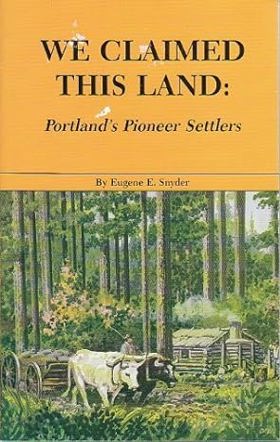
A collection of biographical sketches profiling the 212 pioneers who settled the land that is now Portland, Oregon
xxv, 289 pages : maps, portraits ; 23 cm
CIRC [ 1 ]
Vanport by Manly Maben
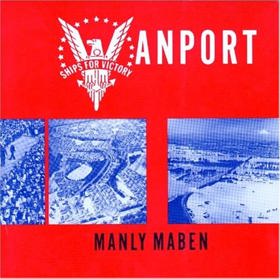
"Vanport City, Oregon, was conceived in 1942 as a temporary housing project for the families of men and women who came to the Pacific Northwest to work in the Kaiser shipyards and further the war effort (World War II). Situated on a flood plain between Vancouver, Washington, and Portland, Oregon, the Columbia River reclaimed the city for its own in a flood on Memorial Day, 1948. In its brief but vital lifetime, Vanport pushed the Portland area into a new era of change and development, leaving a legacy that is felt even today. During its time, Vanport was the largest housing project in the United States, (perhaps the world) and the second largest city in Oregon"--Cover
xiv, 151 pages : illustrations ; 23 cm
CIRC [ 1 ]
Island origins trappers, traders & settlers by J. D. Cleaver
Portland an informal history & guide by Terence O'Donnell, Thomas Vaughan
Early Portland stump-town triumphant; rival towns on the Willamette, 1831-1854 by Eugene E. Snyder
I remember Portland by Laurence Pratt
Portland, Oregon, its history and builders by Joseph Gaston
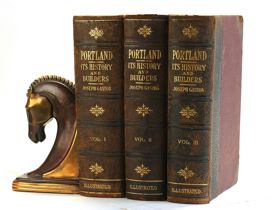
in connection with the antecedent explorations, discoveries, and movements of the pioneers that selected the site for the great city of the Pacific
3 volumes : illustrations, maps, portraits ; 27 cm
ONLINE CIRC [ 3 ]
History of Portland, Oregon by H. W. Scott
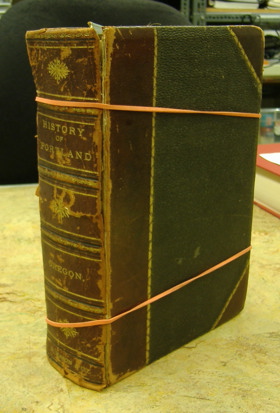
Published in 1890 and compiled by Harvey W. Scott, the formidable long-time editor of The Oregonian, History of Portland, Oregon offers a sweeping civic chronicle of the city's rise from a muddy clearing on the Willamette River to the dominant commercial metropolis of the Pacific Northwest. The exhaustive volume details early municipal struggles, infrastructural triumphs, and the fiercely competitive navigation of regional river trade, culminating in extensive biographical sketches of the city's pioneer elites. A keen insight drawn from the text is how Scott leverages his dual authority as a historian and the region's most powerful journalist to actively manufacture, rather than merely record, Portland's civic mythology. By inextricably linking the city's economic progress to the moral and financial virtues of its conservative merchant class, the book functions as a sophisticated ideological tool designed to cement the hegemony of the local business establishment while deliberately marginalizing labor movements and competing frontier narratives.
651 pages, 69 unnumbered leaves of plates : illustrations, portraits ; 26 cm
ONLINE CIRC [ 1 ]
Related Online Resources
Vintage Portland
City of Portland Archives and Record Center (PARC) assumed responsibility for the Vintage Portland blog, which was conceived, created and maintained by Dan Davis starting in 2009. It is our goal to provide a broad sampling of the PARC’s extensive pho
WEB LINKJapanese American Museum of Oregon
Formerly known as the Oregon Nikkei Legacy Center, the Japanese American Museum of Oregon at Naito Center is a venue for culture and research as well as an invaluable resource for exploring Nikkei experiences and their role in Oregon’s multicultural community. Our permanent exhibit space highlights Issei immigration and early life in Oregon, Nihonmachi (Japantown), life after Executive Order 9066 (including the Portland Assembly Center), and contemporary Nikkei life.
WEB LINK
Multnomah County
- Alameda
- Arleta
- Barnes Heights
- Bertha (historical)
- Bonneville
- Bonny Slope
- Bridal Veil
- Bridlemile
- Burlingame
- Burlington
- Carson Heights
- Corbett
- Dodson
- Dunthorpe
- Englewood
- City of Fairview
- Faloma
- Folkenberg
- Fulton (historical)
- Gilbert
- Green Hills
- City of Gresham
- Hillsdale
- Holbrook
- Interlachen
- Johns Landing
- Kellogg Park
- Kings Heights
- Latourell
- City of Maywood Park
- Orient
- Plainview (historical)
- Pleasant Home
- City of Portland
- Portland Heights
- Powell Valley
- Powellhurst
- Riverview (historical)
- Riverwood
- Russellville
- South Portland (historical)
- Springdale
- City of Troutdale
- Twelvemile Corner
- University Park
- Vanport City (historical)
- Vermont Hills
- Villa Ridge
- Warrendale
- Westmoreland
- Whitwood Court
- Willamette Heights
- City of Wood Village
- Woodstock
Political Boundaries
Last updated: 2025-09-23