Catalog of British Columbiana and Pacific Northwest Americana
Encyclopedia Cascadia Catalog contains book titles of mostly non-fiction Pacific Northwest Coast of North America Titles (primarially British Columbia, Idaho, Oregon and Washington State) in an easy-to-understand title catalog. If you see a link with this badge ONLINE CIRC it means that there is an online institution that provides free access to that title. In some cases there may be more than one institution hosting the title digitally.
| Catalog Title | Published |
|---|---|
|
Don't never tell nobody nothin' no how the real story of West Coast rum running by Rick James 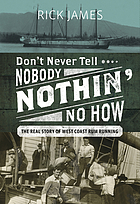
'"We operated perfectly legally. We considered ourselves philanthropists! We supplied good liquor to poor thirsty Americans ... and brought prosperity back to the Harbour of Vancouver ..." Captain Charles Hudson At the stroke of one minute past midnight, January 17, 1920, the National Prohibition Act was officially declared in effect in the United States. From 1920 to 1933 the manufacture, sale, importation and transportation of alcohol and, of course, the imbibing of such products, was illegal. Prohibition was already a bust in Canada and it wasn't long before fleets of vessels, from weather-beaten old fish boats to large ocean-going steamers, began filling their holds with liquor to deliver their much-valued cargo to their thirsty neighbours to the south. Contrary to popular perception, rum-running along the Pacific coast wasn't dominated by violent encounters like those portrayed in the movies. Instead, it was usually carried out in a relatively civilized manner, with an oh-so-Canadian politeness on the British Columbian side. Most operated within the law. But there were indeed shootouts, hijackings and even a particularly gruesome murder associated with the business. Using first-hand accounts of old-time rum-runners, extensive research using primary and secondary documentation, and the often-sensational newspaper coverage of the day, Don't Never Tell Nobody Nothin' No How sets out to explain what really went down along the West Coast during the American "Noble Experiment."'-- Provided by publisher 312 pages : illustrations, maps ; 24 cm CIRC [ 0 ]
|
2018 |
|
Dominion the railway and the rise of Canada by Stephen R. Bown 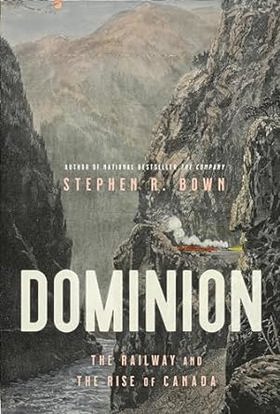
"Stephen R. Bown continues to revitalize Canadian history with this thrilling account of the engineering triumph that created a nation. In The Company, his bestselling work of revisionist history, Stephen Bown told the dramatic, adventurous and bloody tale of Canada's origins in the fur trade. With Dominion he continues the nation's creation story with an equally thrilling and eye-opening account of the building of the Canadian Pacific Railway. In the late 19th century, demand for fur was in sharp decline. This could have spelled economic disaster for the venerable Hudson's Bay Company. But an idea emerged in political and business circles in Ottawa and Montreal to connect the disparate British colonies into a single entity that would stretch from the Atlantic to the Pacific. With over 3,000 kilometers of track, much of it driven through wildly inhospitable terrain, the CPR would be the longest railroad in the world and the most difficult to build. Its construction was the defining event of its era and a catalyst for powerful global forces. The times were marked by greed, hubris, blatant empire building, oppression, corruption and theft. They were good for some, hard for most, disastrous for others. The CPR enabled a new country, but it came at a terrible price. In recent years Canadian history has been given a rude awakening from the comforts of its myths. In Dominion, Stephen Bown again widens our view of the past to include the adventures and hardships of explorers and surveyors, the resistance of Indigenous peoples, and the terrific and horrific work of many thousands of labourers. His vivid portrayal of the powerful forces that were molding the world in the late 19th century provides a revelatory new picture of modern Canada's creation as an independent state."-- Provided by publisher 400 pages, 8 unnumbered pages of plates : illustrations, maps ; 25 cm CIRC [ 0 ]
|
2023 |
|
Distant neighbors a comparative history of Seattle & Vancouver by Norbert MacDonald 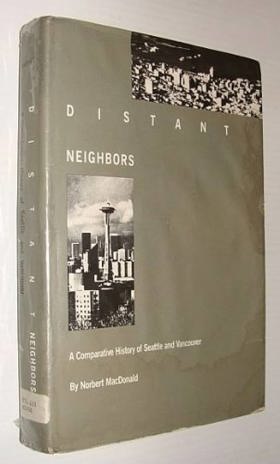
Distant Neighbors: A Comparative History of Seattle & Vancouver by Norbert MacDonald is a 1987 urban history that explores the parallel yet distinct development of two major Pacific Northwest cities from the 1880s through the mid-20th century. The book analyzes how differing national contexts, political structures, and economic policies shaped the unique civic characters, immigration patterns, and physical landscapes of each municipality despite their close geographic proximity and shared regional environment. Ultimately, it provides a foundational comparative framework for understanding the fascinating divergence between American and Canadian urban evolution on the Pacific coast. xxii, 259 pages, 30 unnumbered pages of plates : illustrations ; 25 cm CIRC [ 1 ]
|
1987 |
|
Distant Dominion Britain and the Northwest Coast of North America, 1579-1809 by Barry M. Gough 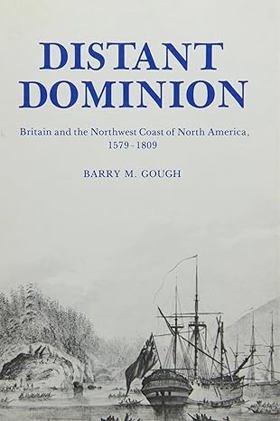
"The voyages of Cook and Vancouver heralded a vast influx of irrepressible white men.... They brought with them their morals, ideologies, knowledge, technology, plants and animals. They also brought diseases, rum and guns....powers to build and powers to destroy." Until the 1700's, the Northwest Coast of North America stood largely apart from the civilized world. Formidable mountain barriers and remoteness from Atlantic sea lanes kept the territory outside the orbit of emerging European empires. In the late 18th and early 19th centuries, however, Britain, Spain, France, Russsia, and the United States vied for control of this promising new frontier. Three of history's greatest mariners -- Sir Francis Drake, Captain James Cook, and Captain George Vancouver -- spearheaded British expeditions of discovery and trade to the Northwest coast. Despite competition from her European and American rivals, Britains ability to use and control the sea enabled her to establish by the late 1700's a "beachhead of empire" in the area now known as British Columbia.Gough shows how, by outmanoevring her Spanish rivals in a "skilful game of diplomatic chess," Britain concluded the Nootka Agreement. Thus she was able to exploit her trading partnership with the coast Indians and cement a lucrative sea-borne commerce with the Far East. The arrival overland of the Nor'westers and other fur-trading groups further strengthened Britain's financial and political interests in the area -- ending forever the isolation of Northwest America, and 'changing beyond measure the culture of its Indian peoples.' Distant Dominion is the first comprehensive survey to examine Britain's motives for expeditions to this most distant frontier of British maritime development. It is also the first to draw the history of the coast into the general realm of Pacific history, relating its development to events in Europe, the American eastern seaboard, Australia, the Falkland Islands, and China. This entertaining book offers fresh insight into an exciting chapter of North American history. 215 pages CIRC [ 1 ]
|
2014 |
|
Distant corner Seattle architects and the legacy of H.H. Richardson by Jeffrey Karl Ochsner, Dennis Alan Andersen 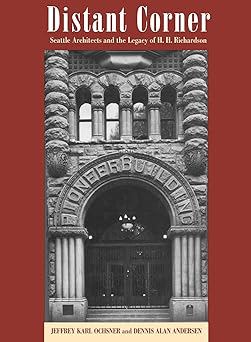
On the afternoon of 6 June 1889, a fire in a cabinet shop in downtown Seattle spread to destroy more than thirty downtown blocks covering 116 acres. Disaster soon became opportunity as Seattle’s citizens turned their full energies to rebuilding: widening and regrading streets, laying new water pipes and sewer lines, promulgating a new building ordinance requiring construction in the commercial core, and creating a new professional fire department. A remarkable number of buildings, most located in Seattle’s present-day Pioneer Square Historic District, were permitted within a few months and constructed within a few years of the Great Seattle Fire. As a result, the post-fire rebuilding of Seattle offers an extraordinarily focused case study of late-nineteenth-century American urban architecture. Seattle’s architects, seeking design solutions that would meet the new requirements, most often found them in the Romanesque Revival mode of the country’s most famous architect, Henry Hobson Richardson. In October 1889, Elmer Fisher, Seattle's most prolific post-fire architect, specifically cited the example of H. H. Richardson in describing the city's new buildings. In contrast to Victorian Gothic, Second Empire, and other mid-nineteenth-century architectural styles, Richardson’s Romanesque Revival vocabulary of relatively unadorned stone and brick with round-arched openings conveyed strength and stability without elaborate decorative treatment. For Seattle’s fire-conscious architects it offered a clear architectural system that could be applied to a variety of building types - including office blocks, warehouses, and hotels - and ensure a safer, progressive, and more visually coherent metropolitan center. Distant Corner examines the brief but powerful influence of H. H. Richardson on the building of America’s cities, and his specific influence on the architects charged with rebuilding the post-fire city of Seattle. Chapters on the pre-fire city and its architecture, the technologies and tools available to designers and builders, and the rise of Richardson and his role in defining a new American architecture provide a context for examining the work of the city’s architects. Seattle's leading pre- and post-fire architects - William Boone, Elmer Fisher, John Parkinson, Charles Saunders and Edwin Houghton, Willis Ritchie, Emil DeNeuf, Warren Skillings, and Arthur Chamberlin - are profiled. Distant Corner describes the new post-fire commercial core and the emerging network of schools, firehouses, and other public institutions that helped define Seattle’s neighborhoods. It closes with the sudden collapse of Seattle’s economy in the Panic of 1893 and the ensuing depression that halted the city’s building boom, saw the closing of a number of architects’ offices, and forever ended the dominance of Romanesque Revival in American architecture. With more than 200 illustrations, detailed endnotes, and an appendix listing the major works of the city's leading architects, Distant Corner offers an analysis of both local and national influences that shaped the architecture of the city in the 1880s and 1890s. It has much to offer those interested in Seattle’s early history, the building of the city, and the preservation of its architecture. Because this period of American architecture has received only limited study, it is also of importance for those interested in the influence of Boston-based H. H. Richardson and his contemporaries on American architecture at the end of the nineteenth century. xii, 409 pages : illustrations ; 29 cm CIRC [ 0 ]
|
2003 |
|
Dispatches and dictators Ralph Barnes for the Herald Tribune by Barbara S. Mahoney 
Dispatches and Dictators uncovers the fascinating story of Oregon native Ralph Barnes, the New York Herald Tribune's European correspondent, who served in Paris, Rome, Moscow, Berlin, and London in the years between the two world wars. Barnes has been praised by colleagues and competitors alike as one of the best reporters of that pivotal era. But since his death in the 1940 crash of a British bomber in Yugoslavia, he has been largely forgotten. With persistence and unusually keen insight, Ralph Barnes reported on Fascism, Communism, Nazism, and the events leading to World War II. Stalin confined Barnes to Moscow for disclosing that millions were dying during the Soviet collectivization of agriculture, and Hitler expelled Barnes from Germany for predicting the Nazi attack on the Soviet Union. Recently, scholars have rediscovered Barnes, recognizing the perceptiveness of his observations about the nature of the Soviet regime, the centrality of anti-Semitism to the Nazis, and the descent into war. Drawing from Barnes's dispatches, his personal correspondence, and the recollections of his colleagues, Dispatches and Dictators offers a valuable perspective on the interwar period and on the challenges facing journalists covering the events of the time. Barnes's story also offers an intimate glimpse into one family's experience with the risks, hardships, and separations that belie the romantic popular image of the foreign correspondent. vi, 310 pages : illustrations ; 24 cm CIRC [ 0 ]
|
2002 |
|
Discovering nothing in pursuit of an elusive Northwest Passage by David L. Nicandri 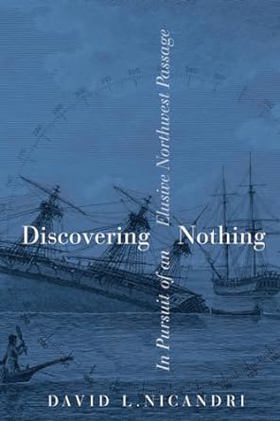
"The many attempts by navigators to find a Northwest Passage via its Pacific portal all ended in failure; however, their discoveries spurred expansionist developments that would forever alter the landscape of North America. In Discovering Nothing, David L. Nicandri maps a cast of geographic visionaries and practical explorers as they promoted or sought a workable commercial route linking the Pacific Ocean to the Atlantic. The discovery of the legendary northern passage proved elusive, but the equivalent land bridges that were built in the form of two transcontinental railroads changed the futures of Canada and the United States. Drawing from close readings of explorers’ personal journals, Nicandri provides readers a detailed, engaging, and multifaceted investigation into the many players and failed enterprises at the core of this search, beginning in the eighteenth century through to today--and to the unexpected impact of climate change on this fabled passage."-- Provided by publisher 328 pages CIRC [ 0 ]
|
2024 |
|
Discovering Main Street travel adventures in small towns of the Northwest by Foster Church 
Small towns punctuate the landscape of Oregon and Washington. They burrow in crinkles of hills, sit alongside mighty rivers, survive in desert canyons and sagebrush plains, dot the fertile Willamette Valley, and perch at the edge of the Pacific Ocean. In Discovering Main Street, Foster Church reveals the unexpected and unique pleasures of exploring small towns, what he calls “the last frontier of American tourism.” Organized by region—Willamette Valley, Oregon Coast, Southern Oregon, Eastern Oregon, and Southern Washington—the profiles in Discovering Main Street begin with route tips and end with comments on where to stay and eat. Church’s engaging narratives provide history, highlights, and insights into each of the nearly fifty profiled communities. A useful introduction summarizes Church’s recommendations for a small town visit, which include hanging out at the local cafe, attending a school sports event, and hiking the surroundings—because without exception, small towns in the Northwest are set in hauntingly beautiful environments, from stark deserts to deep, mossy forests. Discovering Main Street provides an alternative to the outdoor adventure guides that dominate bookshelves in the Northwest. It will appeal to armchair travelers, to Northwest enthusiasts, and to any curious explorers seeking adventure in hidden—and unexpected—places. 192 pages : maps ; 22 cm CIRC [ 0 ]
|
2010 |
|
Discover Nanaimo an illustrated history by Charles Lillard, Lynn Welburn, Greater Nanaimo Chamber of Commerce 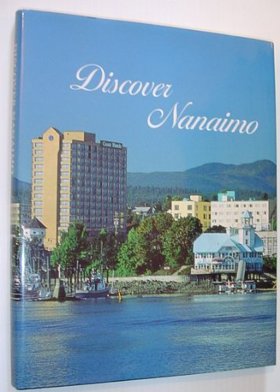
Published in 1992 by the Greater Nanaimo Chamber of Commerce, Discover Nanaimo: An Illustrated History by Charles Lillard and Lynn Welburn provides a richly documented examination of the city's past. The authors skillfully weave together archival photography and narrative text to trace Nanaimo's transformation from a resource-extraction hub into a vibrant coastal community. By balancing civic milestones with everyday social history, the volume offers scholars and regional enthusiasts an engaging window into the Pacific Northwest's economic and cultural development. 149 p. : ill. (some col.), ports. ; 29 cm. CIRC [ 0 ]
|
1992 |
|
Dining car to the Pacific the "famously good" food of the Northern Pacific Railway by William A. McKenzie 
"William A. McKenzie offers an illustrated and detailed account of hospitality on the Northern Pacific - a service that many considered the best in the industry - drawing on sources ranging from railroad records of the 1860s to anecdotal accounts from the people who were there. In addition, McKenzie includes more than 150 authentic recipes used on the line, such as the Great Big Baked Potato, Washington Apple Pan Cake, and Northern Pacific Fruit Cake. Dining Car to the Pacific will be a treasured addition to the libraries of historians, cooks, and any one with nostalgia for the dinning car experience."--Jacket xi, 164 pages : illustrations ; 22 x 28 cm. CIRC [ 0 ]
|
2004 |
|
Digressions of a native son by Emmett Watson 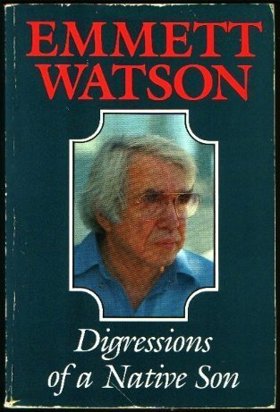
Digressions of a Native Son is a 1982 memoir by Emmett Watson (1918-2001), a Seattle journalist whose columns appeared in Seattle newspapers for more than 50 years. 251 pages ; 21 cm CIRC [ 0 ]
|
1982 |
|
Digging Duvall's past by Allen Miller, Duvall Historical Society (Wash) 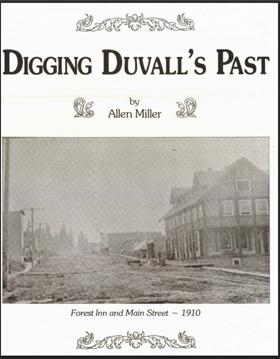
52 pages of great newspaper articles written by Allen Miller, many vintage black and white photos covering logging, new buildings in town, schools and more. iv, 52 pages : illustrations, portraits ; 28 cm CIRC [ 0 ]
|
1995 |
|
|
1983 |
|
Dictionary of Oregon history by Howard McKinley Corning
|
1989 |
|
Destination Cortez Island a sailor's life along the BC coast by June Cameron 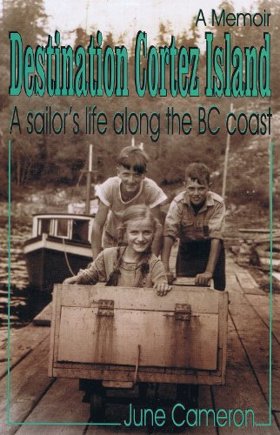
"My grandfather brought his wife and nine children to Cortez Island in 1917 with the dream of founding his own orchard, flower garden, and nursery." And so started a family legacy that would draw the author back to BC's coastal islands for the rest of her life. In 1930, June's parents bought the Loumar, a 36-foot wooden boat destined to become the family summer home for two decades. Now in her memoir of photographs, June relives the magic of those summer days on the Loumar. She provides historical background and highlights points of interest for travellers visiting the island today. 224 pages : illustrations, maps ; 22 cm CIRC [ 1 ]
|
1999 |
|
Desolation Sound a history by Heather Harbord 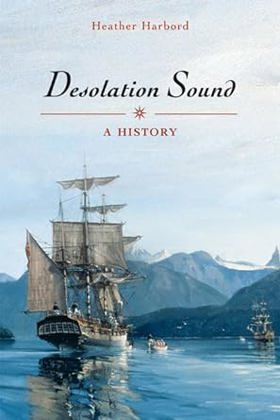
Beautiful Desolation Sound, 150 km north of Vancouver, has for many years been the most popular cruising destination on the BC coast, but is today almost as devoid of local occupants as it was in 1792 when the dyspeptic Captain George Vancouver gave it its misleading name. It has not always been this way. Thick clamshell middens in remote bays, rotted pilings on silent estuaries, ambitious stone terraces on vacant hillsides, overgrown fences around deserted fields, even abandoned railroads--all contribute to an impression that this is an area full of ghosts, an area with a storied past. In Desolation Sound, author Heather Harbord details that remarkable past and brings those ghosts back to unforgettable life. We meet Mike Shuttler, the Homer-quoting hermit who figured in famous books by Stuart Edward White and M. Wylie Blanchet. We meet his illiterate neighbour Phil Lavigne, who said, when Shuttler died, "All dem words, and 'e 'ad to die like all de rest of us!" We meet "the Cougar Queen of Okeover Arm," who said, "Living in the bush like I do, a gun is as much a part of my household tools as a vacuum cleaner is in the city." We visit Baloney Bay, a sprawling Depression-era logging camp where human life had so little value they piled accident victims in a heap and didn't bother moving them until the end of the working day. We meet Sliammon chief Joe Mitchell, whose ancestors had an aboriginal city with buildings 200 feet long in now-deserted Grace Harbour. Harbord assiduously tracks down all the old legends that cling to the shoreside trees like Spanish moss, debunking some, confirming many. Desolation Sound is a captivating book full of great characters, heroic deeds, humorous anecdotes and well-researched fact. It fills a crucial hole in the history of the BC coast. xi, 260 p. : ill., maps, ports. ; 23 cm. CIRC [ 1 ]
|
2007 |
|
Defending Idaho's natural heritage by Ken Robison 
Idaho is rich in natural treasure with more than 100 named mountain ranges, surging rivers, deep canyons, abundant wildlife, seagoing fish, vast forests and picturesque lakes. Throughout the 20th Century many in Idaho saw the state's natural heritage threatened. Early in the 20th Century the state's club women campaigned for a Sawtooth National Park. In the 1930s, a hunting enthusiast named Harry Shellworth led a movement to establish a primitive area in central Idaho. A forester named Bob Marshall persuaded the Forest Service to designate an even larger primitive area north of the Salmon River. Despite these efforts Idaho suffered huge losses of fish and wildlife habitat. Beginning in 1954, sportsmen fought back by sponsoring an initiative to curb dredge mining damage and opposing dams on the Clearwater River and on the Snake River below the mouth of the Salmon. Still to come were intense struggles to stop a proposed open pit mine in the White Clouds, retain a free flowing Snake River in Hells Canyon and protect the Salmon River Wilderness. All of these battles were fought with the intent of preserving the land and the history that make up Idaho's natural heritage. The stories of the various conservation efforts are collected in this book 351 pages : illustrations ; 23 cm CIRC [ 0 ]
|
2014 |
|
Deep, dark and dangerous the story of British Columbia's world-class undersea tech industry by Vickie Jensen 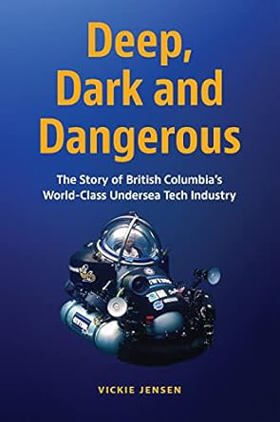
"How British Columbia became an international hotspot for submarines, submersibles, Newtsuits, underwater robotics, Arctic sonar and a host of other cutting-edge undersea technologies. In Deep, Dark & Dangerous, maritime historian Vickie Jensen explores the fascinating story of British Columbia's rise to become a world leader in the underwater tech industry. She profiles both trailblazing innovators and newcomers to the field, and traces BC's colourful history and bright future as a front runner in the world of subsea technology innovation. This little-known saga began in the early 1960s. Two commercial hard-hat divers from the Vancouver area, Don Sorte and Al Trice, realized that they needed a small manned submersible with robot arms for deep-sea work. They couldn't find one to buy, so they decided to partner with machinist Mack Thomson and build their own. Experts told them it would be suicidal to try a home-made version, but just over two years and $100,000 later, their Pisces I was successfully making two-thousand-foot dives. They formed International Hydrodynamics, which went on to build fourteen submersibles and produce a generation of experts that would launch an entire industry of subsea companies in BC. During the same period, Phil Nuytten went from opening Vancouver's first scuba shop as a teenager to becoming a commercial diver and starting his undersea construction company at age twenty-five. Now, Nuytten is best known for his atmospheric diving suits, Newtsuit and Exosuit, along with a series of submersibles for scientific research. Drawing on her background in documenting both history and industry, Jensen uncovers the stories of over forty subsea pioneers, both historical and current, and details the innovations that are responsible for BC's remarkable and continuing subsea reputation. Written with colour and flair, this is a fascinating and exciting story that anyone can enjoy."-- Provided by publisher 282 pages : illustrations ; 24 cm CIRC [ 0 ]
|
2021 |
|
Deep River the C. Arthur Appelo story : Wahkiakum County, Washington by Carlton E. Appelo
|
1978 |
|
Deep and sheltered waters the history of Tod Inlet by David Robert Gray , Royal British Columbia Museum (Issuing body) 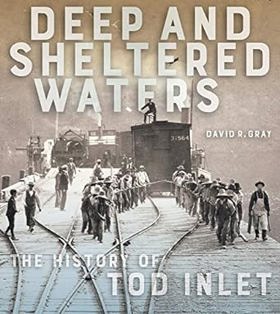
"This book brings to light the fascinating story of a community and place: Tod Inlet, near Victoria, BC. From the original inhabitants from the Tsartlip First Nation to the lost community of immigrant workers from China and India, from a company town to the development of parkland, the wealth of history in this rich area reflects much of the history of the entire province. The story of Tod Inlet and its communities spans from Vancouver Island to the BC coast north to Ocean Falls, south to California, and east to Golden, BC. David Gray draws from interviews with elders of the Tsartlip First Nation, descendants of the Chinese and Sikh workers, and the local community, and from archives held in Victoria and Ottawa. This detailed, illustrated book by an award-winning filmmaker tells the whole story of the natural area, the archaeological sites, the community of Tod Inlet, the Vancouver Portland Cement Company and cement plant (an industrial first), and the development of the Butchart Gardens."-- Provided by publisher xii, 248 pages : illustrations (some color), maps ; 23 cm CIRC [ 1 ]
|
2020 |
|
DeeDee's Indigenous dream families between St. Elmo and Lytton by Vera Isabel Creighton 
Published in 2022 by Vera Isabel Creighton, DeeDee's Indigenous dream families between St. Elmo and Lytton explores the deeply intertwined familial, cultural, and geographic histories of Indigenous communities inhabiting the rugged corridor between St. Elmo and Lytton in British Columbia. Drawing on regional archives, personal narratives, and local genealogies, the book documents the enduring social networks and resilience of families navigating the disruptions of colonial encroachment along the Fraser Canyon. A keen insight drawn from the text is how it shifts the focus away from macroeconomic frontier histories to center kinship and oral tradition, revealing how indigenous family structures served as the primary vehicle for cultural survival and continuity through decades of systemic displacement 122 pages CIRC [ 0 ]
|
2022 |
|
Debaters and dynamiters the story of the Haywood trial by David H. Grover 
In December of 1905, ex-Governor Frank Steunenberg of Idaho was killed when a dynamite bomb shattered his home in Caldwell, Idaho. The dynamiter s confession implicated four officials of the powerful Western Federation of Miners, a militant union that had figured prominently in the labor wars of the day. The trial of the union men became a subject of national interest. A trial in a small town in Idaho with national implications regarding unions, Socialism and labor riots. viii, 310 pages, 8 unnumbered pages of plates : illustrations ; 24 cm CIRC [ 0 ]
|
1964 |
|
De Smet's Letters and sketches, 1841-1842 Letters and sketches with a narrative of a year's residence among the indian tribes of the Rocky Mountains. by Pierre-Jean De Smet
Published as a collection of his correspondence, Jesuit missionary Pierre-Jean De Smet’s Letters and Sketches documents his arduous 1841-1842 journey to establish St. Mary's Mission among the Flathead (Salish) Indians in the Bitterroot Valley of present-day Montana. The text provides vivid, firsthand ethnographic observations of the Rocky Mountain tribes, detailing their daily customs, buffalo hunts, and initial enthusiastic reception of Catholicism. A keen insight drawn from the letters is the profound paradox of De Smet’s mission: while he deeply admired the Indigenous peoples and frequently romanticized them as uncorrupted paragons of natural virtue, his ultimate objective was to systematically replace their traditional spiritual practices with rigid European Catholic orthodoxy. Furthermore, these widely circulated letters inadvertently acted as powerful promotional literature for westward migration, accelerating the white American expansion that would ultimately dismantle the isolated indigenous Catholic utopias De Smet had hoped to build. pages [123]-411 : 13 plates ; 25 cm. ONLINE CIRC [ 1 ]
|
1843 |
|
De San Blas hasta la Alta California los viajes y diarios de Juan Joseph Pérez Hernández by María Luisa Rodríguez-Sala 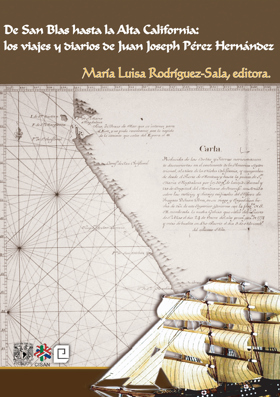
This book deals with the vicissitudes and feats of Juan Joseph Pérez Hernández, a Spanish Royal Navy seaman in charge of the maritime exploration of the northern part of the New World in the last quarter of the eighteenth century. The author explains that the ultimate reason for these travels was to be found in the policy and aspirations of two European empires, the Spanish and the Russian. The Spaniards wanted to consolidate and expand their territories in these northern latitudes in the face of the threat of the penetration through trade and settlement by the nascent Russian empire. | Esta obra narra los avatares y hazañas de Juan Joseph Pérez Hernández, navegante al servicio de la Real Armada española y encargado de la exploración marítima y descubrimiento de las tierras septentrionales del Nuevo Mundo durante el último cuarto del siglo XVIII. El motivo ulterior de dichas travesías, explica la autora, se hallaba en la política y las aspiraciones de dos imperios europeos, el español y el ruso; el primero debía afirmar y expandir sus territorios en aquellas latitudes septentrionales, ante la amenaza de una incursión comercial y poblacional del naciente imperio ruso. 294 pages ; 23 cm CIRC [ 1 ]
|
2006 |
|
Day hiking. Central Cascades by Craig Romano, Alan Bauer 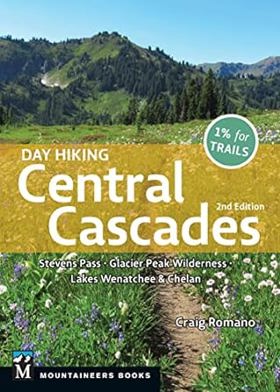
Describes 125 hiking trails in the Central Cascades in Washington state, including detailed route descriptions, information on camping options, flora, fauna, historical trails, photographs, and maps. With some of the largest tracts of wilderness to be found in the Pacific Northwest, the Central Cascades are packed with wildlife, geological diversity, and opportunity for adventure. Using US Highway 2 as its primary organizing principle, this second edition of Day Hiking Central Cascades focuses on the best day hikes to be found between the Sultan Basin and Wenatchee, and around Blewett Pass, Chelan, and the Stehekin and Entiat River Valleys. 355 pages : illustrations (some color), maps (some color) ; 18 cm CIRC [ 1 ]
|
2009 |