City of Everett Snohomish County, Washington
Mapped Location
City of Everett: The mapped location is an approximation and should not be used for navigation or wayfinding.
Information
General information on City of Everett
- Feature Type: Incorporated
Official, historical, colloquial and alternative toponyms for City of Everett
A brief list of names that this geographic feature has been named
| Name | Description |
|---|---|
| City of Everett | Official |
| Everett | Official |
| Port Gardner | Historical |
Origin Notes and History of City of Everett
References to City of Everett that document the origin of its place name
EVERETT, the county seat of Snohomish County, is situated on Puget Sound, at the mouth of the Snohomish River. It was first platted on August 22, 1890, as "Port Gardner" by W. J. Rucker and B. J. Rucker. Soon afterward a group of capitalists headed by Charles Colby of New York and Henry Hewitt, Jr., of Tacoma, purchased land for the projection of a large commercial enterprise. The city was enlarged and named in honor of Everett Colby, son of one of the promoters. The pet-name of the place is "City of Smokestacks."
A Selected Bibliography of City of Everett, Snohomish County, Washington
A compilation of essential readings detailing the history, geography, and culture of the region.
Mill town footlights the theaters of Everett, Washington by David Dilgard, Everett Public Library
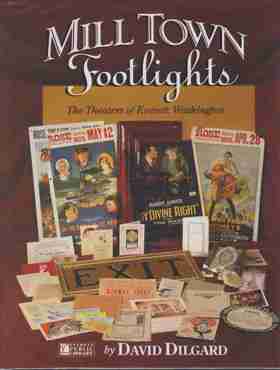
Published in local editions by historian David Dilgard and the Everett Public Library, Mill Town Footlights: The Theaters of Everett, Washington chronicles the vibrant, bustling entertainment history of a booming turn-of-the-century industrial city. The book details the rise and fall of Everett’s historic playhouses, vaudeville houses, and nickelodeons, illustrating how cultural institutions thrived amidst the grit, smoke, and labor strife of a quintessential Pacific Northwest mill town. Drawing on rich archival photographs and local ephemera, the text traces how early residents sought out sophisticated theatrical escapism as a vital counterbalance to grueling industrial labor. A keen insight drawn from the work is how the rapid emergence of high-culture entertainment in an isolated timber hub demonstrates that rough-edged frontier economies were deeply hungry for civic refinement, using the performing arts to rapidly project an image of metropolitan permanence and respectability onto a raw landscape
iv, 116 pages : illustrations ; 29 cm
Desiderata
Voices from Everett's first century by Snohomish County Museum and Historical Association

Oversize softbound social history of Everett, WA 1892-1994. 217 pages; illustrated with b/w historical photos of Everett and Snohomish County
vii, 217 pages : illustrations ; 28 cm
Non-circulating [ 1 ]
Riverside remembers books I, II & III by Greater Riverside Organization (Everett, Wash)
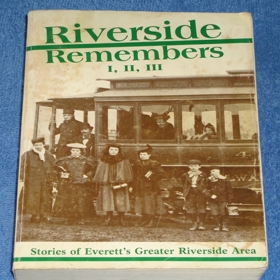
Riverside Remembers: Books I, II & III by the Greater Riverside Organization is a multi-volume grassroots historical compilation, originally published in the mid-1980s, that chronicles the robust working-class heritage of Everett, Washington's historic Riverside neighborhood. The comprehensive collection gathers rich oral histories, archival photographs, and pioneer anecdotes to vividly detail daily life in the community, profiling the resilient mill workers, local labor organizers, families, and neighborhood characters who defined this industrial waterfront hub along the Snohomish River. Ultimately, it serves as an invaluable, community-driven repository that preserves the distinct grit, cultural identity, and enduring civic spirit of one of Everett's oldest and most historically significant neighborhoods.
ix, 111 pages : illustrations ; 21 cm
Non-circulating [ 1 ]
Memory lanes of Old Everett and its East Riverside by Helmer Malstrom, David Dilgard
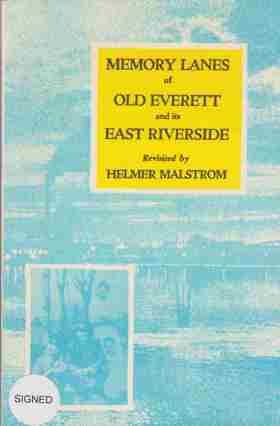
Memory Lanes of Old Everett and Its East Riverside by Helmer Malstrom and David Dilgard is a 1986 local history published by Memory Lane Publishers that captures the working-class heritage and early industrial landscape of this quintessential Puget Sound mill town. The book offers a richly detailed retrospective of early Everett, Washington, focusing heavily on the bustling East Riverside neighborhood where the city's vital lumber and shingle mills were concentrated along the Snohomish River. Blending pioneer anecdotes, grassroots documentation, and regional lore, the authors vividly resurrect the gritty, industrious spirit of the early 20th-century waterfront. Ultimately, it serves as an invaluable and nostalgic community resource for local historians seeking to understand the daily lives, economic roots, and enduring fabric of one of Snohomish County's most significant industrial centers.
xi, 188 pages : color illustrations ; 21 cm
Non-circulating [ 1 ]
Mill town a social history of Everett, Washington, from its earliest beginnings on the shores of Puget Sound to the tragic and infamous event known as the Everett Massacre by Norman H. Clark
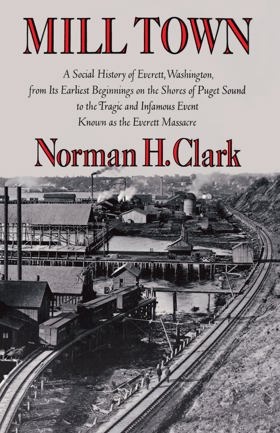
A social history of Everett, Washington, from its earliest beginnings to the tragic and infamous event on November 5, 1916, which came to be known as the Everett Massacre
viii, 267 pages, 12 unnumbered pages of plates : illustrations ; 21 cm
Non-circulating [ 1 ]
Snohomish County
- Alderwood Manor
- Andron
- City of Arlington
- Arlington Heights
- Arlington Junction
- Barco
- Bedal
- Beverly Acres
- City of Bothell
- City of Brier
- Bromart
- Bryant
- Casino Corner
- Cathan
- Cathcart
- Cavalero Corner
- Cedar Valley
- Cicero
- Clearview
- Town of Darrington
- Echo Lake
- Edgecomb
- City of Edmonds
- English
- Esperance
- City of Everett
- Everett Junction
- Fairmont
- Firdale
- Florence
- Fobes Hill
- Forest Glade
- Fortson
- Fryelands
- Galena
- Getchell
- City of Gold Bar
- Grace
- City of Granite Falls
- Halford
- Halterman
- Hazel
- High Rock
- Hyland
- Town of Index
- Jamison Corner
- John Sam Lake
- Jordan
- Kennard Corner
- Kruse
- Kruse Junction
- Lake Bosworth
- Lake Goodwin
- Lake Ketchum
- Lake Roesiger
- City of Lake Stevens
- Lake Stickney
- Lakewood
- Larimers Corner
- Lochsloy
- City of Lynnwood
- Machias
- Maltby
- Martha Lake
- City of Marysville
- May Creek
- McKees Beach
- Meadowdale
- City of Mill Creek
- Mission Beach
- City of Monroe
- Monte Cristo
- City of Mountlake Terrace
- City of Mukilteo
- Murphys Corner
- Nelsons Corner
- Norman
- North Creek
- North Lynnwood
- North Marysville
- North Stanwood
- North Sultan
- Osborn Corner
- Oso
- Pearson Eddy
- Picnic Point
- Pilchuck
- Pilchuck
- Priest Point
- Rees Corner
- Reiter
- Riverside
- Robe
- Roosevelt
- Rowan
- Seattle Heights
- Seattle Hill
- Serene
- Shaker Church
- Silvana
- Silvana Terraces
- Silver Firs
- Silverton
- Sisco
- Sisco Heights
- City of Snohomish
- Sobey
- South Snohomish
- Spee-Bi-Dah
- City of Stanwood
- Startup
- Stimson Crossing
- City of Sultan
- Sunny Shores
- Swede Heaven
- Thrashers Corner
- Three Lakes
- Totem Park
- Trafton
- Tulalip
- Tulalip Bay
- Tulare Beach
- Tulker
- Turner Corner
- Verlot
- Wagner
- Warm Beach
- Weallup Lake
- West Lake Stevens
- White Horse
- Wintermutes Corner
- Woodruff
- Woods Creek
- City of Woodway
Political Boundaries
Last updated: 2017-03-12