City of Granite Falls Snohomish County, Washington
Mapped Location
City of Granite Falls: The mapped location is an approximation and should not be used for navigation or wayfinding.
Information
General information on City of Granite Falls
- Feature Type: Incorporated
Official, historical, colloquial and alternative toponyms for City of Granite Falls
A brief list of names that this geographic feature has been named
| Name | Description |
|---|---|
| City of Granite Falls | Official |
| Granite Falls | Official |
Origin Notes and History of City of Granite Falls
References to City of Granite Falls that document the origin of its place name

GRANITE FALLS, a town in Snohomish County, named from the falls in the Stillaguamish River, where the bed of the stream and walls of the canyon are of granite. (Frank Niles, in Names MSS., Letter 350.) Early traders among the Indians called the place "Portage." William M. Turner and F. P. Kistner settled there in 1884 and the railroad put in its appearance in 1889. On August 4, 1891, the townsite was recorded, the promoters being S. W. Holland and T. K. Robe. (History of Skagit and Snohomish Counties, pages 864-366.)
Related Catalog Titles
A Bibliography for City of Granite Falls, Snohomish County, Washington
Pioneers of the Stillaguamish by Dennis Conroy, Carol Husby Ronken
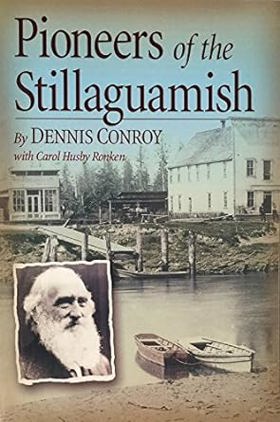
Published by local historians Dennis Conroy and Carol Husby Ronken, Pioneers of the Stillaguamish compiles extensive genealogical records, historical photographs, and pioneer recollections to chronicle the early European-American settlement of the Stillaguamish River valley in Washington. The book details the arduous process of clearing dense old-growth timber, establishing homesteads, and building rudimentary roads and schools along the unpredictable river corridor during the late 19th and early 20th centuries. By centering the struggles and daily lives of ordinary families, the text preserves the foundational social fabric of communities like Arlington and Stanwood. A keen insight drawn from the work is how local pioneer histories capture the immense cognitive dissonance of frontier expansion; by meticulously detailing the relentless destruction of ancient forests to plant farms, the text unwittingly reveals how the triumph of civilization for homesteaders was simultaneously an act of catastrophic ecological erasure for the valley's original inhabitants
viii, 149 pages : illustrations, maps ; 23 cm
CIRC [ 1 ]
Snohomish County
- Alderwood Manor
- Andron
- City of Arlington
- Arlington Heights
- Arlington Junction
- Barco
- Bedal
- Beverly Acres
- City of Bothell
- City of Brier
- Bromart
- Bryant
- Casino Corner
- Cathan
- Cathcart
- Cavalero Corner
- Cedar Valley
- Cicero
- Clearview
- Town of Darrington
- Echo Lake
- Edgecomb
- City of Edmonds
- English
- Esperance
- City of Everett
- Everett Junction
- Fairmont
- Firdale
- Florence
- Fobes Hill
- Forest Glade
- Fortson
- Fryelands
- Galena
- Getchell
- City of Gold Bar
- Grace
- City of Granite Falls
- Halford
- Halterman
- Hazel
- High Rock
- Hyland
- Town of Index
- Jamison Corner
- John Sam Lake
- Jordan
- Kennard Corner
- Kruse
- Kruse Junction
- Lake Bosworth
- Lake Goodwin
- Lake Ketchum
- Lake Roesiger
- City of Lake Stevens
- Lake Stickney
- Lakewood
- Larimers Corner
- Lochsloy
- City of Lynnwood
- Machias
- Maltby
- Martha Lake
- City of Marysville
- May Creek
- McKees Beach
- Meadowdale
- City of Mill Creek
- Mission Beach
- City of Monroe
- Monte Cristo
- City of Mountlake Terrace
- City of Mukilteo
- Murphys Corner
- Nelsons Corner
- Norman
- North Creek
- North Lynnwood
- North Marysville
- North Stanwood
- North Sultan
- Osborn Corner
- Oso
- Pearson Eddy
- Picnic Point
- Pilchuck
- Pilchuck
- Priest Point
- Rees Corner
- Reiter
- Riverside
- Robe
- Roosevelt
- Rowan
- Seattle Heights
- Seattle Hill
- Serene
- Shaker Church
- Silvana
- Silvana Terraces
- Silver Firs
- Silverton
- Sisco
- Sisco Heights
- City of Snohomish
- Sobey
- South Snohomish
- Spee-Bi-Dah
- City of Stanwood
- Startup
- Stimson Crossing
- City of Sultan
- Sunny Shores
- Swede Heaven
- Thrashers Corner
- Three Lakes
- Totem Park
- Trafton
- Tulalip
- Tulalip Bay
- Tulare Beach
- Tulker
- Turner Corner
- Verlot
- Wagner
- Warm Beach
- Weallup Lake
- West Lake Stevens
- White Horse
- Wintermutes Corner
- Woodruff
- Woods Creek
- City of Woodway
Political Boundaries
Last updated: 2017-07-02