Knappton Pacific County, Washington
Mapped Location
Knappton: The mapped location is an approximation and should not be used for navigation or wayfinding.
Information
General information on Knappton
- Feature Type: Place
Official, historical, colloquial and alternative toponyms for Knappton
A brief list of names that this geographic feature has been named
| Name | Description |
|---|---|
| Knappton | Official |
Origin Notes and History of Knappton
References to Knappton that document the origin of its place name
CEMENTVILLE, on the Columbia River in Pacific County. Machinery was installed there by a man named Hopkins for the making of cement. (H. B. Settem, Knappton, in Names MSS., Letter 98.)
KNAPPTON, a town on the Columbia River, in Pacific County. It was named for J. B. Knapp, who built a sawmill there. (H. B. Settem, Knappton, in Names MSS., Letter 93.)
A Selected Bibliography of Knappton, Pacific County, Washington
A compilation of essential readings detailing the history, geography, and culture of the region.
The Columbia River's "Ellis Island" the story of Knappton Cove by Nancy Bell Anderson, Heather Bell Henry
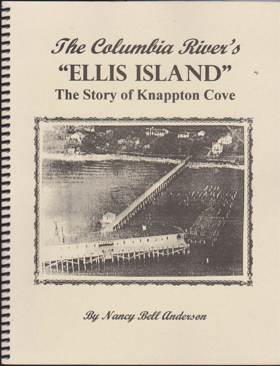
The United States mandated the medical inspection of all arriving immigrants in 1891. The Columbia River Quarantine Station in Knappton Cove, Washington, established 1899, was one of four points of entry on the west coast for immigrants coming to America. Thousands of European and Asian immigrants underwent health inspections at the station
98 pages : illustrations, maps ; 28 cm
Desiderata
Knappton the first 50 years, Pacific County, Washington by Carlton E. Appelo
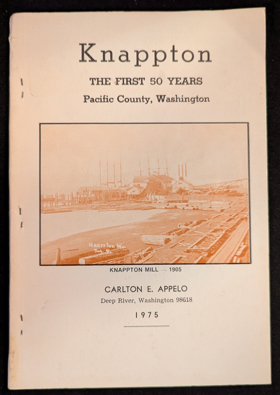
Knappton the first 50 years, Pacific County, Washington chronicles the grueling industrial expansion and isolated maritime settlement along the rugged, storm-battered northern shore of the massive Columbia River estuary. Appelo details how the region's formidable physical barriers—specifically the treacherous, shifting sandbars of the river mouth, the violent winter squalls driving in from the open Pacific, and the steep, impenetrable coastal rainforests plunging directly into the tidal wash—strictly dictated the margins of early human survival, commercial fishing, and timber extraction. By mapping the immense physical labor required to construct precarious salmon canneries and maritime quarantine facilities on piling-supported wharves directly over the tidal flats, and to wrestle massive old-growth timber from the sheer coastal bluffs, the narrative highlights the monumental effort necessary to anchor a permanent industrial enclave in this demanding estuarine environment. The profound lack of viable overland routes to the territorial interior initially forced these remote laborers and pioneer homesteaders into an absolute reliance on the perilous marine highway, completely anchoring their commercial existence and physical survival to the unpredictable arrival of coastal schooners and the severe hydrological force of the Columbia River's massive tidal exchange. Ultimately, this local historical record serves as a deeply localized spatial history, demonstrating how the extreme estuarine geography, violent maritime weather, and immense hydrological power of this Pacific Northwest frontier fundamentally shaped the fiercely resilient, strictly maritime-dependent character of the Knappton settlement.
88 pages : illustrations ; 23 cm
Non-circulating [ 1 ]
Pacific County
- Balevile (historical)
- Bay Center
- Bay Center Junction
- Bedford
- Breakers
- Brigham City (historical)
- Brooklyn
- Bruceport
- Burt
- Camp Brix (historical)
- Chinook
- Davis
- Dexter by the Sea
- East Raymond
- Elk Creek
- Firdale
- Fort Canby
- Frances
- Frankfort
- Globe
- Heather
- Hilda
- Hines
- Holcomb
- Holman
- City of Ilwaco
- Klipsan Beach
- Knappton
- Lebam
- City of Long Beach
- Loomis
- McGowan
- Megler
- Menlo
- Middle Nemah
- Moores Corner
- Nahcotta
- Nallpee
- Naselle
- Nemah
- Nemah Junction
- North Cove
- North Nemah
- Ocean Park
- Oceanside
- Oceanview
- Oysterville
- Pacific City (historical)
- Pluvius
- City of Raymond
- Rhodesia Beach
- Seahaven (historical)
- Seaport (historical)
- Seaview
- City of South Bend
- Stringtown
- Sutico
- Swem
- Tokeland
- Upper Salmon Junction
- Venice
- Willapa
Political Boundaries
Last updated: 2017-06-30