Fort Langley National Historic Site of Canada Feature
Mapped Location
Fort Langley National Historic Site of Canada: The mapped location is an approximation and should not be used for navigation or wayfinding.
Information
General information on Fort Langley National Historic Site of Canada
- Feature Type: Feature
Official, historical, colloquial and alternative toponyms for Fort Langley National Historic Site of Canada
A brief list of names that this geographic feature has been named
| Name | Description |
|---|---|
| Fort Langley National Historic Site of Canada | Official |
A Selected Bibliography of Fort Langley National Historic Site of Canada, Feature
A compilation of essential readings detailing the history, geography, and culture of the region.
Fort Langley, birthplace of British Columbia by B. A. McKelvie, Charles Lillard
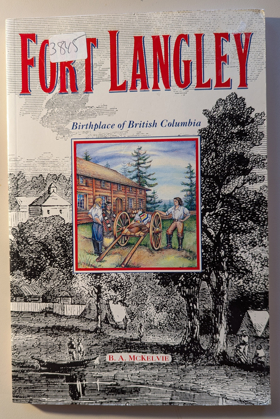
Co-authored by B.A. McKelvie and Charles Lillard, Fort Langley, Birthplace of British Columbia chronicles the foundational history of the Hudson's Bay Company fur-trading post established along the lower Fraser River in 1827. The book details how the fort evolved from a modest trading stockade dealing in salmon and beaver pelts into the geopolitical staging ground where British colonial rule was officially proclaimed in 1858. Drawing on historical journals and company records, the text illustrates the complex economic web linking fur traders, maritime supply ships, and local Indigenous populations. A keen insight drawn from the work is how the romantic narrative of a colony's "birthplace" obscures its corporate origins; by tracing British Columbia's administrative roots directly back to a commercial trading monopoly, the authors reveal that the region's political foundation was engineered less by heroic statecraft than by the ruthless logistical demands of the fur trade.
112 pages, [8] pages of plates : illustrations, maps ; 23 cm
Non-circulating [ 1 ]
Fort Langley outpost of Empire by B. A. McKelvie

An account of the Hudson's Bay Company's operation at Fort Langley in southern British Columbia in the early-to-mid 19th Century
ix, 98 pages illustrations (some color) maps (on lining-papers) 27 cm
Desiderata
Fort Langley, 1827-1927 a century of settlement in the valley of the lower Fraser River by Denys Nelson, Art, Historical and Scientific Association of Vancouver, B.C.
Denys Nelson’s 1927 centennial monograph, Fort Langley, 1827–1927: A Century of Settlement in the Valley of the Lower Fraser River, documents the strategic transformation of the Hudson’s Bay Company’s primary coastal river post into the administrative cradle of mainland British Columbia. Sited along the tidal reaches of the lower Fraser, the fort’s stockades, agricultural tracts, and river landings were superimposed squarely upon the ancestral territories, seasonal salmon-harvesting grounds, and canoe corridors of the Stó:lō—most notably the Kwantlen and Katzie nations. Nelson’s chronicle details how early fur trade survival and commercial viability hinged entirely on complex interdependent alliances with local Coast Salish communities, who not only provided the thousands of salmon that anchored the fort’s pioneering salted-fish export trade to Hawaii and California, but also commanded the aquatic navigation essential for provisioning the interior brigade trails. By tracing the outpost's evolution from a defensive trading station through the frantic influx of the 1858 Fraser Canyon Gold Rush—culminating in Sir James Douglas’s proclamation of the Crown Colony of British Columbia—to an established agrarian valley, the work illustrates how colonial civic authority and riverine commerce were physically anchored to an enduring Indigenous waterway.
31 pages : illustrations, portraits ; 24 cm
ONLINE Circulation [ 1 ]
Last updated: 2001-01-12