San Juan Islands Feature
Mapped Location
San Juan Islands: The mapped location is an approximation and should not be used for navigation or wayfinding.
Information
General information on San Juan Islands
- Feature Type: Feature
Official, historical, colloquial and alternative toponyms for San Juan Islands
A brief list of names that this geographic feature has been named
| Name | Description |
|---|---|
| San Juan Islands | Official |
Origin Notes and History of San Juan Islands
References to San Juan Islands that document the origin of its place name

SAN JUAN COUNTY, named for one of the largest islands in Washington Sound, which should be known as San Juan Archipelago. Following the boundary treaty of 1846, a dispute arose between the British and American Governments for the possession of this group of islands, which dispute was settled by Emperor William I., of Germany, as arbitrator on October 21, 1872. On receiving information of that award the Territorial Legislature of Washington organized the archipelago into San Juan County on October 31, 1873.
A Selected Bibliography of San Juan Islands, Feature
A compilation of essential readings detailing the history, geography, and culture of the region.
It's always uphill from the dock the story of the Puget Sound islands by Ann B. Irish

"Here is a look at the Puget Sound islands throughout history -- the San Juan Islands, Whidbey Island, Bainbridge and Vashon Islands, and many others. Featured are the people who have come to the islands: Native Americans, explorers, entrepreneurs, settlers and visitors. We learn of the Native peoples' traditional ways of life and the changes that the new settlers brought. The islands saw small pioneer farms and, later, very successful strawberry fields. Industries emerged, from lumber mills large and small to boat construction and even ski design and production. National defense installations have also been on the islands, and wartime policies have had a strong impact on Bainbridge and Vashon. Yet the islands have also hosted many summer camps, resorts and the parks that islanders and visitors today enjoy. We learn about the boats that brought people to the islands before the age of motor vehicles. More recently, how have automobile ferries and bridges impacted the islands? Here, too, is the story of the bridges to the islands that have not been built. Finally, what are the challenges these islands may face in the future?" -- Publisher description
xv, 349 pages : illustrations, maps ; 24 cm
Desiderata
Native American wives of San Juan settlers by Karen Jones Lamb

Karen Jones Lamb’s biographical and genealogical chronicle, Native American Wives of San Juan Settlers, recovers the foundational domestic, familial, and cross-cultural relationships that anchored mid-to-late nineteenth-century non-Indigenous settlement across the San Juan Archipelago. The work documents how early homestead claims, sheep stations, and lime-quarrying ventures across San Juan, Orcas, and Lopez islands were established directly within the ancestral marine territories, reef net locations, and seasonal harvesting sites of Northern Straits Salish peoples, including the Lummi, Samish, Songhees, and Saanich. Lamb details how settler survival on isolated island homesteads depended profoundly on the labor, ecological knowledge, and extensive kinship networks of Indigenous women, whose open-water canoe navigation and foraging skills maintained isolated households long before the advent of regular steamship service. Ultimately, these biographical accounts illustrate how cross-cultural marriages bridged the turbulent transition from the joint military occupation of the Pig War to formalized American civilian governance, highlighting the central role of Native women in sustaining the archipelago's early civic and maritime communities.
94 pages : illustrations ; 27 cm
Desiderata
Voices from the islands true stories about Washington State's fabulous San Juan Islands and those who inhabit them by Gordon Keith
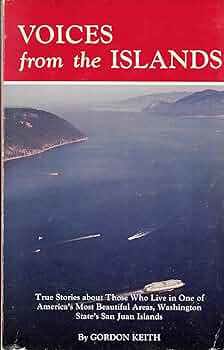
'Voices from the Islands' is must reading for anyone who has ever secretly or openly expressed a desire to live on a small island accessible only by boat or plane. In this potpourri of island stories, articles and interviews with old-timers as well as new-comers, you will meet such diverse individuals as Little Wolf, the Stuart Island Indian who was ‘raised with the wolves’; and a cartoonist who moved to an island to retire, but is presently syndicating his own cartoons nationally. You’ll meet an old-time individualist named Roger Purdue, who refused to let Orcas Island’s volunteer Fire Fighters on the roof of his house when the chimney burst into flames, because he didn’t want them walking around on his roof. There is also an interview with a former Hollywood script writer who gave up his lucrative assignments and moved to an island to live closer to nature. On the lighter side, there is an account of some Islanders who dumped an entire shipment of Seattle Post Intelligencers into the bay because of an article calling their town ‘the armpit of the San Juans.’ And, you’ll enjoy reading about the residents of a small island community who got their dander up when a 42-foot, state-owned cabin cruiser went aground and was left with no one aboard. Outraged at what seemed sheer negligence by the state, several islanders towed the vessel to the Olga dock, intending to hold it for salvage. “How to Win a Political Campaign with the Help of Your Opponent” is a humorous incident from Henry Jackson’s early days as an aspiring senator. Besides the thirty-three articles and interviews - illustrated by more than fifty photographs—-the author tells why he moved to the San Juans and why it took him and his family seven years, after they had purchased their Orcas Island home, before they could move into it. Whether you read Voices from the Islands for an intimate look at island life, or just to while away a few pleasant hours, you will find your time well spent.
xvii, 278 pages : illustrations ; 22 cm
Non-circulating [ 1 ]
It came to pass in the San Juan Islands by Roderic Marble Olzendam, Gordon Keith

It Came to Pass in the San Juan Islands captures the pioneer history and unique maritime culture of the sprawling, rugged archipelago situated at the turbulent junction of the Strait of Juan de Fuca and the Strait of Georgia in northwestern Washington. Olzendam and Keith detail how the isolated, rocky, and heavily timbered topography of these landmasses—ranging from the steep, mountainous slopes of Orcas Island to the more pastoral valleys of Lopez and San Juan—dictated a fiercely independent settler lifestyle reliant on small-scale farming, fishing, and the exploitation of the nearby water boundary with Canada. By highlighting the early communities' complete dependence on the Mosquito Fleet and emerging regional ferry networks to navigate the treacherous tidal currents of the Salish Sea, the narrative underscores the profound physical barriers that separated these remote outposts from the mainland. Ultimately, the book serves as a deeply localized spatial history, demonstrating how the formidable marine geography of this Pacific Northwest archipelago fundamentally forged the enduring self-reliance of its island inhabitants.
ix, 139 pages : illustrations ; 23 cm
Non-circulating [ 1 ]
San Juan County, Washington, inventory of natural areas on private lands by Nature Conservancy (U.S.)., San Juan County (Wash). Planning Department
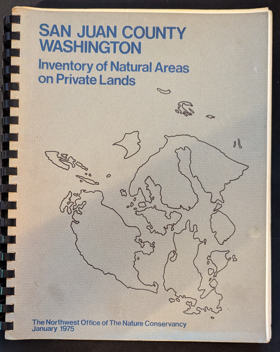
San Juan County, Washington, inventory of natural areas on private lands examines the ecological conservation and spatial mapping of the scattered, rain-shadowed archipelago situated within the protected marine waters of the Salish Sea. The Nature Conservancy and the county planning department detail how the region's fragmented island topography—specifically the rocky, tide-swept shorelines, the rare Garry oak woodlands, and the isolated, ecologically fragile prairie bluffs—strictly dictated the margins of private land ownership and environmental preservation. By mapping the delicate terrestrial ecosystems dispersed across these insular landmasses, the narrative highlights how the specific maritime isolation and complex marine geography harbor distinct, highly localized ecological sanctuaries amid increasing development pressures. Ultimately, this environmental inventory serves as a deeply localized spatial history, demonstrating how the intricate archipelagic geography and fragile microclimates of this Pacific Northwest maritime frontier fundamentally shaped the ecologically vital, carefully managed character of the San Juan Islands.
128, [54] pages : illustrations ; 28 cm
Non-circulating [ 1 ]
Living high by June Burn

By June BurnCourage, gaiety, and a fresh approach to live are reflected in this "unconventional autobiography." It is a story of a twentieth-century pioneers as resourceful as ever they were in the days of the old frontier. June Burn and her husband Farrar determined to go their own sweet way, enjoying "first hand living" and not surrounding to the routines of a workday world. Through the years they had some high and glorious adventures, which included homesteading a "gumdrop" in the San Juan Islands, of the Pacific Northwest, teaching Eskimos near Siberia, and exploring the United States by donkey cart with a baby aboard. - Living High, 1958 edition book jacket
292 pages ; 23 cm
Non-circulating [ 1 ]
San Juan Islands, the Cronstadt of the Pacific by Archie W. Shiels

Archie W. Shiels’s San Juan Islands, the Cronstadt of the Pacific explores the profound strategic importance and the remarkable diplomatic resolution that secured the intricate maritime borders of the northern Puget Sound. The narrative illustrates how the dynamic environmental realities of this coastal archipelago—defined by the deep, vital transit channels weaving between the forested communities of Orcas, Lopez, Shaw, and San Juan islands, and their crucial position linking mainland ports like Anacortes to the broader Pacific—initially created a highly contested geopolitical landscape. By detailing the prolonged joint military occupation of the islands during the mid-nineteenth century boundary dispute, the text highlights how local resilience, pragmatic daily adaptation, and genuine cross-cultural cooperation on the ground steadily diffused international tensions. Ultimately, the account demonstrates that thoughtfully navigating these complex maritime boundaries and embracing patient, peaceful international arbitration were essential steps in preserving the enduring tranquility and cohesive civic development of these unique island communities.
275 p. : incl. front. (map) 24 cm.
Non-circulating [ 1 ]
Related Online Resources
Island Histories: Stories of the San Juans
San Juans Explorer is a digital guide to the history, natural history, and culture of the San Juan Islands. A project of the Public History Program at Eastern Washington University, the geolocated stories on San Juans Explorer were created by student
WEB LINK
Last updated: 2017-06-29