Bainbridge Island Feature
Mapped Location
Bainbridge Island: The mapped location is an approximation and should not be used for navigation or wayfinding.
Information
General information on Bainbridge Island
- Feature Type: Feature
Official, historical, colloquial and alternative toponyms for Bainbridge Island
A brief list of names that this geographic feature has been named
| Name | Description |
|---|---|
| Bainbridge Island | Official |
Origin Notes and History of Bainbridge Island
References to Bainbridge Island that document the origin of its place name

BAINBRIDGE ISLAND, in Kitsap County. The Wilkes Expedition, 1841, by discovering Agate Passage, made known the existence of the island. It was named in honor of Captain William Bainbridge, hero of the Constitution in the Java action, and one of the famous men in United States naval records.
A Selected Bibliography of Bainbridge Island, Feature
A compilation of essential readings detailing the history, geography, and culture of the region.
It's always uphill from the dock the story of the Puget Sound islands by Ann B. Irish

"Here is a look at the Puget Sound islands throughout history -- the San Juan Islands, Whidbey Island, Bainbridge and Vashon Islands, and many others. Featured are the people who have come to the islands: Native Americans, explorers, entrepreneurs, settlers and visitors. We learn of the Native peoples' traditional ways of life and the changes that the new settlers brought. The islands saw small pioneer farms and, later, very successful strawberry fields. Industries emerged, from lumber mills large and small to boat construction and even ski design and production. National defense installations have also been on the islands, and wartime policies have had a strong impact on Bainbridge and Vashon. Yet the islands have also hosted many summer camps, resorts and the parks that islanders and visitors today enjoy. We learn about the boats that brought people to the islands before the age of motor vehicles. More recently, how have automobile ferries and bridges impacted the islands? Here, too, is the story of the bridges to the islands that have not been built. Finally, what are the challenges these islands may face in the future?" -- Publisher description
xv, 349 pages : illustrations, maps ; 24 cm
Desiderata
Port Madison, Washington territory, 1854-1889 by Fredi Perry

They Cast a Long Shadow. A History of the Nonwhite Races on Bainbridge Island by Brian, Ed Roberts, Bainbridge Island School District 303, WA
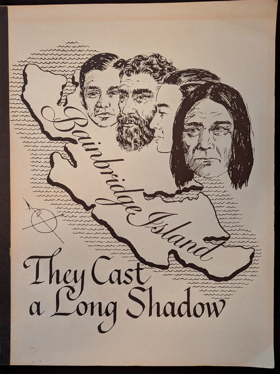
Written as a curriculum aid for students in the Bainbridge Island, Washington school district, this collection of stories about the Japanese, the Chinese, the Hawaiians, the Filipinos, the Vietnamese, and the American and Canadian Indians is an attempt to explain "what life is like for people who look different". The stories all relate the history of each of these ethnic groups on Bainbridge Island, an agricultural community, from the time of their arrival through the present. Accounts of individual's experiences from each group and black and white photographs are used to illustrate the stories. (PR)
122
Non-circulating [ 1 ]
Bainbridge landings by Allen Beach
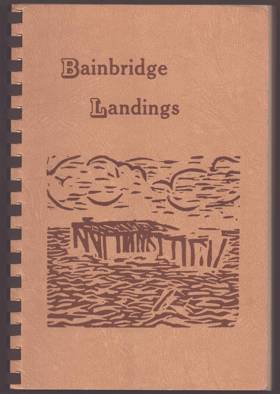
Allen Beach’s Bainbridge Landings chronicles the intimate maritime and pioneer history of Bainbridge Island, an isolated, heavily forested landmass strategically situated in the heart of Washington's Puget Sound. The narrative meticulously maps the island's convoluted, deeply indented shoreline, illustrating how the dense, impassable interior timber forced early settlement to cluster entirely around sheltered estuarine inlets like Eagle Harbor and the deep-water anchorage of Port Blakely. By detailing the massive coastal lumber mills, sprawling shipyards, and the vital daily operations of the "Mosquito Fleet" steamboats that serviced dozens of scattered wooden piers, the book demonstrates how the surrounding tidal waters served as the absolute economic and social lifeline for these disconnected enclaves. Ultimately, the text captures the defining marine geography of this inland island community, highlighting how its physical isolation from the mainland and total reliance on aquatic transit dictated the industrial development and cultural rhythm of the region long before the advent of the modern automobile ferry system.
unpaged.
Non-circulating [ 1 ]
Last updated: 2017-02-12