Vancouver Island Feature
Mapped Location
Vancouver Island: The mapped location is an approximation and should not be used for navigation or wayfinding.
Information
General information on Vancouver Island
- Feature Type: Feature
Official, historical, colloquial and alternative toponyms for Vancouver Island
A brief list of names that this geographic feature has been named
| Name | Description |
|---|---|
| Vancouver Island | Official |
Origin Notes and History of Vancouver Island
References to Vancouver Island that document the origin of its place name
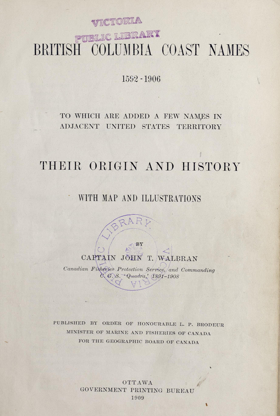
Vancouver island. Vancouver rock, Milbank sound. Vancouver bay, Jervis inlet. Vancouver city, Burrard inlet.
After Captain George Vancouver of the Royal Navy, who made an extensive exploring survey of this coast in command of H.M.S. Discovery, accompanied by the armed tender Chatham, during the years 1792-1793-1794. The two vessels sailed from Falmouth, 1 April, 1791, and the Discovery anchored in the Shannon on her return, 12 September, 1795, the Chatham arriving in England a few weeks afterwards. The following note relating to the return of the Discovery appears in the Annual Register, 1795, XXXVII, Chronicle, p. 35, under date 24 September, 1795:—
"The Discovery sloop of war, Captain Vancouver, arrived at Limerick on the 13th inst., in company with the homeward bound East India fleet, having completely effected the object of her expedition, and made some important discoveries on the northwest coast of America. She sailed from England with 150 men on• board, and such was the attention of the officers to their health, that only one died in the course of a very fatiguing voyage of four years. They speak in the highest terms of the inhabitants of the Sandwich Islands, from whom they experienced every possible civility and attention."
Vancouver island, the largest on the west coast of North America, was first named "Quadra and Vancouver," after the two naval officers in the service, respectively, of Spain and Great Britain, who met at Nootka in 1792 to carry out certain provisions of the Britannic-Spanish agreement embodied in the "Nootka convention," dated 28 October, 1790, the result of what is known in British naval annals as The Spanish Armament." These officers were Captain ("capitan de navio" ) Don Juan Francisco de la Bodega y Quadra, commandant of Nootka and of the marine establishment at San Blas; and Commander George Vancouver, R.N., of H.M.S. Discovery. Quadra's vessel, flying his commodore's broad pennant, was the Activa, brig, 12 guns. Quadra and Vancouver were most kindly disposed to each other, and during a pleasant autumn picnic together in September, 1792, while visiting the Nootka chief Maquinna at his summer village at the head of Tahsis canal, it was suggested to Vancouver by the Spanish commander that some port or island should be named after them both, not only to commemorate their meeting but the friendly intercourse that existed between them. Vancouver agreed to this request of Quadra's, and says in his journal:
"Conceiving no spot so proper for this denomination as the place where we had first met, which was nearly in the centre of a tract of land that had first been circumnavigated by us, forming the southwestern sides of the gulf of Georgia, and the southern sides of Johnstone's straits and Queen Charlotte's sound, I named that country the island of Quadra and Vancouver; with which compliment he seemed highly pleased." (Vancouver, 8°, Il, p. 357.)
The name of Quadra has, however, as regards this island, long fallen into disuse and that of Vancouver alone remains.
Vancouver was born at King's Lynn, Norfolk, 22 June, 1757, the youngest child of John Gasper Vancouver and Bridget Berners, his wife, and he was baptized in St. Margaret's church on the 16 March, 1761. Vancouver's father was of Dutch or Flemish origin, and settled in Lynn some years before the birth of George. He was deputy collector of customs in King's Lynn, then the third largest seaport in England, under Sir Charles Turner. He resided in a house in New Conduit ward, rented at £10 per annum, 1755-1773, and in this house his son George was born. The house is built of brick, and at this date (1906) the lower part has been converted into a shop. In 1750, Mr. John G. Vancouver with Sir Charles Turner was appointed surveyor of the highways in the adjoining parish of South Lynn. In the year 1759-1760 he and another burgess were chosen to collect the church rate. He died on the 12 January, 1773, and was buried in the churchyard of All Saints, South Lynn. Captain Vancouver honoured his mother by naming point Bridget and Berners bay in Lynn canal, Alaska, after her. Lynn canal he named after his birthplace, and Couverden point, the west point of entrance to the canal, after the seat of his ancestors, which place is in North Holland. Vancouver also bestowed many Norfolk names in Alaska besides the foregoing, amongst them being Windham bay, Holkham bay and Port Snettisham; Walpole, Coke, Anmer and Styleman points, all Norfolk names or names in connection with King's Lynn. (From the parish records, King's Lynn, Norfolk, and other sources in that county, per Mr. A. E. Rust, parish clerk; Vancouver, 8°, V, pp. 423, 429, 435, and 436.)
Vancouver entered the navy in 1771 with the rating of A.B., but was placed on the quarterdeck as a junior officer, and under this rating sailed with Cook in the Resolution on that navigator's second voyage of discovery, 1772-1775, and was a midshipman in the Discovery, Commander Clerke, during Cook's third and last voyage, 1776-1780. (For the rating of junior officers on entering the naval service in the 18th century, see "The British Fleet," Commander Robinson, R.N., 1895, p. 356; and "Naval Chronicle," 1806, XV, pp. 400-407, Article XXXVI.)
The following anecdote relating to Vancouver's voyage in the Resolution is given in the Naval Chronicle for 1799, I, p. 125 :—
"Captain Vancouver used to say that he had been nearer the south pole' than any other man—for when the immortal Cook, in latitude 72°, was stopped in his progress by impenetrable mountains of ice and was preparing to tack about, he went to the very end of the bowsprit and waving his hat, exclaimed, Ne plus ultra.'"
When a midshipman in the Discovery he narrowly escaped meeting with the same fate as his commander, as the day before Cook's death Vancouver was on shore with Edgar, the master of the Discovery, attempting to capture a native who had escaped with some plunder from that vessel, when a scuffle arose with the natives regarding a canoe, when both Edgar and Vancouver owed their lives to tho interference of a chief named Pareah.
As regards Vancouver's connection with Cook and commencing his career at sea under that renowned navigator, the writer has been informed by an old resident of King's Lynn that in all probability the acquaintance took place through the Burney family. Dr. Charle Burney, father of Fanny Burney the novelist, was a celebrated musician and author in the 18th century. He resigned his appointment as organist of a London church in 1751, acting on medical advice, and obtained similar employment at King's Lynn. He there made the acquaintance of the Vancouver family. Dr. Burney returned to London in 1760, and in 1771 spent a few days at the house of Lord Sandwich where he had been specially invited to meet Captain Cook, Mr. Banks, and Dr. Solander, on their return from the South Seas in the Endeavour. His eldest son James Burney, a young naval officer, afterwards post captain and author, was introduced to Cook by Lord Sandwich and ultimately sailed with Cook as a junior officer in the Resolution, from which ship, during the progress of the voyage, he was promoted to 2nd lieutenant of the Adventure. Vancouver served during this voyage in the Resolution. Cook must have appreciated the services of Burney because though absent from England on the North American station when the third voyage was preparing, he was sent for and appointed 1st lieutenant of the Discovery, and in this vessel one of the midshipmen was George Vancouver. Burney returned, owing to deaths during the voyage, 1st lieutenant of the Resolution. (Cook's 2nd voyage, 40, 11, p. 254; 3rd Voyage, 1, p. 11; 111, p. 285.)
Vancouver on returning in the Discovery passed for lieutenant, his passing certificate being dated 19 October, 1780, this date being a fortnight after his arrival in England. This document states that Vancouver "by certificate appears to be more than twenty-three years of age, and that he has gone to sea more than eight years." He was appointed lieutenant on the Martin sloop, 9 December, 1780, and from her was moved into the Fame, one of the ships that sailed with Rodney for the West Indies in December, 1781, and took part in Rodney's victory over the French fleet on the 12 April, 1782. The Fame returned to England in the summer of 1783 and in the following year Vancouver was appointed to the Europa, a two decked ship of 50 guns which in 1786, under the command of Captain Vashon, went out to Jamaica with the broad pennant of Commodore Alan (afterwards Lord) Gardner. From her he was paid-off in September, 1789, and he was then, at Gardner's suggestion, appointed to go out with Captain Roberts as second in command of an exploring expedition to the South seas, as the Pacific was then generally termed, and a new vessel, which was named the Discovery, was selected for that purpose. Owing to the Nootka difficulty, which took place in the summer of 1790, the voyage was postponed, nearly the whole of the crew dispersed, and Vancouver was appointed to the Courageux, commanded by Gardner, where he remained until 17 November following, when he was ordered to London to attend the commands of the board of Admiralty. On the 15 December, 1790, he was promoted to commander and given charge of the expedition which has gained for him on this coast imperishable fame.
His instructions, dated 8 March, 1791, with additional instructions, dated 20 August, 1791 (the latter received by the Dædalus storeship), were to proceed to the northwest coast of America for the purpose of acquiring a more complete knowledge of it between 30° latitude and Cook's river, and also at Nootka "to be put in possession of the buildings, and districts, or parcels of lands, which were occupied by His Majesty's subjects in the month of April, 1789, agreeable to the first article of the late convention." (Introduction, Vancouver's Voyage, 8°, I, p. 68.) The vessels came out via the Cape of Good Hope, Australia, New Zealand, and the Sandwich islands, arriving on this coast 17 April, 1792, when the surveying duty commenced and was carried out during the years, 1792, 1793 and 1794, with a zeal beyond all praise. The remarks he made in his journal while examining this broken and intricate coast line respecting the description of the shore, rocks, and shoals are excellent, and the names he bestowed along the coast of what is now known as the state of Washington, British Columbia, and Alaska, are an enduring mark of his faithful work. The diplomatic portion of his orders, owing to a difference of opinion between Vancouver and Quadra as to the portion to be ceded, had to be left in abeyance (see Kendrick arm) pending further instructions from England and Spain, which did not arrive till Vancouver had sailed from Nootka for home, 16 October, 1794.
While absent from England, Vancouver was advanced to post rank, 28 August, 1794. After his return he devoted himself entirely to preparing his journal for publication. He had corrected the proofs of all but the last few pages when he died at the old Star and Garter inn, Richmond Hill, Surrey, 10 May, 1798, and was buried in the churchyard of St. Peters, at Petersham, on the 18th. His brother John, with assistance from Captain Puget, completed the work for the press, it was dedicated to King George Ill, and published in two editions, 3 volumes, 4°, with folio atlas of charts, 1798, and 6 volumes, 8°, with one general chart, 1801. The copper plates of the charts were stolen between the first and second publications and never recovered, the general one only being re-engraved. An oil painting of Vancouver (copy) is in the legislative buildings, Victoria; the original of this copy is supposed to have been painted by Lemuel F. Abbott, circa 1796, and is in the National Gallery, London. His friend Quadra, in 1794, had pre-deceased him and was greatly regretted by Vancouver. On Christmas Day, 1794, at the fourth and last Christmas dinner Vancouver had on board the Discovery, the memory of Quadra was duly honoured.
The following is the text of Vancouver's will which doubtless was dictated in the Brewer Room at the Inn during his last illness, the view from which room Vancouver on first entering had spoken of most highly.
"Captain George Vancouver, being desirous of making arrangements of his property, has declared before us this twenty-eighth day of April, one thousand seven hundred and ninety-eight, that he revoked all former wills and that after paying a legacy of twenty-five pounds to his agent, Mr. Sykes, he gave to his elder brother, John Vancouver, the rest of his property which is now about to be engaged in the purchase and improvement of Ealing Manor in Berks, subject to the payment of fifty pounds per annum to his brother Charles Vancouver, and of twenty-five pounds per annum to each of his sisters, Sarah and Mary Vancouver, during each of their natural lives, and that, in the event of his brother Charles Vancouver, dying before both or either of his sisters then the annuity of fifty pounds per annum so given to him, Charles Vancouver, to be equally divided between his two said sisters, Sarah and Mary Vancouver."
The will is witnessed by David Dundas and Granville Penn. It is evident from this document that Vancouver at the time of his death had two brothers and two sisters living, and was doubtless seriously ill when it was executed, as he died twelve days later. John Vancouver was married to Martha Partridge, one of the Partridges of Hockham Hall, Norfolk, who at the latter end of the eighteenth century also had a seat in Berkshire. This, no doubt, was why John was trying to acquire Ealing Manor. John was not able to secure the place as the property is not known to have ever been in his hands. His wife died at Llangennech Park in Carmarthenshire, 23 April, 1807, and he was living in 1809.
It has been recorded by Sir Joseph Banks that Captain Vancouver was a strict disciplinarian. One of his midshipmen, the Hon. Thomas Pitt, afterwards Lord Camelford, of notorious memory, whom Vancouver for continued wilful disobedience and contemptuous conduct finally punished by discharging him to the shore at the Sandwich islands, bitterly resented the treatment he had received on the Discovery, and in 1797 sent his late commander a challenge. Captain Vancouver declining to accept a challenge from his late insubordinate officer, unless any flag officer to whom the case might be referred should decide that he owed Camelford satisfaction, the latter refused any such reference and meeting Vancouver in the streets of London attempted to strike him with a stick, but was prevented by the bystanders. (Dict. Nat. Biog. IN Ill, p. 96; Annual Register, 1807; and Naval Chronicles.)
Vancouver bay, Jervis inlet, was named by Captain Richards, in 1860, because Vancouver, when examining the inlet in the Discovery's yawl accompanied by the launch, stayed here on the night of Sunday, 17 June, 1792.
Vancouver rock, Milbank sound, derives its name from the fact that Vancouver particularly noted it as a "very dangerous sunken rock when passing to the westward of it in the Discovery, 20 June, 1793. (Vancouver, 80, IV, p. 55.) Name adopted by Captain Pender (master, R.N.), Beaver, 1866.
Vancouver, the growing and prosperous city on Burrard inlet, owes its existence to the building of the Canadian Pacific Railway, of which it is the western terminus. Before the railway was constructed n small collection of houses was named Granville, but when it was decided that the Canadian Pacific Railway would make this point the terminus the village sprang into prominence and in 1886 the city was incorporated under the name of "Vancouver" in honour of the man who ninety-four years before had explored and named Burrard inlet. The inlet was surveyed by Captain Richards, H.M.S. Plumper, 1859-1860, and the harbour and approaches resurveyed by Mr. W. J. Stewart, Hydrographic department, Canada, 1891.
The facsimile of the signature of Vancouver given in this work was procured for the writer by H.B.M. consul at Honolulu in 1905, from a letter of Vancouver's written by him in 1794 to Kamehameha, (Tamaahmaah) King of Owhyhee, and which letter is preserved in the archives of the territory of Hawaii at Honolulu.
See Cape Cook: Discovery island; Chatham islands; Point Sarah ; Roberts point; Quadra island; Burrard inlet; Broughton strait ; Puget sound; Baker mountain: Johnstone strait; Whidbey island ; Gardner inlet; Wales point; Vashon island; Duff point; Kendrik arm; Domett point; Banks island; Birch bay; Cordero channel; Nootka sound; Maquinna point ; Tlupana arm: Rodney mountain ; Meares island; Duncan rock; Rivers inlet; Hunter point; Skeena river • Stephens island; and Grenville channel.
Related Catalog Titles
A Bibliography for Vancouver Island, Feature
The curious passage of Richard Blanshard first governor of Vancouver Island by Barry M. Gough
"Celebrated historian Barry Gough brings a defining era of Pacific Northwest history into focus in this biography of Richard Blanshard, the first governor of Vancouver Island--illuminating with intriguing detail the genesis and early days of Canada’s westernmost province. Early one wintry day in March 1850, after seven weary weeks out of sight of land, a well-dressed Londoner, a bachelor aged thirty-two, stood at the ship’s rail taking in the immensity of the unfolding scene. From Her Britannic Majesty’s paddlewheel sloop-of-war Driver, steadily thumping forth on Imperial purpose, all that Richard Blanshard could make out to port, in reflected purple light upon the northern side, was a forested, rock-clad island rising to considerable height. Vancouver’s Island they called it in those far-off days. This was his destination. Richard Blanshard was governor of the young colony for three short, unhappy years--only one and a half of which were spent in the colony itself. From the very beginning he was at odds with the vastly influential Hudson’s Bay Company, run by its Chief Factor James Douglas, who succeeded Blanshard as governor of the colony of Vancouver Island and later became the first governor of the colony of British Columbia. While James Douglas is remembered, for better or worse, as a founding father of British Columbia, Richard Blanshard’s name is now largely forgotten, despite his vitally important role in warning London of American cross-border aggressions, including a planned takeover of Haida Gwaii. However, his failures highlight the fascinating struggles of the time--the supreme influence of commerce, the disparity between expectations and reality, and the bewildering collision of European and Pacific Northwest culture."-- Provided by publisher
368 p.
CIRC [ 0 ]
The land of heart's delight early maps and charts of Vancouver Island by Michael Layland
"Just how, and why, did Vancouver Island get onto the map? How was knowledge of our immediate geography acquired and recorded? With 130 maps, dating between 1593 and 1915, this cartographic history tells the story of how Vancouver Island and the surrounding area came to be mapped. The book shows local cartographic milestones, marking progress in our knowledge through the island's rich--although comparatively short--recorded history. However, the maps, by themselves and without context, cannot tell the whole story. The accompanying text reveals the motives, constraints, agendas, and intrigues that underpin their making."--Publisher's description
232 pages : maps (chiefly color) ; 25 cm
CIRC [ 1 ]
Those island people by Lynne Bowen
Those Island People,began with a series of articles in the Times-Colonist about interesting and often unknown Islanders: gold seekers and gamblers, former slaves and veteran soldiers, missionaries and rabble rousers. Some of their forebears had been on the Island for thousands of years, but most of them came from somewhere else to make their lives on Vancouver Island. Those Island People involved more than the usual amount of detective work. I was determined to have a photograph for every chapter, but photographs of some subjects had eluded me for years.
x, 118 pages : illustrations, map, portraits ; 23 cm.
CIRC [ 1 ]
A most unusual colony Vancouver Island 1849-1860 by Maureen Duffus
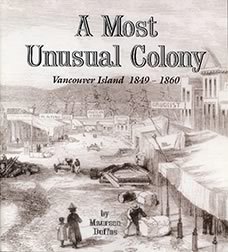
To travel back in time to the Colony of Vancouver Island, read the story of the Hudson's Bay years as told through recollections of a colonial childhood by the fictional Kate Murray and the letters of the real Mary Yates. The letters are inventions, but the real Mary lived through the events of the early years. Their stories combine to give an authentic glimpse of the extraordinary life inside the palisades of Fort Victoria, the world of children at Chaplain Staines's school, the settlers who rebelled against the HBC's autocratic rule, and the growing sophistication of colonial social life before and after BC's gold rush of 1858.
viii, 156 pages : illustrations, maps, portraits ; 24 cm
CIRC [ 1 ]
Seven shillings a year the history of Vancouver Island by Charles Lillard, Ellen J. Lehman (Donor)
This is the first book to describe the history of Vancouver Island, beginning with the cultures of the Indians and ending with the Second World War. - Back cover
viii, 248 pages : illustrations ; 22 cm
CIRC [ 1 ]
Place-names of the Island Halkomelem Indian people by David Lewis Rozen (Creator)
The Island Halkomelem Indian people live on the southeastern part of Vancouver Island and on some of the southern Gulf Islands in British Columbia. A total of three hundred two (302) place-names are known to these people today, in their Coast Salish language. Each of these names is transcribed in a practical writing system, corresponding to the pronunciation of the Indian words by some of the thirteen elderly Island Halkomelem people who collaborated on this study. For each geographical name, information regarding its traditional and present utilization by the Indians is given. This data is derived from interviews with the Indian people conducted by the author over a ten year period and also includes all the available information on each place-name from the pertinent ethnographic, linguistic and historical literature. After the information on the place-names is presented a brief analysis of the Indian names is attempted, focusing on a preliminary typology of the names derived from the use, English translations and etymologies of each name. A complete and detailed series of maps is included. The study concludes with some statements about how the Indian geographical toponymy reflects Island Halkomelem culture
ONLINE CIRC [ 1 ]
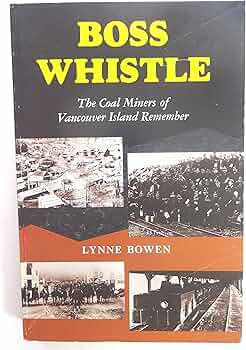
Boss whistle the coal miners of Vancouver Island remember by Lynne Bowen
Related Online Resources
Vancouver Island Local History Society
Vancouver Island Local History Society’s Mission: a) To promote, encourage, and engage the study of local and regional history within the communities of Vancouver Island and the Gulf Islands. b) To develop and support local history initiatives that take a critical and exploratory approach to Indigenous and non-Indigenous relations. c) To develop and support projects that are inclusive, diverse, and representative of communities in the past and present. d) To act as a facilitator of local efforts that build relationships between organizations and communities and situate history as a foundational or key element. Includes a wiki type resource of transcribed documents from the Point Ellice House & Museum collection.
WEB LINK
Last updated: 2025-09-23