Capital Regional District Regional District
The CRD was formed in 1966 as a federation of seven municipalities and five electoral areas to provide coordination of regional issues and local government in rural areas in the Greater Victoria region.
Mapped Location
Capital Regional District: The mapped location is an approximation and should not be used for navigation or wayfinding.
Information
General information on Capital Regional District
- Feature Type: Regional District
- Regional District Administrative Centre: City of Victoria
- Established: Tuesday, February 1, 1966
Official, historical, colloquial and alternative toponyms for Capital Regional District
A brief list of names that this geographic feature has been named
| Name | Description |
|---|---|
| Capital Regional District | Official |
Related Catalog Titles
A Bibliography for Capital Regional District, Regional District
On island time a traveler's atlas : illustrated adventures on & around the islands of Washington & British Columbia by Chandler O'Leary
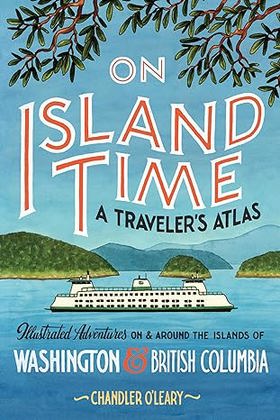
Dream of escaping to an island, for the slower pace and stunning views? An illustrated love letter to the Pacific Northwest's iconic islands--focusing on Puget Sound, the San Juans, and Canada's Gulf Islands and Vancouver Island--this guide charms and educates travelers, locals, and armchair adventurers alike. Kick back, relax, and get On Island Time! This quirky illustrated travel guide showcases the hidden delights, natural wonders, and singular history of Washington and British Columbia's islands, from the author of bestselling The Best Coast, Illustrated Adventures Along the West Coast Historic Highways
xi, 195 pages : color illustrations, color maps ; 27 cm
CIRC [ 1 ]
Making a Living on Saturna: Jon and Priscilla an oral history by William Gerald Schermbrucker

"Interviews with Jon Guy and Priscilla Ewbank who came separately to Saturna Island in the 1970's and made a rich life and living together, raising three children and making several successful businesses as part of a vibrant community. The interviews and postscript bring us to the present. The text is enriched with 10 colour and 30 BW photographs from the family collections, as well as an original colour map of the island showing places mentioned. Jon and Priscilla were and are key island figures who were involved deeply in every key aspect of the community over these decades."-- Provided by publisher
pages cm
CIRC [ 0 ]
The nature of borders salmon, boundaries, and bandits on the Salish Sea by Lissa K. Wadewitz, Center for the Study of the Pacific Northwest
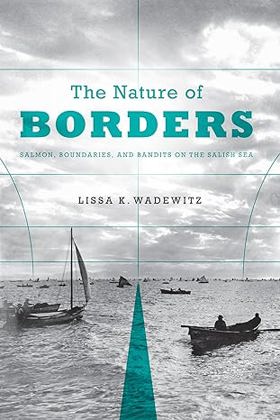
For centuries, borders have been central to salmon management customs on the Salish Sea, but how those borders were drawn has had very different effects on the Northwest salmon fishery. Native peoples who fished the Salish Sea--which includes Puget Sound in Washington State, the Strait of Georgia in British Columbia, and the Strait of Juan de Fuca--drew social and cultural borders around salmon fishing locations and found ways to administer the resource in a sustainable way. Nineteenth-century Euro-Americans, who drew the Anglo-American border along the forty-ninth parallel, took a very different approach and ignored the salmon's patterns and life cycle. As the canned salmon industry grew and more people moved into the region, class and ethnic relations changed. Soon illegal fishing, broken contracts, and fish piracy were endemic--conditions that contributed to rampant overfishing, social tensions, and international mistrust. The Nature of Borders is about the ecological effects of imposing cultural and political borders on this critical West Coast salmon fishery. This transnational history provides an understanding of the modern Pacific salmon crisis and is particularly instructive as salmon conservation practices increasingly approximate those of the pre-contact Native past. The Nature of Borders reorients borderlands studies toward the Canada-U.S. border and also provides a new view of how borders influenced fishing practices and related management efforts over time.
xi, 271 pages, 27 unnumbered pages of plates : illustrations, maps ; 23 cm.
CIRC [ 0 ]
Forgotten Cusheon Cove, Salt Spring Island by Charles Kahn, C. T. Hatfield
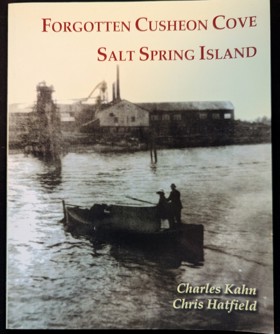
Imagine it's 1915 and you're on a small island in the Strait of Georgia with a population of just over 900. Now imagine a large sawmill with what was then state-of-the-art machinery on an isolated cove on the southeast side of the island. The mill employs up to 150 workers, many of them non-resident Norwe-gians, Swedes, Japanese, and Chinese. This is only a fragment of the story Chris Hatfield researched after he acquired the 100-acre site in 1984 and began finding items discarded by the different communities that had once lived there. Chris partly donated and partly sold most of the land to BC Parks in 2006. This little book explores the property's history.
53 p. : ill., maps, ports. ; 26 cm.
CIRC [ 1 ]
Enchanted isles the southern Gulf Islands by David A. E. Spalding, Kevin Oke
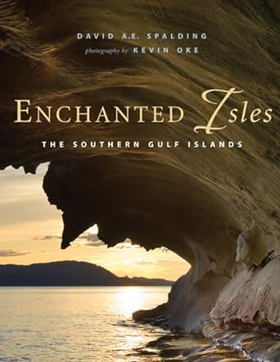
The southern Gulf Islands between Nanaimo and Victoria are among British Columbia's greatest scenic treasures, projecting an appeal so powerful as to make nesomanes (island lovers) of the most unromantic souls. Ranging in size from Saltspring (pop. 12,000) to unoccupied D'arcy, they first began to attract European settlers in 1859 and have been home to a special breed of freedom-loving denizen ever since. Author David A.E. Spalding and photographer Kevin Oke are both members of this unique tribe and in this book pay tribute to their chosen region with the sensitivity and insider knowledge only long-time residents can provide. Brimming with gorgeous colour photographs by Oke, Enchanted Isles begins with a historic overview detailing how the islands served as a favoured hideaway of some of BC's most distinguished eccentrics. Remittance men and other escapees from British stuffiness form one stream of islanders, but there have been many others. A census of Saltspring in 1895 included a Patagonian, Germans, Portuguese, Hawaiians, Americans, Shetlanders and Scandinavians. Today you may expect to find individuals from virtually anywhere in the world. Enchanted Isles showcases local wildlife, captures local character and history and offers insider tips for visitors. It is a spectacular coffee-table book that shows why the Gulf Islands rank with Whistler and the Pacific Rim as one of the most popular tourist destinations in BC.
144 p. : col. ill. ; 29 cm.
CIRC [ 1 ]
An historical guide to the landmarks, events, activities, parks, beaches, plants and wildlife, accommodations, restaurants, shops and services available on Salt Spring Island, British Columbia. This book features charming stories of the early pioneers and offers over 200 photographs, easy-to-read map, where to stay, shop, eat and explore, points of interest, how to get around, list of major island events and activities, as well as where to see plants and wildlife. This book presents Salt Spring Island in a way no other book has. Meet the postman of the 19th century and explore what Salt Spring has to offer today, while taking a trip back in time.
242 pages : illustrations ; 21 cm.
CIRC [ 1 ]
An historical guide to Pender Islands landmarks, events, activities, parks, beaches, plants & wildlife, accomodations, restaurants, shops & services by V. A. Lindholm
Published in local editions by V. A. Lindholm, An Historical Guide to Pender Islands Landmarks, Events, Activities, Parks, Beaches, Plants & Wildlife... serves as a comprehensive regional compendium for navigating the natural and human history of the Southern Gulf Islands. The guide meticulously catalogs local heritage sites, indigenous place names, early pioneer settlements, and the diverse marine and terrestrial ecosystems that define the Pender Islands. By weaving practical travel logistics together with deep historical context, the book bridges the gap between a standard visitor directory and an environmental chronicle. A keen insight drawn from the text is how community-compiled island guidebooks often act as quiet acts of ecological and cultural preservation; by meticulously detailing the specific natural habitats and historical idiosyncrasies of a small archipelago, the text implicitly teaches visitors how to respectfully inhabit a fragile insular ecosystem without loving it to death.
111, [26] pages : illustrations ; 21 cm
CIRC [ 1 ]
The Sooke story the history and the heartbeat by Elida Peers , Sooke Region Museum
This history tells of the native people and of the first settlers - and with some anecdotal quotes, condenses the years of development of community, industry and culture into these pages. Anyone who has lived for any length of time in the Sooke area or whose family were participants in the early years of its growth will find this book of great interest." - Introduction
433 pages : illustrations ; 23 cm
CIRC [ 1 ]
The story of Sidney by Peter Grant
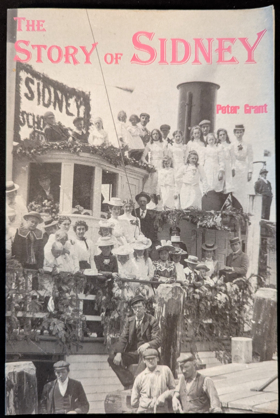
Authored by Peter Grant, The Story of Sidney chronicles the evolution of the coastal town on Vancouver Island, British Columbia, from its early Indigenous presence and 19th-century agricultural settlement into a vibrant modern community. The book details the establishment of local farms, the arrival of the railway, and the maritime connections that bridged the Saanich Peninsula to the broader Salish Sea region. Drawing on local archives, historical photographs, and personal accounts, the text highlights the community's persistent drive to balance commercial growth with small-town coastal character. A keen insight drawn from the work is how transportation revolutions dictate the very heartbeat of coastal towns; just as the transition from neighborhood steamships to the Swartz Bay ferry terminal radically reshaped Sidney's economic destiny, it proved that the survival of an island-adjacent community depends entirely on how successfully it manages its role as a regional gateway.
96 pages : illustrations ; 23 cm
CIRC [ 1 ]
Salt Spring the story of an island by Charles Kahn
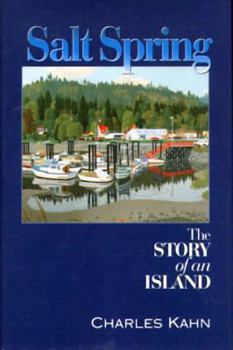
The largest of BC's southern Gulf Islands, beautiful Salt Spring Island has long been a favoured holiday destination and a prized real-estate area for those in search of an idyllic rural residence. Now available in trade paper, Salt Spring: The Story of an Island chronicles the island's rich history from the days when Coast Salish people inhabited Salt Spring's shores, through some 150 years of settlement by many diverse groups. Because of the island's rugged geography, the early story of Salt Spring is largely the story of hard-working people in small isolated communities industriously carving farms out of rough terrain. Many of the settlers who followed came to find a place where they could live their lives free of the constraints of most societies. This was as true for the African-Americans, many of whom were among the first non-aboriginal settlers to arrive in 1859, as it was for those fleeing conventional middleclass life and for Americans seeking to avoid the Vietnam War. And it's true of almost every new islander who arrives today with a unique personal dream.
344 pages : illustrations, maps, portraits ; 24 cm
CIRC [ 1 ]
A most unusual colony Vancouver Island 1849-1860 by Maureen Duffus
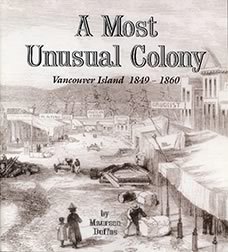
To travel back in time to the Colony of Vancouver Island, read the story of the Hudson's Bay years as told through recollections of a colonial childhood by the fictional Kate Murray and the letters of the real Mary Yates. The letters are inventions, but the real Mary lived through the events of the early years. Their stories combine to give an authentic glimpse of the extraordinary life inside the palisades of Fort Victoria, the world of children at Chaplain Staines's school, the settlers who rebelled against the HBC's autocratic rule, and the growing sophistication of colonial social life before and after BC's gold rush of 1858.
viii, 156 pages : illustrations, maps, portraits ; 24 cm
CIRC [ 1 ]
The Victoria and Sidney railway, 1892-1919 by Darryl E. Muralt, British Columbia Railway Historical Association, British Columbia Heritage Trust

Wonderfully written history of the ever-troubled Victoria and Sidney Railway in British Columbia. Packed with black and white photos, the book brings the railway and the people who ran it (and the long-suffering passegers) to life while providing a fascinating look at life in rural Canada at the turn of the century. With maps, equipment rosters, chronology and numerous appendices that flesh out the history of the Saanich Peninsula. 236 pages.
236 pages : illustrations, maps, portraits ; 28 cm
CIRC [ 1 ]
French presence in Victoria, B.C., 1843-1991 by John Greene, Association historique francophone de Victoria
Published by the Association historique francophone de Victoria and authored by John Greene, French Presence in Victoria, B.C., 1843–1991 chronicles nearly a century and a half of Francophone contributions to the cultural, economic, and religious fabric of Vancouver Island. The book traces the arrival of French-Canadian fur traders, Catholic missionaries, and European immigrants who helped establish and shape the early colonial capital long before Confederation. Through archival records, church registers, and personal accounts, the text illuminates how a distinct Francophone community maintained its linguistic and cultural identity despite the overwhelming dominance of British institutions. A keen insight drawn from the work is how multiculturalism in early Western Canadian cities existed beneath a veneer of British imperial hegemony; by uncovering the vital, behind-the-scenes roles played by French speakers in commerce and governance, the study reveals that the foundational history of British Columbia was far more pluralistic than its overtly Anglo-Saxon administrative facade suggested.
v, 200 pages, [17] pages of plates (1 folded) : illustrations, maps ; 22 cm
CIRC [ 1 ]
The Fernwood files by John J. Ellis, Charles Lillard

Mayne Island & the outer Gulf Islands a history by Marie Elliott
Mayne Island & the Outer Gulf Islands: A History by Marie Elliott chronicles roughly 120 years of social, economic, and political development across Mayne and its neighboring southern Gulf Islands. Drawing on archival records, oral histories, and pioneer accounts, Elliott highlights how maritime transportation fundamentally shaped local livelihoods—from early homesteading, logging, and hothouse tomato farming to postwar tourism. The book also examines the cultural fabric of these relatively remote communities, notably detailing the significant contributions of Japanese-Canadian settlers before their wartime internment. Finally, it traces the modern struggles over ferry service, rapid land development, and conservation that ultimately spurred the creation of the Islands Trust to protect the region.
x, 152 pages : illustrations ; 23 cm
CIRC [ 1 ]
This old town city of Victoria central area heritage conservation report by Victoria (B.C.)., Les D. Mazer, Martin Segger, Brian Murray Sikstrom
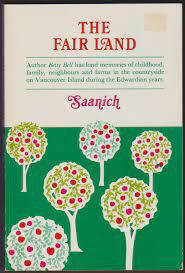
The fair land, Saanich by Betty Bell
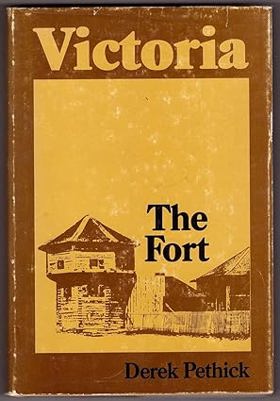
Summer of promise Victoria 1864-1914 by Derek Pethick
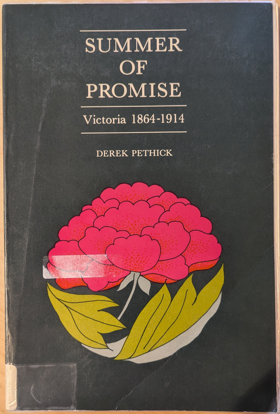
In 1864 Governor James Douglas handed over his office to Arthur Edward Kennedy, closing an era in Vancouver Island's history and ushering in a period of growth and development. The optimism felt by its people was to a large extent justified; the ensuing years were to bring stability, prosperity and many changes. In Summer of Promise, a sequel to Victoria: The Fort, the author chronicles the years from 1864 to the outbreak of World War One in 1914, seeing them through the eyes of the inhabitants of the city which was the capital of the colony and later of the province. Despite its geographical isolation, its population remained well aware of world events: the Boer War, the death of Queen Victoria, the ascension of Edward VII to the throne and the rising threat of the German navy were as much talked about as the waning of many traditional religious beliefs and the enfranchisement of women. Nearer home, these were important years for Victoria as the colony voted to join the Dominion of Canada, the railroad connected the new province with the rest of the country, and the "All Red Route" linked it by steamship to Australia and the Orient. Motorcars, aeroplanes, telephones, the telegraph and electricity brought British Columbia into the twentieth century. From the momentous to the mundane, and sometimes even to the ridiculous, Derek Pethick documents an era in Victoria's history. Summer of Promise is enlightening, fascinating and enjoyable reading.
191 pages, 8 unnumbered leaves of plates : illustrations ; 23 cm
CIRC [ 1 ]
Fort Victoria letters 1846-1851 by Hartwell Bowsfield, Hudson's Bay Company
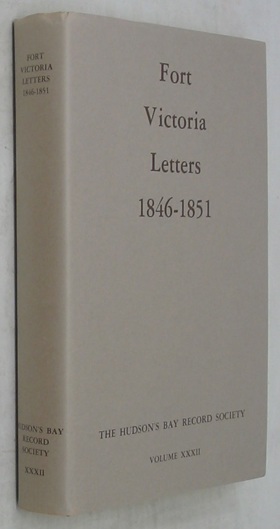
Letters of James Douglas, Chief Factor of the Hudson's Bay Company Pacific headquarters at Fort Victoria, Vancouver Island, British Columbia
xcix, 277, xvii pages, 3 unnumbered leaves of plates (2 folded) : maps ; 24 cm.
CIRC [ 0 ]
Sitting on a salt spring by David Conover
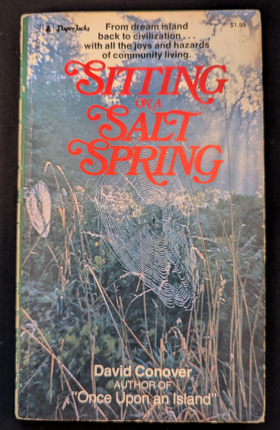
From dream island back to civilization ... with all of the joys and hazards of community living.
160 pages ; 18 cm
CIRC [ 1 ]
A Victorian tapestry impressions of life in Victoria, B.C., 1880-1914 by Janet Cauthers, Provincial Archives of British Columbia Aural History
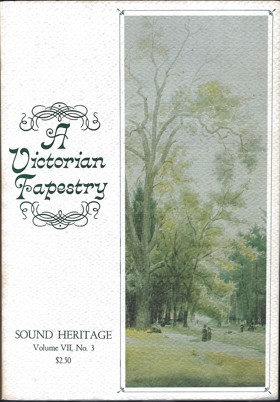
A history of Victoria, 1842-1970 by Harry Gregson
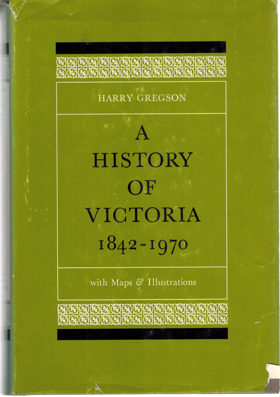
"Victoria as a trading post, gold rush town, despondent backwater, thriving industrial center, pleasant residential resort and busy university city... these are some of the developments entertainingly described..." Dust jacket
ix, 246 pages illustrations, maps 24 cm
CIRC [ 1 ]
Salt Spring Island by Bea Hamilton
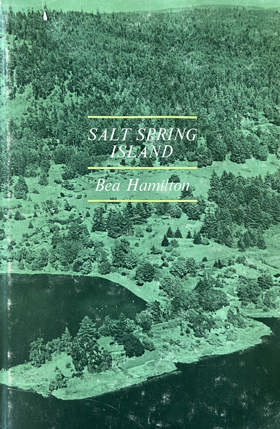
Victoria the fort by Derek Pethick
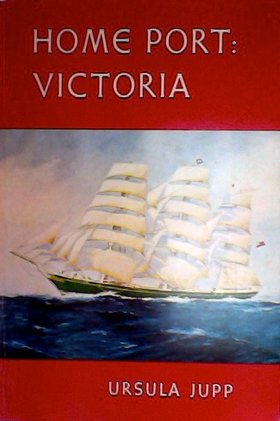
Home port Victoria a collection of true stories of men and ships that sailed from this port, told by seamen at meetings of the Thermopylae Club, Victoria, B.C., including short sketches of their narrators, articles on relevant history of the Port of Victoria, and two maps by Ursula Jupp, Thermopylae Club
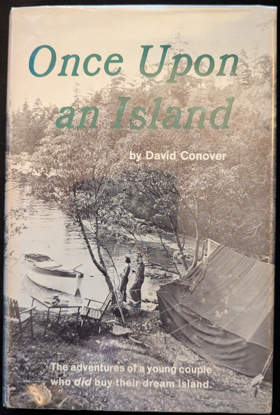
Once upon an island by David Conover
A Gulf Islands patchwork some early events on the islands of Galiano, Mayne, Saturma, North and South Pender by British Columbia Historical Association Gulf Islands Branch
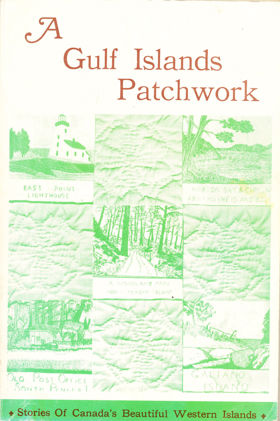
Stories and history of some of British Columbia's Gulf Islands. Contributions by many writers including Wilson Duff on, 'Indians of the Gulf islands'.
192 pages : illustrations ; 23 cm
CIRC [ 1 ]
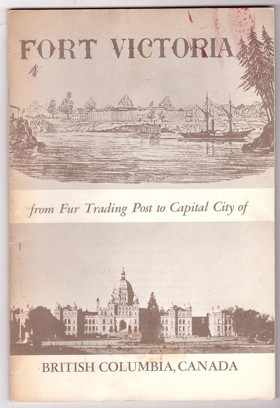
Fort Victoria from fur trading post to capital city of British Columbia, Canada by Herbert P. Plasterer
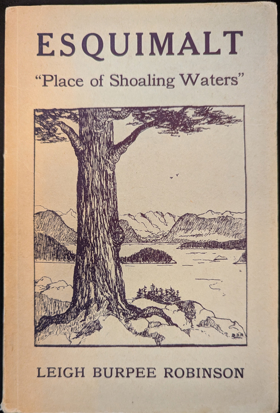
Esquimalt "place of shoaling water" by Leigh Burpee Robinson
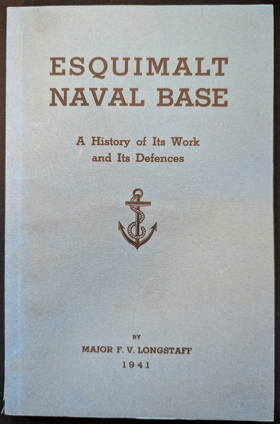
Esquimalt naval base a history of its work and its defences by F. V. Longstaff
All about Victoria, British Columbia by Alfred Emberson
Originally published in the late nineteenth and early twentieth centuries, Alfred Emberson’s All About Victoria, British Columbia serves as a comprehensive travel guide and promotional handbook for the rapidly modernizing provincial capital. The book meticulously catalogs the city’s geography, local customs, transportation networks, and burgeoning hospitality industry, effectively marketing Victoria to tourists and potential investors as a sophisticated enclave of British gentility on the edge of the Pacific wilderness. A keen insight drawn from the work is how the early travel guide actively commodified a highly sanitized version of colonial settlement; by charting hotels and scenic attractions while completely omitting the ongoing displacement of the region's Coast Salish peoples, the guidebook sold Victoria not as a contested frontier, but as an exclusive, fully conquered playground designed solely for Anglo-American leisure.
104 pages illustrations 16 cm
ONLINE CIRC [ 1 ]
Some reminiscences of old Victoria by Edgar Fawcett
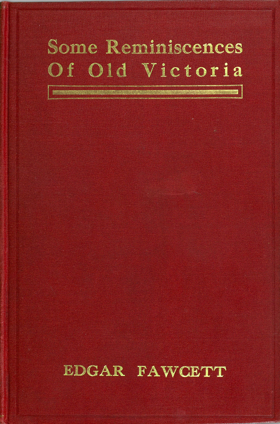
Authored by early pioneer Edgar Fawcett, Some Reminiscences of Old Victoria offers a deeply personal, nostalgic chronicle of British Columbia's capital city during its chaotic transition from a quiet Hudson's Bay Company outpost to a booming gold rush epicenter. Drawing upon his own arrival in 1859 and decades of civic observation, Fawcett meticulously reconstructs the social fabric of the 19th-century port, detailing early dirt streetscapes, the sudden influx of transient miners, local eccentricities, and the establishment of colonial institutions. Through conversational anecdotes and vivid recollections, the text serves as a vibrant, street-level time capsule of a frontier society rapidly attempting to replicate British gentility on the edge of the Pacific wilderness. A keen insight drawn from the work is how pioneer nostalgia inherently sanitizes the disruption of colonial expansion; by fondly mythologizing the eccentricities and genteel aspirations of Victoria's early British settlers, Fawcett’s memoir illustrates how the pioneer elite actively constructed an insulated, aristocratic social hierarchy to maintain cultural dominance amidst the overwhelming demographic shifts of the gold rush era.
4 unnumbered pages, [5]-294 pages : plates, portraits ; 20 cm
ONLINE CIRC [ 1 ]
Salt Spring Island, British Columbia by Edward F. Wilson
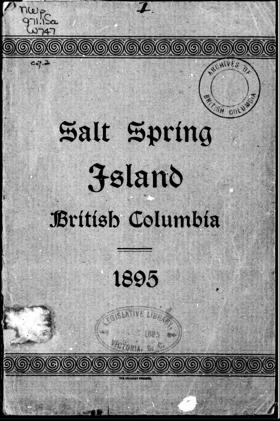
Originally marked on the naval charts of 1858 as "Admiral Island," it has of late years altogether dropped that name, and is now known both popularly, and also in the more recently published maps, as Salt Spring Island^ — the saline springs, of which there are some 14 or 15 on the island, being sufficient reason for its present name
30 pages : illustrations, map
ONLINE CIRC [ 1 ]
Capital Regional District
- Albert Head
- Ardmore
- Bear Mountain
- Beaver Lake
- Beaver Point
- Bedwell Harbour
- Belmont Park
- Braemar Heights
- Brentwood Bay
- Cadboro Bay
- District of Central Saanich
- Colquitz
- City of Colwood
- Cordova Bay
- Deep Cove
- East Sooke
- Township of Esquimalt
- Fairfield
- Fernwood
- Fulford Harbour
- Galiano
- Ganges
- Glen Lake
- Goldstream
- Gordon Head
- Happy Valley
- District of Highlands
- Hope Bay
- James Bay
- Keating
- Lake Hill
- City of Langford
- Leechtown
- Lighthouse Point
- Long Harbour
- Luxton
- Marigold
- Mayne Island
- District of Metchosin
- Millstream
- Milnes Landing
- Montague Harbour
- Musgrave Landing
- North Galiano
- District of North Saanich
- District of Oak Bay
- Otter Bay
- Pender Island
- Port Renfrew
- Port Washington
- Prospect Lake
- River Jordan
- Royal Oak
- District of Saanich
- Saanichton
- Saseenos
- Saturna
- Sevenoaks
- Shirley
- Town of Sidney
- District of Sooke
- Strawberry Vale
- Sturdies Bay
- Swartz Bay
- Tillicum
- Vesuvius
- City of Victoria
- Town of View Royal
- Village Bay
Political Boundaries
Last updated: 2025-09-23